

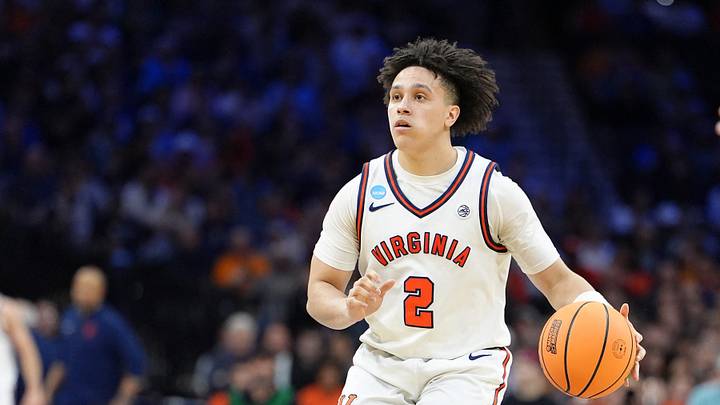
Preseason rankings are useful. They aren't predictions carved into stone.
Every October, several teams enter the season with something that feels undervalued. Maybe it's continuity. Maybe it's an elite point guard. Sometimes a transfer class fits together better than expected, or an emerging sophomore turns a good roster into a great one.
After working through rosters across the country, these are 10 teams we're increasingly willing to buy entering 2026-27.
1. Virginia
Virginia might have the single most valuable commodity in modern college basketball.
Continuity.
Ryan Odom returns Thijs De Ridder, Johann Grünloh, Sam Lewis and Chance Mallory from a 30-win team. De Ridder averaged 15.6 points and 6.2 rebounds, Grünloh blocked 80 shots and Mallory finished with a 3.0 assist-to-turnover ratio.
While other contenders spend November figuring out roles, Virginia already knows what works. The Cavaliers may not have the most NBA prospects in the country, but they have one of the clearest paths toward being excellent immediately.
2. Louisville
Calling Louisville a sleeper would be ridiculous.
We're buying the Cardinals anyway.
Pat Kelsey assembled one of the deepest transfer classes in America, adding Flory Bidunga, Jackson Shelstad, Seth Trimble, Karter Knox, Álvaro Folgueiras, Adrian Wooley and others.
Bidunga provides elite rim protection. Shelstad gives Louisville a proven lead guard. Trimble has extensive ACC experience.
The concern is chemistry because almost everyone is new.
The upside is a Final Four.
3. Miami
Miami may be closer to becoming a major national factor than casual fans realize.
Acaden Lewis gives the Hurricanes a proven young point guard after averaging 12.2 points, 5.3 assists and 1.9 steals at Villanova. Shelton Henderson is positioned for a major sophomore jump after averaging 13.8 points as a freshman.
Somto Cyril adds physicality inside, while Caleb Gaskins brings more young talent.
Miami has guards, size and athleticism.
That's a pretty good place to start.
4. Tennessee
Tennessee's roster reconstruction makes the Volunteers fascinating.
Barnes has assembled a backcourt featuring Juke Harris, Terrence Hill Jr. and Dai Dai Ames. Harris' size at 6-foot-7 creates immediate matchup possibilities, while Ames brings substantial experience.
Tennessee's defensive floor under Barnes is usually high. If this group develops enough offensive chemistry, the Volunteers could become one of the SEC's best teams despite losing important pieces from last season.
5. BYU
Start with Wright.
Any team returning a guard who averaged 18.1 points and 4.6 assists while shooting 41% from 3-point range deserves attention.
Then look around him.
BYU's current roster includes five-star freshman Bruce Branch III, Kentucky transfer Collin Chandler, Syracuse transfer Tyler Betsey and Jaxon Kohler, whose eligibility situation remains something to monitor.
There is uncertainty.
There is also an enormous amount of talent.
6. Villanova
Kevin Willard's second Villanova roster has the pieces to become substantially better than its preseason national profile.
Tyler Perkins returns after averaging 13.7 points, while Oregon transfer Kwame Evans Jr. and Ohio State transfer Devin Royal completely reshape the frontcourt.
Villanova now has scoring, size and high-major experience at multiple positions.
The Wildcats won 24 games last season. Another jump shouldn't surprise anyone.
7. Marquette
Nigel James Jr. gives us a reason to buy Marquette almost by himself.
James averaged 16.4 points, 4.9 assists and 2.0 steals as a freshman. Players who produce like that during their first college season tend to become extremely interesting as sophomores.
Marquette also returns Royce Parham and added Louisville transfer Sananda Fru to strengthen the frontcourt.
Shaka Smart has a star point guard.
That makes the Golden Eagles dangerous before we consider anything else.
8. Texas Tech
Texas Tech would rank higher if JT Toppin were fully healthy.
The Red Raiders still belong here because Grant McCasland has assembled enough experience to remain dangerous while Toppin works back from the torn ACL he suffered in February.
Darrion Williams is back in Lubbock, while Donovan Atwell, Cruz Davis, Dra Gibbs-Lawhorn and Jamichael Stillwell provide additional proven options.
If Toppin returns anywhere near his previous form during the season, Texas Tech's ceiling changes completely.
9. Arkansas
Arkansas lost Darius Acuff Jr. and Meleek Thomas along with several other important players.
John Calipari responded by assembling another fascinating collection of young guards.
Jordan Smith Jr. headlines the freshman group, while Jason Andrews, Davion Thompson and others give Arkansas substantial young talent. Jeremiah Wilkinson also joins after transferring from Georgia.
This roster will make freshman mistakes.
Its ceiling is considerably more interesting than its experience level suggests.
10. Nebraska
Nebraska isn't the first program casual fans will mention when discussing national contenders.
That's part of the appeal.
Fred Hoiberg continues building around size, shooting and offensive versatility, and Pryce Sandfort gives the Cornhuskers an established perimeter weapon around whom to structure the offense.
Nebraska doesn't need to become a national championship favorite to outperform expectations. If the Cornhuskers remain efficient offensively and become more consistent defensively, they can spend significant time in the national rankings.
Buying doesn't mean ignoring the questions
Every team here has them.
Louisville has to establish chemistry. Miami needs its young stars to continue developing. Tennessee rebuilt its backcourt. BYU has eligibility uncertainty in its frontcourt. Texas Tech is waiting on Toppin's recovery.
But preseason evaluation isn't about finding teams without questions.
Those teams barely exist.
It's about identifying rosters whose upside may be greater than the market around them suggests.
Virginia's continuity, Louisville's talent and Miami's young backcourt make those three particularly appealing.
By January, at least a few teams on this list could look like obvious national contenders.
 Add us as a preferred source on Google