

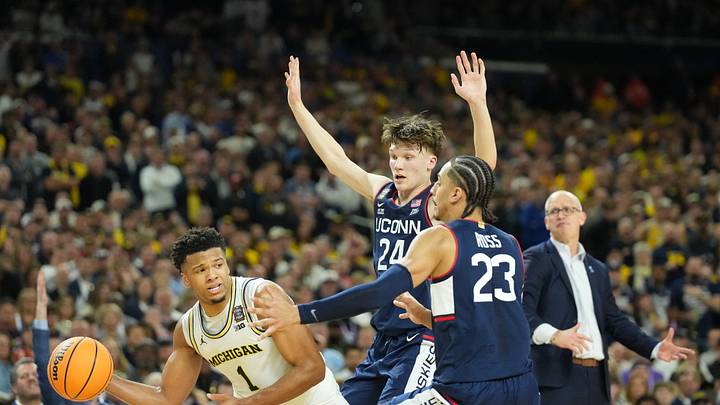
The freshman season gets most of the attention in college basketball. Recruiting rankings follow players onto campus, NBA Draft projections begin almost immediately and every big performance becomes evidence that the next star has arrived.
The sophomore season can be even more revealing.
Players have experienced the speed and physicality of the college game. They've played in hostile road environments, gone through conference scouting reports and learned what opponents will do to take away their strengths. The best sophomores don't merely improve statistically. They return knowing exactly where they need to improve.
The 2026-27 season has an excellent group positioned to make that leap. Some already played starring roles as freshmen. Others showed enough in smaller roles to make a much larger second season feel inevitable.
Here are 15 sophomores capable of making significant jumps.
1. David Mirkovic, Illinois
Mirkovic isn't starting from a particularly low point. He averaged 13.5 points, a team-high 8.1 rebounds and 2.6 assists as a freshman, earning All-Big Ten honorable mention and a spot on the conference's All-Freshman team. He also made the NCAA Tournament All-South Region team while helping Illinois reach the Final Four.
The next step could put him among the best players in the country. Mirkovic already showed unusual versatility for a player his size, including nine double-doubles and a remarkable 27-point, 21-rebound performance against Colgate. He broke Kofi Cockburn's Illinois freshman record for total rebounds during the NCAA Tournament, another indication that his first season wasn't simply promising. It was historically productive by Illinois freshman standards.
His health is the preseason variable after undergoing foot surgery in August. Illinois has not announced an official return timetable, but Mirkovic appeared in the team's first fall-practice photos Monday without visible support on his foot. That's encouraging, although it isn't the same thing as an official medical clearance. If Mirkovic is healthy when the season gets rolling, his sophomore year could move him from excellent Big Ten player to legitimate All-American.
2. Braylon Mullins, UConn
Mullins already owns the kind of March moment that can define an entire college career. His long 3-pointer with 0.3 seconds remaining against Duke sent UConn back to the Final Four, turning a productive freshman season into something much more memorable.
Now UConn needs more from him over an entire season. Mullins averaged 12.0 points and 3.5 rebounds while earning Big East All-Freshman honors, and he scored in double figures in five of the Huskies' six NCAA Tournament games. Those performances provided a glimpse of what a larger offensive role could produce.
Dan Hurley's roster still has plenty of weapons, which should prevent opponents from constructing entire game plans around Mullins. If his late-season confidence carries into November, he has the shooting and offensive talent to become one of the most dangerous sophomore guards in America.
3. Trey McKenney, Michigan
Michigan's offseason changed dramatically when five-star freshman Brandon McCoy Jr. suffered a season-ending ACL injury. That puts additional responsibility on several Wolverines, and McKenney is one of the most obvious candidates to absorb it.
He already showed why Michigan was so excited about him during his freshman season. McKenney possesses the physical strength to attack smaller guards and enough skill to create offense from multiple areas of the floor. The question now isn't whether he belongs at this level. It's how much responsibility Michigan is prepared to give him.
The defending national champions still have experienced talent, including Elliot Cadeau, and Roddy Gayle's recent fifth-year eligibility ruling gives the Wolverines another veteran option. That should keep McKenney from having to do everything while still allowing his offensive role to expand substantially.
4. Andrej Stojakovic, Illinois
Stojakovic's freshman season demonstrated that he can score efficiently without hijacking an offense. He averaged 13.5 points and 4.5 rebounds while shooting 50% from the field, giving Illinois another versatile scoring option during its Final Four run.
His sophomore opportunity comes from increased responsibility. Keaton Wagler is gone to the NBA, which leaves possessions and late-clock opportunities available in Brad Underwood's offense. Stojakovic has the size and scoring touch to take a significant share of them.
Illinois also has enough surrounding talent that defenses won't be able to focus exclusively on him. If Mirkovic is healthy and the Ivisic brothers provide the expected interior presence, Stojakovic should receive favorable matchups throughout the season. That environment could turn a very good freshman scorer into one of the Big Ten's most difficult covers.
5. Jake West, Northwestern
West is a different kind of sophomore breakout candidate because he isn't starting from star-level freshman production. He averaged 5.3 points and 2.8 assists, numbers that won't automatically put him on casual fans' preseason watch lists.
That's exactly why he's interesting.
Northwestern has an opportunity for West to become much more involved offensively, and his freshman experience should make that transition easier. Guards often make substantial jumps once they understand how opposing teams defend ball screens and where their opportunities will appear within a half-court offense.
West doesn't need to become a 20-point scorer for this prediction to work. If he develops into a reliable double-figure scorer and primary creator, Northwestern's ceiling changes significantly.
6. Caleb Holt, Arizona
Holt is already talented enough that calling him a potential breakout almost feels conservative. Arizona recruited him to become an important player, and he'll have an opportunity to do exactly that on a roster coming off a Final Four appearance.
What makes his situation especially appealing is that Arizona doesn't need him to manufacture everything. Motiejus Krivas provides an experienced anchor inside, and Tommy Lloyd's offensive system creates opportunities through pace and movement rather than endless isolation basketball.
Holt's athleticism gives him a chance to impact games before every part of his offensive repertoire is polished. If his shooting and decision-making improve alongside his natural physical tools, his second season could move him into the national awards conversation.
7. Isaiah Johnson, Texas
Johnson showed immediately at Colorado that college basketball wasn't going to overwhelm him. He scored 24 points in his debut and eventually produced nine 20-point games during his freshman season.
Now comes a different challenge at Texas.
Sean Miller has assembled a roster with significant talent and expects the Longhorns to compete near the top of the national rankings. Johnson won't merely be asked to score for a developing team. He'll be asked to make winning decisions for a contender.
That's why his sophomore season is so intriguing. The scoring ability is already established. If Johnson becomes a more complete creator and defender while maintaining his aggressiveness, Texas may have one of the country's biggest second-year stars.
8. Dame Sarr, Duke
Sarr's sophomore leap may not be measured strictly by points per game because Duke has too much talent for everyone to produce enormous scoring numbers.
His value comes from versatility. Sarr can defend multiple positions, play alongside different guard combinations and give Jon Scheyer lineup flexibility against opponents with unusual size or athleticism.
The offensive development is what could turn him into a star. If Sarr becomes a more consistent shooter and creator while maintaining his defensive impact, Duke suddenly has another player capable of deciding games. On a roster already featuring John Blackwell, Caleb Foster and another excellent freshman class, that's a frightening possibility.
9. Patrick Ngongba II, Duke
Ngongba has an opportunity to become one of those players whose importance exceeds his national publicity. Duke's perimeter talent will dominate preseason discussion, but somebody still has to rebound, defend the paint, screen and finish around the basket.
Ngongba has already shown he can handle those responsibilities. His sophomore jump should be about consistency and expanded offensive confidence rather than reinventing his game.
If he becomes a reliable double-figure scorer while anchoring Duke's interior defense, the Blue Devils become considerably more complete. Championship teams rarely survive on perimeter talent alone, and Ngongba could become the frontcourt stabilizer Scheyer needs.
10. Cam Ward, Michigan State
Michigan State returns Jeremy Fears Jr., which means the Spartans already know who will organize their offense. That creates an appealing situation for Ward, who can focus on expanding his own game rather than being asked to solve everything.
Ward's athleticism gives Tom Izzo another versatile forward capable of running the floor and creating matchup problems. His sophomore development could become especially important because Michigan State's returning core is a major part of its preseason appeal.
The Spartans don't need Ward to suddenly become their leading scorer. They need him to become more consistent, more physical and more productive. If he does, Michigan State's depth becomes one of its biggest advantages in the Big Ten.
11. Ivan Kharchenkov, Arizona
Arizona's Final Four run gave several young players an accelerated basketball education, and Kharchenkov enters his second season with that experience already behind him.
His opportunity comes from the Wildcats' need to replace production while maintaining the balance that made last year's team so successful. Lloyd's system rewards players who can make quick decisions, move without the ball and attack before defenses are organized.
Kharchenkov has already experienced high-pressure basketball. If his offensive confidence catches up to his experience, Arizona could have another sophomore who makes the Wildcats considerably better than they were in November.
12. Killyan Toure, Iowa State
Toure would rank higher if his preseason situation were cleaner. His shoulder injury is expected to cost him time, which makes the first priority simply getting healthy rather than producing an immediate statistical leap.
Once he returns, however, Iowa State could have a very interesting sophomore guard. Tamin Lipsey's newly cleared return for a fifth season means Toure won't have to shoulder primary point-guard responsibilities as soon as he's available. He can settle into a complementary role around one of the most experienced guards in college basketball.
That could benefit him in the long run. A healthy Toure gives T.J. Otzelberger another athletic perimeter option for a team expecting to remain nationally relevant.
13. Cayden Boozer, Duke
Duke's roster makes predicting individual breakouts difficult because there simply aren't enough shots for every talented player to produce huge numbers.
Boozer nevertheless deserves a place on the list because continuity has value. He already understands Scheyer's expectations and doesn't need the adjustment period facing Duke's incoming freshmen and transfers.
The next step is turning that familiarity into a larger impact. If Boozer improves his shooting and becomes a more dependable two-way option, Scheyer will have even more freedom to mix lineups. His sophomore jump may show up as much in winning possessions as it does in the box score.
14. Jamarion Bateman, Iowa State
Lipsey's return changes the context around every Iowa State guard. Instead of asking younger players to replace a program fixture immediately, Otzelberger can develop them alongside him.
Bateman is one of the players who could benefit most. Iowa State's system demands defensive discipline, toughness and intelligent decision-making, and freshmen often need time to master all three.
A full offseason should help. If Bateman earns a larger role while improving his efficiency, the Cyclones could enter March with substantially more perimeter depth than they appeared to have earlier in the offseason.
15. Najai Hines, UConn
Najai Hines might be one of the best examples in college basketball of a player whose freshman statistics become much more impressive once you consider how little he actually played. Hines averaged 6.5 points, 5.5 rebounds and 2.2 blocks in just 18 minutes per game at Seton Hall while shooting 60.2% from the field.
He didn't start a game, yet still led the Big East in blocks and recorded four double-doubles. His combination of physicality, rebounding and rim protection made him one of the country's more productive freshman big men on a per-minute basis.
Now Hines moves across the Big East to UConn, where Dan Hurley's track record with talented frontcourt players makes the fit especially intriguing. The Huskies have an opening for Hines to become a much larger part of the rotation, and Hurley has already praised his potential to make a significant impact offensively, defensively and on the glass.
If Hines can maintain anything close to his freshman efficiency while playing significantly more minutes, his sophomore numbers could explode. Going from a productive Seton Hall reserve to an important piece for a national championship contender would qualify as exactly the kind of massive second-year jump we're looking for.
Sophomore jumps can change championship races
Mirkovic, and Mullins don't need introductions to serious college basketball fans. Their sophomore seasons are about becoming something larger: national stars capable of driving Final Four runs.
Others on this list are attempting a different leap. West could go from complementary guard to primary creator. Ward could become a major piece of a Michigan State contender. Johnson has moved from Colorado to the pressure and expectations of Texas.
That's why sophomore seasons are so fascinating. Freshman years tell us who can survive college basketball.
Year two often tells us who can dominate it.
 Add us as a preferred source on Google