

2019 has now begun and NCAA basketball teams around the nation are making New Year’s resolutions. What does each Big 5 team need to fix?
Philadelphia had a mixed bag of NCAA basketball success up to the New Year this season. Like the rest of us, the six programs of the City of Brotherly Love will turn inward towards self-reflection as the New Year comes with another chance to improve the weaknesses they all have. What should the teams of the Big 5 seek to improve as the calendar turns?
La Salle: Foul less
There are probably a number of things a team that didn’t win its first game until a few days before Christmas should resolve to do better in the New Year; they could find much better shots, move the ball better, and play more competitive defense. Frankly, Ash Howard could have done a better job adjusting his squad to his style of offense and he and his staff could manage better during games.
But the rebuilding Explorers need to take things one step at a time, and the first thing they should do is give up fewer opportunities at the free throw line. There are few teams in the country that foul more than La Salle; they rank bottom ten in free throw rate against, and they give up more than a quarter of their opponents’ points from the charity stripe.
Penn: Take better care of the ball
Penn does few things exceptionally poorly; they play a classic five-man Ivy style offense (Steve Donahue takes exception to the term “Princeton offense”) and move the ball superbly, shooting a high percentage from the field and finding easy looks often. The Quakers are average in most other statistical categories, but they could improve their offensive rebounding and turnovers.
While AJ Brodeur is a tremendous all-around weapon for Penn, they just don’t have the tools to be gobbling up many more boards than they already are (they do do a fine job on the defensive glass). What they can improve on with Ivy League play on the horizon is their turnovers; they turn the ball over on almost 20% of their possessions, and taking better care of the ball could be the difference in another tight Ivy final.
Saint Joseph’s: Defend the three
Saint Joe’s lives and dies by the three. They have four players that shoot over 40% from beyond the arc, including Charlie Brown (20.5 points per game), who is shooting north of 48% on the season. But as much as they rely on the three, their opponents exploit their weakness defending it. Only two teams in the country give up a higher proportion of their points against on threes, and they’re currently sitting at 289th in defensive 3-point percentage. If Saint Joe’s is going to get their season back on track and compete for an A10 title, they’re going to need to find a way to better disrupt opponents’ outside game.
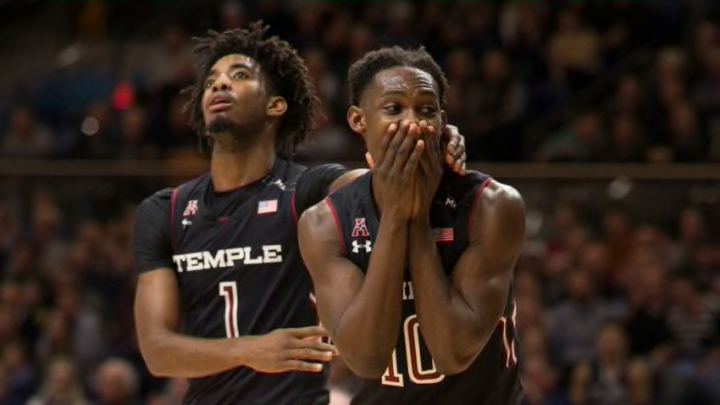
Temple: Spread the offense
In order to improve Temple will need to spread the offense, both by getting more players involved on the offensive side and by diversifying their offense beyond the two-point game. The Owls, despite having two strong scorers Shizz Alston and Quinton Rose, struggle getting to and finishing from the free throw line and don’t have a reliable 3-point threat besides Alston (Rose is shooting an abysmal 17% from three). Temple expected a larger step forward from some of their sophomores, and while Nate Pierre-Louis has become the Owls’ third-leading scorer, production from the four members of the class of 2021 is overall disappointing. If Temple expects a strong AAC season and to have a shot at the tournament come March, they’ll need to find more ways to put the ball through the hoop.
Villanova: Play a little faster
Despite losing their first Big 5 games in six years at the Palestra a few weeks ago, Nova is finally hitting its groove after losing four players from their national title squad to the NBA. With this said, though, Jay Wright could stand to speed up his offense. Nova runs the second-slowest offense in the country, and they use that time to shoot a ton of threes at a mediocre percentage. With the talent they did add and return, they could probably run a more efficient offense by allowing their guys to push the tempo a little bit to find a few more easier shots in transition. I’m not suggesting Jay go back to the drawing board, but I’m not sure running the second-slowest offense is going to win them another national championship.
Drexel: Play even a little bit of defense
Drexel does a lot of things really well; they rank in the top-40 in points scored, total assists, free throw percentage, 3-point percentage. So why are the Dragons 6-9 and ranked 265th in KenPom right now? They’re as bad defensively as they are strong offensively; they’re bottom-300 in defensive field goal percentage, 3-point percentage, field goal attempts, points against per game. They are REALLY bad on the defensive side of the ball, and the only defensive category that reflects favorably on Drexel is free throw percentage; maybe Ali Demir has some creative distraction techniques in his back pocket.
 Add us as a preferred source on Google