

How fast an NCAA Basketball team plays may not be THE most important statistic, but it can say a lot about a team, particularly on the defensive end.
In the college basketball world, the term “tempo” usually refers to how fast a team plays on the offensive end of the floor. Some teams, like North Carolina, (3rd in offensive tempo per KenPom) play really fast and put up shots quickly. Other teams, like Virginia, (351st in offensive tempo) take time to run their offenses and find the optimal shot.
(All statistics used in this article were found via KenPom and are up to date through the games completed on Feb 18.).
But tempo isn’t just relevant on the offensive end of the floor, as defensive tempo is significant as well. A team with a “fast” defensive tempo tends to have shorter possessions defensively, and “slow” defensive tempo teams tend to have longer defensive possessions (*). Teams can be successful with both types of tempo. For example, Lipscomb has the the 40th “fastest” defensive tempo in the nation and also has the 27th ranked defense. Some of this is likely due to Lipscomb being 74th in defensive turnover percentage. It puts a lot of pressure on opposing offenses, causing them to play fast and at times turn the ball over.
(*Note: an offensive rebound constitutes a “new possession,” so giving up a lot of offensive rebounds wouldn’t necessarily produce a “slower” tempo).
But at least this season, it looks like having a “slow” defensive tempo is a better indicator of success on that end of the floor. Among the top 50 “fastest” teams in defensive tempo, Lipscomb was the only team that had a defense ranked in the top 50 overall. Among the top 50 “slowest” defensive tempo teams, 18 had defenses ranked in the top 50. Every team is different, but it makes some logical sense that a slow defensive tempo might correlate with defensive success. If a defense is able to make it really difficult for an offense to find a good shot, this will likely result in longer possessions and a slower defensive tempo. Here are some of the notable “top 50 slowest defensive tempo” teams.

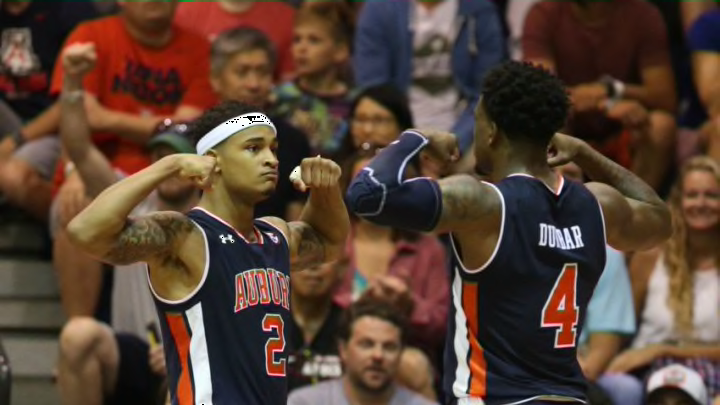
In terms of offensive tempo, I suspected that having a faster tempo might be a better indicator of offensive success. I figured that faster offensive teams would have a better chance of catching defenses off guard and finding good shots. Additionally, I thought better offenses might be able to find good shots quicker, resulting in a “faster” tempo. At least this season, however, great offenses have been produced from both fast and slow tempos. Among the 50 fastest offensive tempo teams, 8 had offenses ranked in the top 50: North Carolina, Buffalo, Gonzaga, Duke, Kansas, NC St, Belmont, and Auburn. Among the 50 slowest offenses, 7 had top 50 offenses: SMU, Wofford, Cincinnati, Villanova, Saint Mary’s, Wisconsin, and Virginia.
Impressively, there are some teams that have managed to both play at very fast offensive tempos and very slow defensive tempos. They’ve been able to play very fast offensively and also get back on defense and force lengthy possessions. Although it’s still unclear which tempo is better offensively, I intuitively find this “fast-slow” combination of offensive and defensive tempo very appealing. Here are the 7 teams that are among the 50 fastest offensive tempo teams AND the 50 slowest defensive tempo teams.

A variety of speeds can produce success in March, but tempos say a lot about how a team operates and can be big factors in terms of match ups. If a super fast offensive team goes up against a super slow defensive team, what effect will that have?
Focusing just on offensive tempos ignores a huge part of a team’s identity.
 Add us as a preferred source on Google