


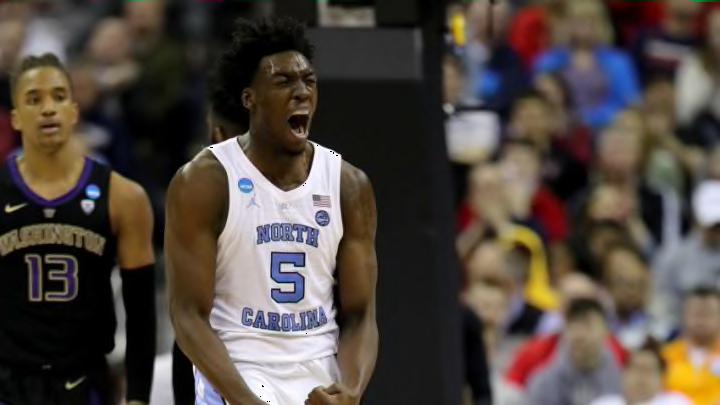

Needs Improvement: Everything
This section is going to be rough. It’s going to sound mean, although that’s not my intention whatsoever. It’s not going to sound positive, unfortunately, as Nassir Little’s game has several holes that are enough to sink him as a prospect if they’re not taken care off — physical, mental, skill-wise, everything. Everything needs improvement for Little, which is why some teams are concerned over his ability to both reach his upside as a player and reach the point of simply being playable at the next level.
Beyond the physical tools and the flashes of skill at lower levels, as well as the aforementioned offensive production based on strong finishing numbers and rebounding, Little offers very little else in terms of natural feel for the game and preternatural instincts as a scorer/playmaker and a help/team defender. Low-feel players have a tough time panning out at the next level, since feel, instincts, and basketball IQ impact every single thing they do; Little does have some skill level, as well as great physical and athletic tools, which help assuage some concerns and is likely why he was able to dominate at the high school level.
Nassir Little’s domination at lower levels and flashes of elite skills are what has teams hanging on to the belief that he can one day be a special player in the NBA, even with the notable struggles he had with acclimating to the college game (and college offense and defense) as a Tar Heel. He’s only 19, which was a late-bloomer in high school, so there’s some optimism that just may be the case again when it comes to higher levels of competition.
Some parties aren’t so convinced, and see him as a horrible prospect, including some of the anonymous assistant coaches that The Athletic’s Sam Vecenie interviewed earlier this year. One particular coach was especially negative when discussing Little’s freshman season:
"“Hate him (as a player). Absolutely hate him. I think he’s a terrible player. I don’t care that he made a couple of 3s against Virginia Tech because everyone was feeling good. I hate him. I think he’s a bad player. I watched him play like crazy. I did see the McDonald’s and Jordan games. That’s great, he played harder than people in those settings, and people fell in love with that. The practice settings, he was competitive. But I see a guy who has no idea what he’s doing.”"
That is, in a word, harsh. Very harsh. Yet, however blunt and rude it may sound, it isn’t completely incorrect. It’s grounded in reality, in stats and film and everything in-between. Little did struggle this year, to a significant degree, and although I wouldn’t go as far as “hating” him as a player, it’s certainly understandable how someone could come away with a brutal evaluation of him as an NBA prospect. Despite entering the season as the perceived top potential draftee on the Tar Heel roster, the year concluded with Coby White stealing that title, and a case can certainly be made that sharpshooter Cameron Johnson profiles as a superior draft prospect and NBA player than Little, too.
Little has fallen out of favor among many draft evaluators, even with his aforementioned physical tools and flashes of talent. When looking at his game as a whole, there is just so much that needs improvement, and some things that may have little chance of getting better at all — whether he works on it or not.
Offense
Nassir Little’s ball-handling and repertoire of guard skills — touch and decision-making as a passer, his vision as a scorer and facilitator, and his shiftiness and counters when attacking closeouts or driving hard to the basket — were perceived as a work in progress out of high school, despite the flashes of tantalizing creation ability.
That was unquestionably still the case for him at UNC, with his loose handle and shaky floor vision and mental processing hurting him (and his teammates) constantly.
With a loose handle, Little would bobble the ball on drives and isolation sets, at times forcing him to pick up his dribble prematurely or, worse, ending the possession with a rushed pass or shot attempt. He’s not particularly shifty with the ball due to the looseness of his handle, as well as the rigidity of his movement: The added bulk made him an even stiffer athlete, making it tougher for him to glide through defenders or break guys down off the dribble with fluidity.
He relied heavily on his strength, force, and craft to finish around the basket as a result, and although he was still a great finisher, he would still charge right into defenders and throw up errant shots if he failed to get to the rim unimpeded. Likewise, he has a tendency to take off a bit too far from the basket, hence the amount of floaters and super-contested and contorted layups he took. Again, the touch is there, so he still hit some of them, and he definitely has the bounce to soar to the rim if need be, but it would make life much easier for him if he were to take (and be able to take) the extra stride to get himself a cleaner look at the bucket. He’s a great finisher, but he’s not a great driver, basically.
There were several instances where Little and his team would’ve been better off with him passing up a shot attempt and resetting the offense, but his lack of adequate floor vision and spatial awareness often resulted in empty possessions where he’d take the ball himself (and on a few occasions, hijack the offense) and try to find himself a shot. At times he would get a bucket, using his strength to get to the rim or bounce off of defenders for pull-ups, but on too many occasions he would either put up a sloppy shot and/or miss open teammates in the process. Shot selection is an issue, which is connected to his feel; his floor vision is also an issue, perhaps an even larger one, since he struggles to make reads as a passer (1.5 assists per 40 minutes) and sports a negative assist-to-turnover ratio (0.5).
Considering how much attention he can draw as a driver, he needs to be able to hit simple passes and kickouts, as to take advantage of whatever the defense gives him. If he gets cut off, he needs to be capable enough to dump the ball off to a big or throw it out to the perimeter. The results of such an action were mixed, and mostly negative, but he did show flashes of competence and improved decision-making as the season wore on and he got more in-game reps.
Although he flashed legitimate upside as a shot-creator and maker during his senior season of high school, putting in significant work to improve his mechanics and get to the point where he could knock down shots confidently with decent efficiency, that seemed to have been lost during his time as a Tar Heel. Given the flashes, touch, free throw shooting, and aforementioned improvements as a shooter in high school, I personally don’t worry about him shooting it at a respectable rate in the NBA — but there are some important tweaks that are necessary.
At the top of his release, Little would bring the ball back closer to his face, with the acute launch angle essentially serving as a slingshot, leading to some wild misses. When interviewed by ESPN at the Draft Combine, he noted that he was cognizant of such an issue, and said that he and his trainers were currently working on soothing that out, which is very encouraging.
His shot base was rather inconsistent. Some shots had his feet too close together, some shots had his knees barely bending, and on others his feet placement were askew and now lined up with the basket. Since his shot uses serious lift (although he seemingly didn’t get as much at UNC than he previously did), that makes his base even more important for the sake of smoothly transferring energy. If the shot starts poorly, it will likely end poorly, too.
He also displayed a worrisome lack of balance and leg control on his shots, with his legs swinging awkwardly, especially on shots out of the post. Perhaps this is a result of playing heavier, but there’s no certainty to such speculation — it’s just odd.
Little had a strong post game in high school, with drop steps and fadeaways (over smaller wings) in his repertoire, making use of his size and the height on his shot. To his credit, he was a good post scorer and it was something he relied on often at lower levels if the offense ever got bogged down — but that preference bled into his collegiate play, as he has a tendency to spin right into traffic (and throw up panicked shots or passes) far more frequently than one should, indicative of his iffy feel for the game and how far he needs to go when it comes to processing what’s happening on the floor.
Defense
As mentioned on the previous slide, Little possesses great physical tools that should translate on the defensive end. He has the length to swallow up smaller ball-handlers, the strength to go toe-to-toe with some bigs, and the verticality to send shots off the backboard on occasion. He does possess defensive upside because of his physical profile, which is attractive to teams.
But that’s basically where the “good” defense ends. In theory, Little should be a great defender. After all, he entered college with the perception of a defensive force, an ultimate stopper capable of D’ing up several positions. But in actuality, he’s not close to that.
In actuality, and to put it as nicely as I can: Nassir Little is terrible at defense. He is really, really, really bad, and for so many reasons.
His athleticism was slightly overhyped, as was his quickness; he’s not a quick-twitch athlete, nor does he possess great hips, so his response time is far too slow to keep up with most ball-handlers and even a large chunk of wings on the perimeter. He bulked up significantly this summer, which is a testament to his work ethic and ability to put on strength, and although it helped him somewhat at defending bigs and battling for rebounds, it sapped him of a lot of the agility and speed that he showed off in high school.
He was alarmingly slow at the NBA Draft Combine in May, posting horrific agility times and ranking slower than some of the centers in attendance, and his lack of adequate foot speed was apparent on defense as he was blown by regularly. If he’s tasked with defending someone one-on-one, he’ll often do it flat-footed and with minimal resistance, often letting drivers get right past him. He doesn’t seem to get low enough in his stance on defense, standing upright more than he should (which is even worse for him since he doesn’t have the requisite speed or recognition to react fast enough).
Little is genuinely terrible at team defense, processing events far too slowly to be impactful. He gets caught in no man’s land several times a game, either giving up open looks or forcing his teammates to recover for him (and he’ll typically stand pat all the while). He struggles to know exactly when and where he should be in team situations, which is a vital aspect of playing within Carolina’s swarming (i.e., over-helping) defensive system that require sharp rotations. His understanding of when to tag or stunt on a drive currently needs work, with some plays resulting in him standing still and others resulting in him cutting off a driving lane that a teammate was already in the process of halting, thus leaving his man open. He also sported a low steal rate (1.5 STL%), pointing toward questions of his event creation and impact upside, despite showing some flashes at UNC (and several in high school).
He’s probably the worst transition defender in the draft, at least among wings and forwards, showing minimal effort, poor recognition and awareness, and often just running back after a make/miss without turning around to see what’s even happening. As a result, his teammates sometimes have to point him (and at times, shove him) in the right direction to prevent opposing teams from capitalizing (which occurs in help situations as well).
Beyond the mental and physical aspects of his defense, his technical approach needs a significant overhaul. He falls for pump fakes often, jumping at the slightest shot fake and taking himself out of the play entirely. His technique when closing out on shooters is equally poor (with the jumpiness impacting him here as well), as he struggles to manage his aggression, either overshooting it and getting dusted by the ball-handler or running directly into the shooter.
Little gets picked on defending off the ball, too, as he struggles mightily as a lock-and-trail defender, often losing the shooter or struggling to get over screens. When facing screens, he often dies on them after taking initial contact, letting the shooter/ball-handler get across without much of a fight. When he stays engaged and tries to close out on the shooter, though, he often struggles to get through the screen, either clipping the screener with his hip or barging right into him (showing off deficiencies in technique, athleticism, and his spatial awareness and feel, since it’s hard to somehow not see 7-footers standing still).
He’s consistently lauded for having a high motor, and although his work ethic is certainly exists and he’s not one to withhold his passion on the court, I’m not so sure if we’re evaluating him accurately here. At least when it comes to his time at UNC, his motor was a bit inconsistent. He’d sky up for rebounds on both ends of the floor and fight for putbacks, and had defensive possessions where he really hounded his opponent, but there were too many possessions (on offense and defense) where it seemed like he was coasting, such as the instances mentioned (and shown) above where he’d watch his man score without putting up a fight. And even on some possessions where he was trying to break down his man on offense or wear down his opponent on defense, it seemed like we weren’t getting the level of aggression and fearlessness that many saw from him when competing at lower levels.
Perhaps this is connected to the element of his feel for the game: Later in the season we did end up seeing some damn good on-ball defense against some NBA-caliber guys in Zion Williamson and Chuma Okeke, and we also saw him being far more assertive against the likes of Iona and Washington (and this isn’t merely a nod at his increased production).
Perhaps there was more to the behind-the-scenes happenings at UNC that could’ve influenced his play, although it’s malpractice to truly speculate into that, and would be unfair to both Little and the university. It’s a curious thing nonetheless, which is the point I’m trying to make here. When he’s engaged, no one tries harder; when he’s not, well, the results aren’t so good.