

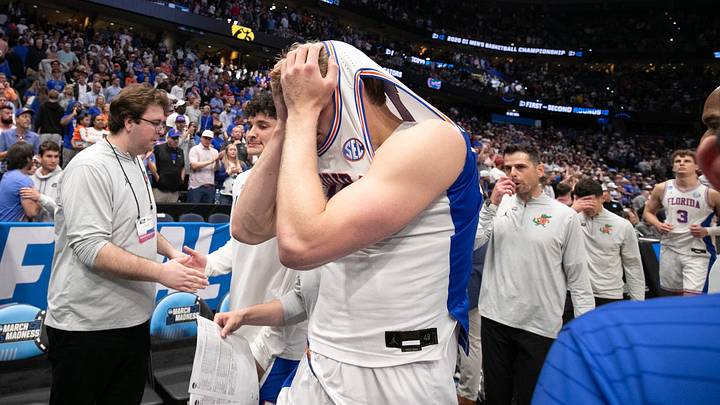
College basketball doesn't have 25 teams that will reach the Final Four. It does, however, have something close to 25 teams that can reasonably believe they could.
That distinction matters entering the 2026-27 season.
Florida has earned its place at the front of the national championship conversation. Duke has reloaded. Illinois returns enough from a Final Four team to believe another run is possible. UConn remains one of the sport's standards.
After them comes an enormous second tier.
Texas has assembled a fascinating roster. Arizona and Michigan State have March-tested programs. Louisville was aggressive in the transfer portal. Tennessee reconstructed its roster. Houston's identity remains one of the safest bets in the sport.
Then came September's eligibility developments, which strengthened teams such as Iowa State, Miami and Kansas.
Here are 25 teams that belong somewhere in the Final Four conversation as October approaches.
1. Florida
The Gators aren't merely No. 1 because somebody needed to occupy the spot.
They have a roster capable of staying there.
Thomas Haugh averaged 17.1 points last season, while Alex Condon averaged 14.9 and Rueben Chinyelu 11.2. Boogie Fland gives Florida another proven option in the backcourt.
The frontcourt combination of Haugh, Condon and Chinyelu could be the best in America.
There is also widespread respect for Florida beyond preseason rankings. When CBS Sports surveyed nearly 100 Division I coaches during the offseason, 55% picked Florida as the team they believed would be the best in the country.
That's a massive number considering how much talent exists elsewhere.
2. Duke
Losing elite talent has become an annual part of life at Duke.
So has replacing it.
Patrick Ngongba II provides experience inside, while another strong recruiting class gives Jon Scheyer options throughout the rotation.
The question isn't whether Duke has Final Four talent.
It's how quickly Scheyer can determine which combinations maximize it.
3. Illinois
Illinois reached the Final Four last season, so Brad Underwood isn't selling a hypothetical.
His players know what a March run requires.
Andrej Stojakovic, David Mirkovic and Tomislav Ivisic give Illinois a potentially devastating collection of size and shooting. Providence transfer Stefan Vaaks adds another creator.
Mirkovic's recovery from offseason foot surgery is one of the major developments to watch. When healthy, he gives Illinois another potential centerpiece.
If the Illini reach March healthy, another Final Four trip is completely realistic.
4. UConn
At some point, Dan Hurley earned the benefit of the doubt.
Braylon Mullins returns after averaging 12.0 points, while Silas Demary gives the Huskies an experienced lead guard after averaging 10.1 points and 5.9 assists.
Wofford transfer Nils Machowski averaged 17.2 points, and Seton Hall transfer Najai Hines averaged 6.5 points, 5.5 rebounds and 2.2 blocks.
That's a useful blend of returning talent and additions.
More importantly, UConn has established an infrastructure capable of turning good rosters into championship teams.
5. Texas
Sean Miller's second Texas roster could be considerably more dangerous than his first.
Colorado transfer Isaiah Johnson provides scoring and creation after an impressive freshman season. TCU transfer David Punch brings defensive versatility, while Elyjah Freeman arrives from Auburn.
Matas Vokietaitis gives the Longhorns continuity inside.
Texas reached the Sweet 16 last season. The next roster appears capable of going further.
6. Arizona
Tommy Lloyd has reached the point where Arizona belongs in this conversation almost automatically.
The Wildcats have consistently played efficient offensive basketball under Lloyd, and last season's Final Four run removed another lingering question about the program's March ceiling.
Roster turnover will force Arizona to evolve again.
The program has earned enough trust to believe it can.
7. Michigan State
Jeremy Fears Jr. might be one of the most important returning point guards in the country.
Tom Izzo also brings back Coen Carr, Kur Teng, Jordan Scott, Divine Ugochukwu and Cam Ward from a Sweet 16 team.
That's significant.
In an era dominated by roster turnover, Michigan State enters the season with players who understand Izzo's system and have already experienced high-level postseason basketball together.
That gives the Spartans a substantial head start.
8. Louisville
Louisville's transfer class changed the program's ceiling.
Jackson Shelstad averaged 15.6 points and 4.9 assists through 12 games at Oregon before a hand injury interrupted his season.
Flory Bidunga gives Pat Kelsey an explosive interior presence after finishing with 82 dunks last season at Kansas.
Add Karter Knox, De'Shayne Montgomery and Alvaro Folgueiras, and Louisville has assembled much more than an NCAA Tournament roster.
This team can challenge Duke in the ACC.
9. Virginia
Ryan Odom has accelerated Virginia's return to national relevance.
The Cavaliers have assembled a roster with enough size, shooting and positional versatility to contend near the top of the ACC.
The challenge will be turning talent into offensive consistency.
Virginia doesn't need to resemble the program's old teams to become dangerous in March. It needs to develop its own identity quickly enough to capitalize on an intriguing roster.
10. Arkansas
John Calipari rarely lacks talent.
Arkansas again has plenty of it.
The Razorbacks' ceiling will depend on whether individual ability becomes collective consistency. That's often the dividing line for portal-heavy teams.
If Arkansas develops a reliable rotation and defensive identity before March, there is enough high-end talent here to beat Final Four-caliber opponents.
11. Miami
Miami's outlook changed dramatically with Malik Reneau's eligibility ruling.
Reneau led the Hurricanes in scoring last season. Now he can potentially pair with Villanova transfer Acaden Lewis to form one of the ACC's more intriguing inside-out combinations.
Somto Cyril, Dante Allen and Shelton Henderson give Jai Lucas even more options.
Miami went from interesting to potentially excellent in a matter of days.
12. Tennessee
Rick Barnes had to rebuild.
He did not rebuild cautiously.
Dai Dai Ames, Juke Harris, Jalen Haralson and Terrence Hill Jr. give Tennessee a completely different perimeter group, while Miles Rubin provides size inside.
There will be a chemistry curve.
But Barnes' defensive standards give Tennessee a foundation while its new offensive hierarchy develops.
13. Houston
Kelvin Sampson doesn't require a roster full of preseason celebrities to build a Final Four team.
Houston's formula remains brutally effective: defend, rebound, create extra possessions and make opponents uncomfortable for 40 minutes.
Dedan Thomas Jr. is one of the important additions to a roster that should again possess high-end defensive potential.
Houston's style travels exceptionally well to March.
14. Iowa State
Tamin Lipsey's eligibility ruling transformed Iowa State's outlook.
Lipsey is a three-time All-Big 12 selection and four-year starter whose defense, toughness and playmaking address major needs for T.J. Otzelberger.
The Cyclones did suffer a significant setback with Killyan Toure expected to miss time because of a shoulder injury.
Still, getting Lipsey back gives Iowa State a veteran point guard around whom everything else can stabilize.
15. Kentucky
Milan Momcilovic could be a perfect Mark Pope player.
The 6-foot-8 forward made 136 3-pointers last season at Iowa State, more than anyone else in college basketball.
His shooting creates enormous spacing possibilities.
Kentucky will have to establish roles around another reworked roster, but Pope has enough offensive weapons to build one of the nation's most difficult teams to defend.
16. Kansas
Kansas received an enormous September boost when Tre White was among the players granted eligibility through a preliminary injunction.
White averaged 13.5 points and 6.7 rebounds last season while shooting better than 40% from 3-point range.
He joins a roster featuring elite freshman Tyran Stokes, Utah transfer Keanu Dawes and Taylen Kinney.
Bill Self suddenly has another experienced two-way player on a team that already possessed considerable upside.
17. Gonzaga
Gonzaga's roster has experienced uncertainty, but dismissing Mark Few remains dangerous.
Xaivian Lee is among the key pieces after transferring from Florida, while Braden Huff gives the Bulldogs proven frontcourt production.
Gonzaga's system, offensive execution and player development routinely produce teams that improve substantially between November and March.
That makes the Bulldogs difficult to remove from the conversation.
18. Michigan
Michigan's championship defense became considerably more complicated when Brandon McCoy Jr. suffered a season-ending ACL injury.
That's a major loss.
It doesn't mean the Wolverines disappear.
Trey McKenney and Elliot Cadeau provide established talent, and the defending national champion deserves an opportunity to show what its reconstructed roster can become.
19. North Carolina
North Carolina may not enter October alongside Florida and Duke.
That doesn't mean the Tar Heels can't eventually get there.
The talent base remains substantial, and freshman Maximo Adams is among the newcomers worth monitoring. The 6-foot-7 wing finished No. 26 in the 247Sports Composite after making a major rise during his high school career.
North Carolina's ultimate ceiling will depend on its backcourt and how quickly its new pieces settle into defined roles.
20. Alabama
Nate Oats gives Alabama an offensive identity before the season even begins.
The Crimson Tide want pace, spacing and 3-point volume.
When Alabama has the personnel to execute that approach efficiently, it becomes exceptionally difficult to prepare for.
The question will again be whether the defensive performance can approach the offensive ceiling.
21. St. John's
Rick Pitino has returned St. John's to the national picture.
Now comes the next challenge.
The Red Storm need to convert regular-season relevance into sustained NCAA Tournament success.
Pitino's teams will defend and compete. If St. John's finds enough consistent offense, its style is built to make a higher-seeded tournament opponent miserable.
22. BYU
BYU has become too talented and too ambitious to treat as a novelty.
The Cougars have invested heavily in constructing nationally competitive rosters and should again possess enough high-end ability to survive the Big 12.
The conference will expose any weaknesses quickly.
It will also prepare BYU for virtually anything it could see in March.
23. Texas Tech
Texas Tech has quietly remained part of the national conversation throughout the offseason.
That's significant in a Big 12 filled with programs capable of making deep postseason runs.
The Red Raiders don't need to win the preseason publicity battle. They need to emerge from conference play with a defined identity and enough offensive creation to complement their toughness.
24. Vanderbilt
Vanderbilt's rise has changed expectations.
Merely reaching the NCAA Tournament is no longer necessarily the ceiling.
Playing in the SEC guarantees the Commodores repeated opportunities to measure themselves against elite opponents. If Vanderbilt handles that grind and enters March healthy, it will have already faced Final Four-level competition numerous times.
25. Ohio State
The final spot could reasonably go to several teams.
Ohio State gets it because the Buckeyes have enough talent and opportunity to play their way significantly higher.
The Big Ten will tell us quickly whether that's realistic.
Games against Illinois, Michigan State and the rest of the league's best teams will provide the evidence.
For now, Ohio State belongs at the edge of the Final Four conversation.
The gap between contender and champion remains enormous
Twenty-five teams can dream about the Final Four.
Only four will reach it.
That's what makes this season particularly compelling.
Florida deserves to enter October as the team everyone is chasing. Duke and Illinois aren't far behind. UConn has championship credibility. Texas, Arizona, Michigan State and Louisville have legitimate cases.
And the eligibility rulings arriving just before preseason practice have changed the equation again.
The list will shrink.
For now, though, college basketball enters 2026-27 with an unusually large group capable of believing the final weekend is attainable.
 Add us as a preferred source on Google