

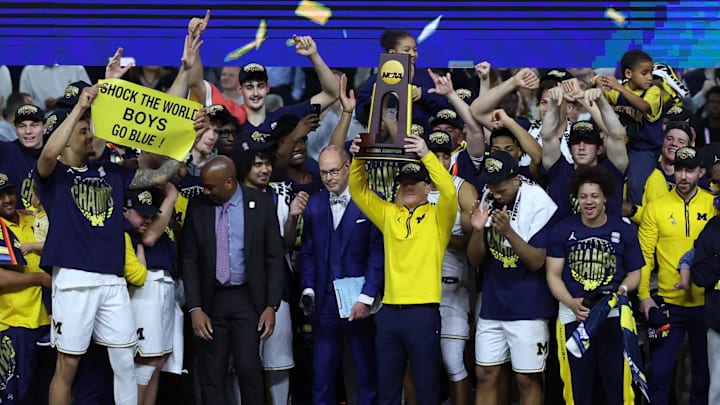
The Michigan Wolverines claimed their place atop the college basketball world on Monday night with a 69-63 victory over the UConn in the national championship, bringing the 2025-26 season to a close.
The Wolverines’ title in head coach Dusty May’s second season with the program came with several historic feats including being Michigan’s second national championship in men’s basketball, the first title for the Big Ten since 2000, and made Michigan the first school to win championships in both football and men’s basketball in the College Football Playoff era.
Whenever a team wins a championship in any sport, and especially in a dominant fashion, people tend to look back at how they did it in hopes of finding a blueprint for future success. With that in mind, here are three key takeaways from Michigan’s national championship season.
Turnarounds Don’t Take as Long as They Used To
Just two seasons ago, Michigan finished last in the Big Ten with an 8-24 overall record. In comes Dusty May who quickly turns the program back around reaching the Sweet 16 in his first season and winning a national championship in his second.
Now Michigan isn’t a bottom-tier program and has had great success outside of that down year. However, going from a season like they had in 2023-24 to a Sweet 16 and a national title in a new coach’s first two years once seemed unfathomable. The biggest reason for this new phenomenon is obviously the transfer portal as May rebuilt his rosters largely through portal additions.
This idea of quick turnarounds can even be seen all across college sports. Just look at what Curt Cignetti has done with Indiana football through two seasons in Bloomington or teams like Miami and Virginia in college hoops who had strong bounce-back seasons in their first year under new coaches.
While this trend may put more pressure on newly hired coaches who can no longer rely on “trusting the process” and taking time to build their programs, it does give hope to so many more teams. Massive turnarounds are now possible in a very short time, and with the right pieces in place, especially at the top, anything is possible.
Experience Matters
In a season where freshmen dominated the headlines, experience ultimately prevailed. This was true not only for Michigan, but also for many of the teams that made deep runs in the tournament. Michigan leaned heavily on veteran talent, with just one freshman in Trey McKenney playing a significant role.
This roster was clearly built through the transfer portal, as head coach Dusty May brought in players who had major experience playing and winning at the college level. This also plays into the point that money certainly does matter, but it isn’t everything. It’s no secret that Michigan spent a lot in putting this roster together, but so did other programs like Kentucky and Indiana who spent but saw very different results.
In their “spending”, Dusty May didn’t just get all the top pieces, but the right pieces with experienced players who fit the mold for the team he wanted to build. In addition, it’s easy to overlook guys like Nimari Burnett and Will Tschetter, who stayed with the program from the Juwan Howard era and provided valuable experience in Ann Arbor during a period of massive turnover for the program.
In a sport like college basketball where freshmen can and usually do dominate, we have seen experience become more valuable when March rolls around, and Michigan showed that this season.
Early Season Matters
Many fans don’t pay as much attention to the early parts of the college basketball season, caught up in the end of football and other sports, but that time can reveal a lot about a team. Coming into the season, Michigan was seen as a top team. However, nobody expected them to dominate like they did, especially after shaky performances in narrow wins over Wake Forest and TCU early in the year.
Going into conference play Dusty May noted that his team had limited time at full strength during the offseason due to injuries and other factors, which contributed to their sluggish start. Once the Wolverines fully gelled though, we saw how dangerous this team could be, particularly with their dominant performance at the Players Era Tournament.
Michigan also challenged themselves in non-conference playing against quality opponents, which helped prepare them for the gauntlet of the Big Ten and March Madness. Looking at recent national champions, we can see a similar trend as many faced early-season tests, developed chemistry along the way, and looked dominant at times early in the year before hitting their stride in conference and tournament play.
 Add us as a preferred source on Google