

The history is hard to ignore. Since San Diego’s surprise run in 2008, the West Coast Conference Tournament has been owned exclusively by Gonzaga Bulldogs and Saint Mary's Gaels.
The WCC Has Long Been a Two-Team Race
Gonzaga has taken five of the last six titles, including last season’s 58–51 grind-it-out win over the Gaels, while Saint Mary’s has consistently been the league’s toughest challenger.
That reality has shaped expectations across the conference. Most seasons begin with the same assumption: everyone else is chasing second place.
Seattle’s First Impression in a New League
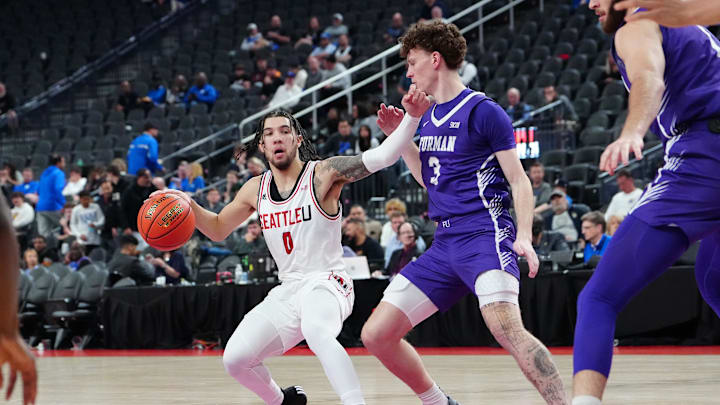
That assumption is being tested by the Seattle Redhawks. In their first season in the West Coast Conference, Seattle enters league play at 11–2 with a résumé that demands attention.
The Redhawks stumbled early with a loss to Cal Poly and later dropped a tight three-point game to UC Santa Barbara. Since then, they have looked like a different team. Six straight wins have followed, including statement victories over Stanford, Washington, and most recently UTSA. This is not a soft nonconference profile inflated by buy games. Seattle has beaten real teams and done it with consistency.
Chris Victor’s Program Takes Shape
Much of this moment traces back to head coach Chris Victor. Victor has quietly built a winning foundation, reaching 20-plus victories in three of his first four seasons. Last year’s 14–18 campaign in the WAC was a step back, but it now looks more like an outlier than a trend.
This season feels different. Seattle is playing with pace, confidence, and balance, scoring 81 points per game while holding opponents to just 66.5. That defensive reliability, paired with improved offensive flow, has made the Redhawks one of the most efficient teams in the league through December.
Maldonado and a Balanced Attack
The offense is led by Brayden Maldonado, who is averaging 15.9 points per game and setting the tone on the perimeter. He is not doing it alone. Seattle’s strength has been its depth, with multiple contributors capable of carrying stretches and a system that does not rely on one player forcing the issue.
That balance will be tested immediately as conference play begins.
A Loud, Intimate Stage on Sunday Night
Seattle opens WCC play at home against the San Francisco Dons, a program that has flirted with breaking into the league’s top tier several times over the years. The Dons arrive at 8–5, dangerous but inconsistent, and well aware that this is a tone-setting game.
The setting matters. The Redhawk Center holds fewer than 1,000 fans, but it rarely feels small. On Sunday night, it is expected to be packed and loud, draped in red and white, and fully invested in what this season could become.
A Long Road to March Credibility
Seattle’s broader history adds perspective to this moment. The program stepped away from Division I from 1980 to 2008, returned, and spent years trying to find footing. They have not appeared in the NCAA Tournament since 1969 and have not won a tournament game since 1964.
Joining the West Coast Conference is the next major test. After San Francisco, Seattle welcomes Washington State, then heads into a daunting road stretch at Gonzaga, Saint Mary’s, and Oregon State. That sequence will go a long way in defining whether this is simply a strong start or the beginning of something more substantial.
A Season Already Worth Celebrating
Regardless of how that stretch unfolds, something has already shifted. Seattle is winning, playing an exciting brand of basketball, and giving its fans a reason to believe as conference season begins. For a league long defined by two names at the top, the Redhawks are forcing a new conversation.
And for the first time in a long time, the rest of the West Coast Conference may need to look over its shoulder.
 Add us as a preferred source on Google