

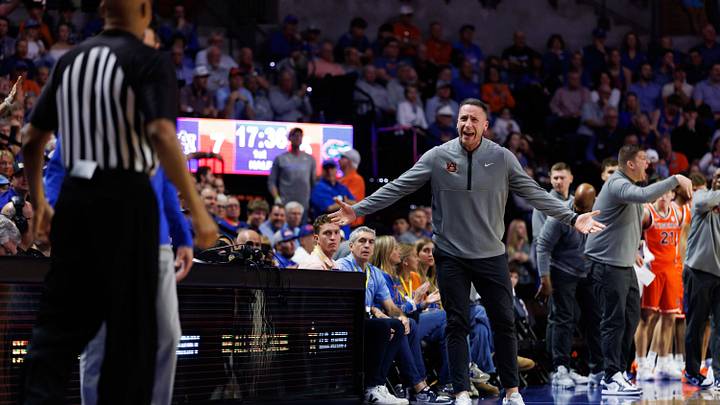
For years, Auburn basketball built one of the clearest identities in college basketball. The Tigers attacked defensively, pushed tempo relentlessly and overwhelmed opponents with wave after wave of fresh bodies. Under Bruce Pearl, Auburn’s depth was never just a luxury. It was the system itself.
That identity vanished last season. Auburn finished No. 345 nationally in bench minutes, according to KenPom data highlighted by The Auburn Observer. Among high-major programs, only a handful of teams relied on their bench less. That was a stunning change for a program that had spent years winning with one of the deepest rotations in the SEC.
And the impact showed up everywhere.
The Tigers struggled to sustain defensive pressure. The offense never consistently found the pace Steven Pearl envisioned. By the end of the season, Auburn looked exhausted, losing eight of its final 10 regular-season games and falling out of the NCAA Tournament picture entirely.
Now, after one aggressive offseason, Auburn suddenly looks much closer to the program fans have become accustomed to watching.
Auburn attacked its biggest weakness head-on
This was not an offseason built around one superstar addition. It was built around solving structural problems.
Auburn spent the portal cycle and international recruiting period adding size, experience and lineup flexibility after last season exposed just how fragile the roster became once injuries and development issues piled up.
Owen Freeman gives Auburn another proven frontcourt option after transferring from Creighton. Bukky Oboye adds legitimate rim protection after arriving from Santa Clara. Thomas Dowd and Adam Olsen bring maturity and physicality to the forward rotation.
On the perimeter, Auburn added scoring and versatility with George Kimble III and Lithuanian wing Mantas Rubštavičius.
The overall message from the roster construction is obvious.
Auburn does not want to survive with seven players ever again.
Last season forced Steven Pearl to adapt on the fly
The reality of Auburn’s 2025-26 season was brutal.
The Tigers entered the year expecting multiple newcomers to help fill out the rotation, but injuries and inconsistency immediately created problems. JUCO additions Abdul Bashir and Emeka Opurum barely contributed because of health issues. Young guards struggled defensively and never fully cracked the rotation during SEC play.
Eventually, Auburn had no choice but to overload its starters.
Three Tigers averaged more than 30 minutes per game, something that had rarely happened during the Pearl era. The constant pressure system Auburn built its success around simply became impossible to maintain with such little depth.
That was especially damaging defensively.
Auburn’s pressure defense only works when players can attack aggressively without worrying about fatigue or foul trouble. Last season, the Tigers frequently looked a step slower by February. The roster simply lacked enough playable bodies to sustain the style Auburn wanted to play.
The offseason response suggests Steven Pearl learned from that immediately.
Tahaad Pettiford may be the biggest winner
Tahaad Pettiford already entered next season as Auburn’s centerpiece. Now he may finally have the supporting structure necessary to maximize his game.
Last season often forced Pettiford into exhausting offensive workloads because Auburn lacked consistent secondary creators and scoring depth. A deeper roster should allow the Tigers to play faster, defend harder and keep Pettiford fresher late in games.
That matters in the SEC.
The conference has become too deep and too physical for teams to survive relying heavily on a short rotation. Every possession becomes more demanding by the middle of conference play. Fresh legs matter. Defensive flexibility matters. Reliable depth matters even more.
Auburn learned that lesson the hard way.
Now the Tigers appear determined to make sure it never happens again.
Auburn finally looks like Auburn again
That may be the biggest takeaway from this entire offseason. This roster looks bigger. Older. More balanced. More capable of surviving the week-to-week grind of the SEC.
Most importantly, it finally looks built to play the style that made Auburn one of college basketball’s most dangerous programs in the first place.
The Tigers may still have questions entering 2026-27. Chemistry always matters with so many newcomers. Shooting consistency will still determine plenty of games.
But after watching Auburn lose the very identity that defined the program last season, the Tigers finally appear to be getting it back.
 Add us as a preferred source on Google