

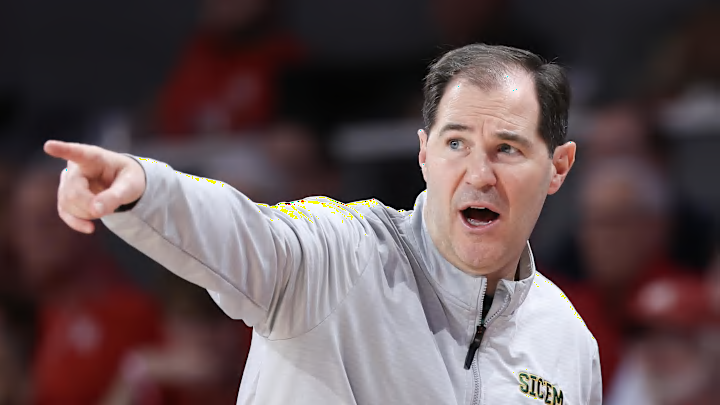
There is a certain standard that comes with Baylor basketball under Scott Drew. It is not just about making the NCAA Tournament anymore. It is about contending in March, staying relevant nationally, and looking like one of the most stable programs in the Big 12. That is why the 2025–26 season felt so jarring.
A 17–17 finish and a 6–12 record in conference play was not just a down year. It was a reminder of how fragile roster construction has become in the transfer portal era. Baylor never quite found consistency, especially once Big 12 play began. Close losses piled up. Defensive identity wavered. And for a program used to being dangerous, the Bears often looked stuck between rebuilding and competing.
The 2025–26 season never found its footing
On paper, there were enough pieces to believe Baylor could push toward the top half of the Big 12. Instead, they spent most of the season trying to stay afloat.
The issues were layered. Guard play showed flashes but lacked control in key moments. The frontcourt rotated bodies without establishing a clear anchor. Against elite teams like Houston, Iowa State, and Arizona, the gap looked real.
More than anything, Baylor struggled to string together momentum. Every time it felt like they were turning a corner, another loss followed. That is how a team with talent ends up .500 instead of dangerous.
This offseason feels different and more intentional
Last year was about survival. This year feels like a plan. The biggest difference is continuity. Seven players are expected to return, a massive shift from the previous offseason when the roster essentially reset. That alone gives Baylor something it did not have last season: a foundation.
Then comes the portal additions, and this is where things get interesting. Baylor did not chase random upside. They targeted production.
- Brett Decker Jr. brings scoring punch after averaging 17 points at Liberty
- Kayden Mingo adds backcourt stability with 13.7 points per game at Penn State
- Isaac Celiscar is one of the most efficient wings in the country, coming off a 13.2 point season at Yale
- Evan Chatman gives Baylor a physical presence inside with 8.8 rebounds per game at UAB
This is not a flashy group. It is a functional one.
Why this roster could quietly work
There is a real argument that this version of Baylor makes more sense than last year’s. The balance stands out immediately. Mingo can run the offense. Decker spaces the floor. Celiscar gives versatility on the wing. Chatman handles the dirty work inside.
Pair that with returning pieces like Isaac Williams IV and developing frontcourt players, and suddenly Baylor looks deeper and more connected.
It also helps that many of these players have multiple years of eligibility remaining. That matters in a sport where constant turnover has made continuity rare.
The pressure is still there in Waco
Even with a better roster build, expectations are not going away. Big 12 Conference remains one of the toughest leagues in college basketball. There are no easy nights. Programs like Houston, Kansas, and Iowa State are not slowing down.
Baylor does not need to win the league to feel like a success. But they do need to look like themselves again. That means toughness. That means identity. That means being a team nobody wants to see in March.
The bigger picture for Baylor Bears
This upcoming season is about more than wins and losses. It is about direction.
Was 2025–26 just a transition year in a new era of roster building? Or was it a warning sign that Baylor’s formula needs adjusting?
The early signs from this roster say Scott Drew understands the assignment. The pieces fit better. The structure is clearer.
Now comes the hard part.
Proving it on the floor.
 Add us as a preferred source on Google