

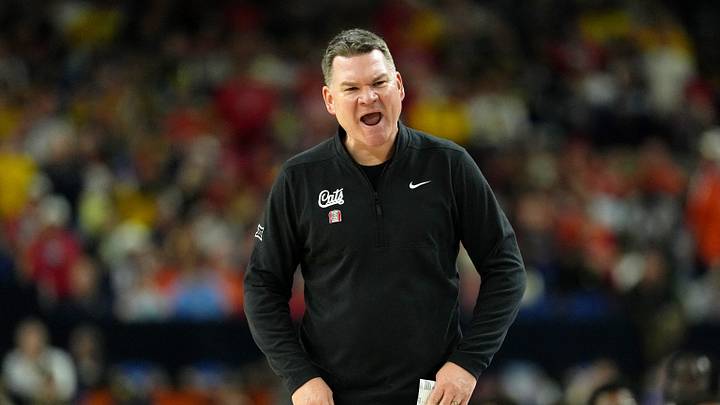
The Big 12 has reached the point where simply describing it as difficult doesn't explain enough. Good teams are going to lose games in this conference. Ranked teams will lose on the road, sometimes repeatedly, and programs with legitimate NCAA Tournament expectations could spend portions of January sitting in the middle of the standings because the schedule provides almost no room to recover from a bad week.
Arizona enters 2026-27 with a strong combination of established production, young talent and recent postseason success. Houston remains Houston under Kelvin Sampson, while Texas Tech has assembled one of the most intriguing veteran rosters in the country. Iowa State has Tamin Lipsey back, Kansas possesses enormous freshman upside and BYU has one of the best returning guards in college basketball.
Here is our Big 12 power ranking entering the 2026-27 season.
1. Arizona
Tommy Lloyd doesn't need to completely rebuild Arizona. He needs to replace important pieces without losing the identity that made the Wildcats so difficult to play, and Motiejus Krivas gives him an excellent place to start. The 7-foot-2 senior provides an enormous interior presence, while sophomore Ivan Kharchenkov returns after becoming increasingly important during Arizona's postseason run.
Then comes Caleb Holt, one of the most talented freshmen in the country. Holt arrives with the physical profile to contribute immediately, while North Carolina transfer Derek Dixon, Clemson transfer RJ Godfrey and the rest of Arizona's current group give Lloyd enough complementary pieces to construct another deep rotation. Arizona has questions to answer after offseason turnover, but its combination of size, returning talent and high-end newcomers gives the Wildcats our No. 1 spot.
2. Houston
There are programs that would look at Houston's personnel losses and call this a transition year. Kelvin Sampson doesn't really do transition years. The Cougars have built their program around defense, rebounding and relentless physicality, and Joseph Tugler returns as the ideal player to carry that identity into another season.
Houston's current roster also includes Dedan Thomas Jr., Chendall Weaver, Mercy Miller and Delrecco Gillespie. Thomas gives Sampson an experienced lead guard after previous stops at UNLV and LSU, while Tugler remains one of the country's most disruptive defensive frontcourt players. Houston may need time to establish its offensive hierarchy, but there is little reason to believe the Cougars will suddenly stop making opponents miserable.
3. Texas Tech
Texas Tech belongs higher than we initially had the Red Raiders because its late offseason roster additions dramatically changed the outlook. Grant McCasland now has a current roster that includes JT Toppin, Darrion Williams, Donovan Atwell, Cruz Davis, Dra Gibbs-Lawhorn and Jamichael Stillwell. That's a substantial collection of experienced college production.
Toppin is the biggest variable after suffering a torn ACL in his right knee in February. Before the injury, he was averaging 21.8 points and 10.8 rebounds and had already established himself as one of college basketball's premier players. Texas Tech should not be projected as though Toppin is guaranteed to immediately return at full strength, but the roster around him is strong enough that the Red Raiders no longer need everything to depend upon one player. If Toppin approaches his previous level during the season, Texas Tech can win the Big 12.
4. Iowa State
Tamin Lipsey's return gives Iowa State an experienced point guard and defensive leader who understands exactly how T.J. Otzelberger wants the Cyclones to play. That stability is particularly important after significant roster turnover.
There is, however, an important injury that has to be included in any accurate preseason assessment. Sophomore guard Killyan Toure underwent surgery on his right shoulder in August and Iowa State announced that he is expected to return in January. Toure started all 37 games as a freshman and averaged 8.6 points, 3.5 rebounds, 2.3 assists and 1.5 steals, so his absence removes a significant piece from the early-season rotation. Iowa State may look different once Toure returns, but Lipsey gives the Cyclones enough experience to remain near the top of the conference while they wait.
5. Kansas
Kansas might have the largest gap between its possible ceiling and established production, and Tyran Stokes is the primary reason the ceiling is so high. The 6-foot-8 freshman enters college as one of the most talented newcomers in America, giving Bill Self a player capable of becoming the centerpiece of the Jayhawks' offense almost immediately.
Kansas' official roster currently includes Stokes, Taylen Kinney, Keanu Dawes, Christian Reeves, Paul Mbiya and several other intriguing pieces. Tre White's situation requires more caution. White has received legal relief and has publicly been connected with a return to Kansas, but as of this writing he is not listed on KU's official 2026-27 roster. Because of that discrepancy, we're not counting White as part of the active rotation until Kansas officially adds him. Even without him, the Jayhawks possess enough young talent to become a serious Big 12 contender.
6. BYU
Rob Wright III's return gives BYU the most important thing a team can have in a league filled with difficult road environments: an established high-level point guard. Wright averaged 18.1 points, 4.6 assists and 3.5 rebounds last season while shooting 46.7% from the field and 41% from 3-point range.
The Cougars have also added significant talent around him, including five-star freshman Bruce Branch III and other newcomers. Jaxon Kohler's situation remains unsettled and should be described that way. The former Michigan State big man is enrolled at BYU and practicing with the team, but his fifth-year eligibility is currently protected by a temporary restraining order. The hearing is scheduled to continue Oct. 20. Kohler is eligible for BYU's Oct. 16 exhibition against Nebraska, but his regular-season status remains unresolved.
7. Baylor
Scott Drew has rebuilt enough rosters that significant turnover doesn't automatically produce panic anymore. Baylor continues to recruit enough talent to remain dangerous, and Drew's offensive track record gives the Bears a chance to outperform this ranking.
The larger question is defensive consistency. In this conference, an excellent offense alone isn't enough to consistently beat Arizona, Houston, Texas Tech and the rest of the upper tier. Baylor has the program infrastructure to move considerably higher, but the current group needs to establish its identity first.
8. Cincinnati
Cincinnati is one of the teams most capable of making this ranking look conservative. The Bearcats have enough physicality to survive Big 12 play, but simply surviving isn't the goal anymore. They need an offense capable of consistently producing when games become half-court possessions.
That is usually the difference between finishing eighth and pushing toward the top four. If Cincinnati develops reliable perimeter creation, the Bearcats could become a comfortable NCAA Tournament team. If offensive inconsistency remains an issue, this league is too deep to allow them to hide it.
9. Arizona State
Arizona State enters the season as one of the conference's more interesting unknowns. Significant change makes preseason evaluation difficult, but the Sun Devils have enough talent to make their placement in the bottom half temporary.
The challenge is building cohesion before conference play. Arizona State won't get several weeks in January to figure itself out because Big 12 opponents will immediately attack whatever weaknesses remain. A strong nonconference stretch could dramatically change the perception of this team.
10. TCU
TCU lost David Punch to Texas, removing an important frontcourt piece and creating another offseason of adjustment. The Horned Frogs still have enough talent to become an NCAA Tournament bubble team, but their path requires defensive consistency and improved offensive creation.
The middle of this conference is unforgiving because a perfectly respectable team can still finish below .500 in league play. TCU needs to establish a dependable strength capable of separating it from the rest of that enormous middle group.
11. Kansas State
Kansas State's ceiling is higher than this ranking if its new pieces fit together quickly. The Wildcats have gone through another period of roster change, creating the familiar modern-college-basketball challenge of turning individual talent into a functioning team in only a few months.
Home court could become particularly important. Kansas State has historically been capable of turning Manhattan into one of the conference's more difficult trips. Reestablishing that advantage would provide a path toward the upper half.
12. UCF
UCF has become the type of opponent Big 12 contenders can't casually overlook. The Knights have enough athleticism and size to make games uncomfortable, but they need greater offensive consistency to climb into the NCAA Tournament conversation.
The difference between 10th and 14th in this league may ultimately come down to which team develops the most reliable guard play and which can manufacture quality possessions late in close games. UCF has enough physical tools to compete. Now it needs the offensive execution to match.
13. Oklahoma State
Oklahoma State continues trying to rebuild toward the level expected from a program with its history. There are reasons for optimism, but the Big 12 doesn't offer many developmental nights. Young players and newcomers will face ranked opponents, experienced guards and hostile road environments once conference play begins.
The Cowboys need to establish a clear identity before that happens. If Oklahoma State becomes a dependable defensive team and finds enough offensive creation to survive late possessions, it can move considerably higher.
14. Colorado
Colorado lost Isaiah Johnson to Texas after he emerged as one of the Buffaloes' important young players, creating an immediate need for new offensive production. One player doesn't necessarily have to replace everything Johnson provided, but several members of the roster must absorb portions of his former responsibility.
That makes Colorado an interesting developmental team. If the Buffaloes distribute the scoring burden effectively and defend consistently, they can remain competitive. If nobody becomes a dependable creator, close Big 12 games will become difficult to finish.
15. Utah
Utah enters the season with fewer established answers than the conference favorites, but that doesn't mean the Utes can't become dangerous. The Big 12 regularly produces teams that look ordinary in October and become difficult opponents by February once rotations and roles become clearer.
The nonconference portion of the schedule is particularly important because Utah needs to establish an offensive hierarchy and determine which combinations can survive defensively before Big 12 play gets started.
16. West Virginia
West Virginia starts at the bottom because its roster carries more uncertainty than the teams above it, not because Morgantown suddenly became an easy place to play. The Mountaineers still possess a home environment capable of making life difficult for conference contenders.
Over an 18-game league schedule, however, home-court energy alone won't be enough. West Virginia has to prove it possesses dependable offense and enough depth to survive the physical demands of Big 12 basketball.
Arizona has company
Arizona deserves to begin first because the Wildcats combine proven frontcourt talent, postseason experience and an elite freshman in Holt. Houston has the defensive identity to challenge anyone, while Texas Tech's late roster construction has pushed the Red Raiders firmly into the championship conversation.
Iowa State should become more dangerous once Toure returns. Kansas has enormous freshman upside, and BYU already possesses elite point guard play with Wright. That's six teams with legitimate reasons to believe they can spend significant portions of the season near the top of the standings.
The Big 12 champion won't simply be the most talented team. It will probably be the one that handles this conference's relentless schedule better than everyone else.
 Add us as a preferred source on Google