

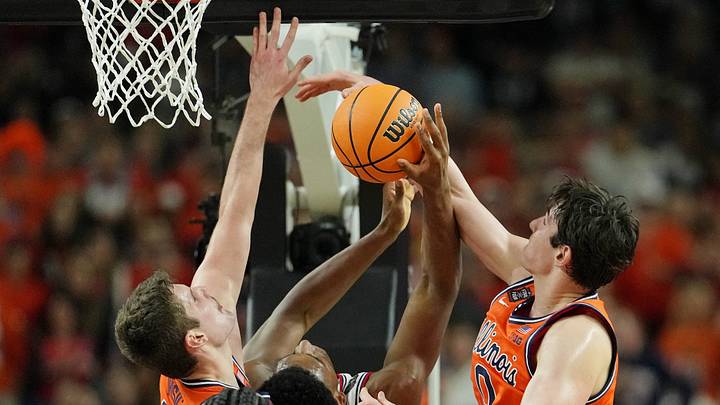
The Big Ten waited a long time for another national championship.
Michigan finally ended the drought.
Now the conference enters 2026-27 with another collection of teams capable of playing deep into March. Illinois returns a significant portion of a Final Four roster. Michigan State has one of the best point guards in America. Michigan is defending a national championship despite absorbing a brutal preseason injury, while USC, UCLA and Purdue all have legitimate reasons to believe they can challenge the league's top group.
That depth makes ranking the Big Ten difficult before October has even started. There is reasonable separation at the top, but the middle of the conference could change dramatically once games begin and reconstructed rosters establish their identities.
Here is our first complete Big Ten power ranking entering 2026-27.
1. Illinois
Illinois gets the top spot because Brad Underwood combines high-end talent with something increasingly valuable in college basketball: continuity.
David Mirkovic, Andrej Stojakovic, Tomislav Ivisic, Zvonimir Ivisic and Jake Davis all return from a team that went 28-9 and reached the Final Four. Mirkovic averaged 13.5 points, a team-high 8.1 rebounds and 2.6 assists as a freshman, while Stojakovic gives Illinois another proven scorer. Add the enormous Ivisic twins and the Illini can create matchup problems few teams in the country can replicate.
Mirkovic's health remains the important preseason storyline after offseason foot surgery, although his participation in fall practice is encouraging. Illinois also needs to establish its new backcourt hierarchy. Stefan Vaaks and freshman Quentin Coleman are among the players who could become increasingly important there.
Those questions matter, but they aren't enough to knock Illinois from No. 1. The Illini are coming off a Final Four appearance, return five rotation pieces and enter the season with legitimate national championship expectations.
2. Michigan State
Jeremy Fears Jr. gives Tom Izzo something every coach wants before a season begins: certainty at point guard.
Fears was already one of the country's best playmakers last season, and Michigan State can construct much of its offense around his ability to organize possessions and create opportunities for teammates. Coen Carr provides experience and extraordinary athleticism, while sophomore Cam Ward has an opportunity to take another significant step.
The Spartans also have size. Anton Bonke gives Michigan State a 7-foot-2 veteran option, and freshman Ethan Taylor provides another 7-foot-2 presence. Kaleb Glenn arrives from Florida Atlantic and gives Izzo another experienced forward.
Michigan State doesn't have to be spectacular offensively to win the Big Ten. It needs to defend, rebound and allow Fears to control games. That's a formula Izzo understands extremely well.
3. Michigan
Michigan would have been an easy choice to challenge Illinois for No. 1 if the offseason had unfolded differently.
Instead, the defending national champion lost five-star freshman Brandon McCoy Jr. for the entire season after he suffered a torn ACL during Michigan's European tour. McCoy was expected to become an immediate contributor, making his absence one of the most consequential preseason injuries anywhere in college basketball.
Then Michigan received important positive news when Roddy Gayle Jr. gained eligibility for a fifth season. Gayle brings experience from last year's championship team, while Elliot Cadeau and Trey McKenney give the Wolverines additional perimeter talent. Michigan also has size with Moustapha Thiam, Jalen Reed and J.P. Estrella.
The roster is still good enough to win the Big Ten. It simply has less margin for error than it did before McCoy's injury.
4. USC
USC has quietly become one of the most intriguing teams in the conference.
The Trojans don't have the same preseason national profile as Illinois, Michigan State or Michigan, but numerous offseason projections have placed USC firmly inside the NCAA Tournament field and, in some cases, near the national top 15.
The question is whether the Trojans can translate individual talent into consistency over a 20-game Big Ten schedule. Travel remains part of the challenge for the league's West Coast programs, and the conference's best teams will punish stretches of poor defensive execution.
USC has enough talent to finish above this spot. The Trojans now have to demonstrate that their ceiling can hold up from January through March.
5. UCLA
Mick Cronin's teams usually establish their identity through defense and physicality, which gives UCLA a reliable starting point regardless of roster changes.
The Bruins should again have enough perimeter talent to create offense, and Trent Perry's development will be particularly important. Perry shot 39.2% from 3-point range and 85.8% from the free-throw line last season, providing UCLA with a proven shooting foundation.
The challenge is creating enough easy offense against the Big Ten's best defensive teams. UCLA can grind through difficult games, but becoming a legitimate conference-title threat will require stretches when the Bruins can separate rather than simply survive.
6. Purdue
Purdue enters a different era, but nobody should confuse different with rebuilding.
Matt Painter has C.J. Cox and Gicarri Harris in the backcourt, 7-foot-4 Daniel Jacobsen in the middle and one of the conference's most fascinating additions in Caden Pierce. Pierce was the 2024 Ivy League Player of the Year at Princeton and averaged 16.6 points, 9.2 rebounds and 3.2 assists during that season.
Pierce also looked comfortable during Purdue's summer exhibition trip, while Jacobsen averaged 10.0 points, 6.3 rebounds and 2.3 blocks over those games. Those performances don't count toward the season, but they offer a useful glimpse of what Purdue's new frontcourt could become.
The Boilermakers are younger and less proven than the conference favorites. Painter's track record makes them difficult to rank much lower.
7. Ohio State
Ohio State enters the season in the enormous middle tier of the Big Ten where a handful of close games could separate a top-six finish from something considerably less impressive.
The Buckeyes have enough talent to reach the NCAA Tournament, but they need greater consistency against the conference's best teams. Big Ten play rarely allows teams to hide weaknesses because the styles change so dramatically from one opponent to another.
Ohio State's opportunity is real. If the Buckeyes develop dependable half-court offense and protect their home floor, they could climb several spots above this ranking.
8. Indiana
Indiana enters another season carrying expectations that come naturally with the program.
The Hoosiers' challenge is turning roster talent into a consistent identity. Big Ten teams that don't know exactly how they want to win tend to get exposed once conference scouting becomes more detailed.
Indiana doesn't need to resemble Illinois or Michigan State. It needs to establish its own dependable formula, particularly defensively and in late-game situations. If that happens quickly, the Hoosiers have enough talent to finish in the upper half and reach the NCAA Tournament.
9. Nebraska
Nebraska deserves considerably more respect than it received nationally for much of last season.
The Cornhuskers showed they could beat quality teams and compete near the upper portion of the Big Ten. The next challenge is demonstrating that success can become sustainable rather than episodic.
Nebraska doesn't need a roster filled with future NBA players to matter in this race. It needs experienced players to execute, defend and consistently win home games. The Cornhuskers could become one of the league's most annoying opponents because they won't require enormous individual performances to succeed.
10. Wisconsin
Wisconsin's offseason changed significantly when John Blackwell transferred to Duke.
Blackwell averaged 18.3 points, 4.8 rebounds and 2.3 assists during his final Wisconsin season, leaving behind a substantial offensive hole. Replacing that kind of production isn't simply about finding somebody else to take the same number of shots.
The Badgers need to establish a new offensive hierarchy.
Wisconsin's system and home-court advantage should keep the Badgers competitive, but the ceiling depends on whether somebody emerges as the dependable creator Blackwell was. Until that happens, placing Wisconsin in the middle of the conference feels appropriate.
11. Iowa
Iowa sits in another portion of the Big Ten where preseason certainty becomes difficult.
The Hawkeyes have enough offensive potential to cause problems, but competing consistently in this league requires more than scoring. Rebounding and defensive reliability become particularly important against the top half of the conference.
The path upward is available. If Iowa proves it can get stops without sacrificing its offensive identity, the Hawkeyes could push into the NCAA Tournament conversation.
12. Oregon
Oregon is difficult to evaluate because the Ducks lost important pieces and now need a new group to establish itself.
The Big Ten schedule won't provide much time for patience. Oregon opens conference play at UCLA and later faces road trips to Michigan State and Michigan, meaning the Ducks will repeatedly be tested away from Eugene.
Oregon's program has enough recent success to warrant respect, but the roster has more questions than the teams near the top of these rankings. The Ducks need their newcomers to become dependable quickly.
13. Maryland
Maryland begins in the lower half, but the Terrapins have enough upside to make this ranking temporary.
The Big Ten's middle tier is tightly packed, and a team that defends consistently and develops reliable guard play can climb quickly. Maryland's home environment also gives it opportunities to steal games against teams with stronger preseason résumés.
The issue is consistency. Until the Terrapins prove they can sustain quality play over several weeks, they're difficult to move much higher.
14. Washington
Washington has the same basic challenge facing several teams in this portion of the standings: finding something it does exceptionally well.
Being adequate in several areas doesn't create much separation in an 18-team conference.
The Huskies need an identity capable of traveling, particularly because Big Ten road trips create unique challenges for the league's West Coast members. Strong guard play would change the outlook considerably.
15. Minnesota
Minnesota enters the season with more questions than established strengths, but that's also what makes the Gophers interesting.
The opportunity for new players to claim significant roles should be available immediately. If Minnesota finds a dependable creator and defends well enough to keep games manageable, it can outperform this placement.
The Big Ten simply doesn't offer many comfortable nights, making early development particularly important for a team trying to climb.
16. Rutgers
Rutgers needs its young talent and newcomers to turn promise into production.
There have been seasons when recruiting excitement created enormous expectations in Piscataway. This year feels different. The Scarlet Knights have less national pressure but still need to prove they can produce efficient offense consistently.
Defense can keep Rutgers competitive. The question is whether enough scoring emerges to turn competitive losses into wins.
17. Northwestern
Northwestern has established a stronger program foundation than this ranking suggests, but the Wildcats enter the season with significant production to replace.
That creates an opportunity for younger guards to assume substantially larger responsibilities. If Northwestern identifies a dependable offensive organizer, the Wildcats could quickly outperform a bottom-two projection.
Until then, there are simply fewer proven answers than the teams above them.
18. Penn State
Penn State starts last because somebody has to in an 18-team league, not because the Nittany Lions are incapable of beating good teams.
Their schedule offers opportunities, and a young or reconstructed team can change dramatically between November and February. Penn State needs to establish dependable scoring and avoid becoming overwhelmed on the glass against the conference's larger frontcourts.
If those things happen, the bottom of these rankings will change.
Illinois has the advantage, not a guarantee
Illinois deserves to begin first because the Illini combine Final Four experience, elite size and multiple proven scorers.
Michigan State has Fears and enough continuity to challenge immediately. Michigan remains dangerous despite McCoy's devastating injury, while USC and UCLA give the conference legitimate contenders on the West Coast.
Then comes Purdue, which might be the league's most interesting evaluation. The Boilermakers don't have the star power that defined recent teams, but Painter has assembled another roster filled with size and intriguing pieces.
The Big Ten finally ended its national championship drought last season.
The conference may have enough contenders to make sure the next one doesn't take nearly as long.
 Add us as a preferred source on Google