

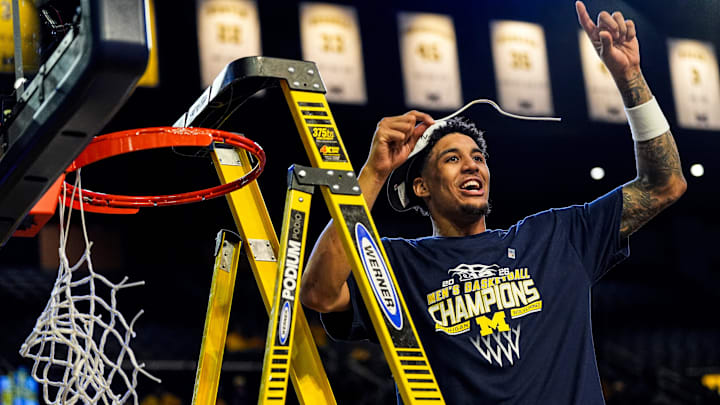
The road to March Madness runs through Chicago this week, and the Big Ten tournament could be one of the most unpredictable events of Championship Week.
Michigan enters as the regular-season champion and the clear team to beat, but the margin between the conference’s top contenders is razor thin. Michigan State, Nebraska and Illinois all finished near the top of the standings, while teams like Purdue, Wisconsin and UCLA are more than capable of catching fire for a deep run.
The Big Ten tournament includes all 18 teams following the conference’s expansion. That means every program from top-seeded Michigan to last-place Penn State will take the floor at the United Center with a chance to steal the conference’s automatic NCAA tournament bid.
The depth of the league has been obvious all season. The Big Ten finished with one of the toughest strength-of-schedule rankings in the country and multiple teams projected comfortably into the NCAA tournament field. But conference tournaments have a way of rewriting the script quickly.
Here is a full breakdown of the teams, stars and coaches that will shape the 2026 Big Ten tournament.
Michigan enters Chicago as the team to beat
Dusty May has turned Michigan into one of the best teams in the country in a very short amount of time.
The Wolverines finished the regular season 29-2 overall and 19-1 in Big Ten play, winning the conference title with an explosive offense and elite defense. Michigan averages 88.4 points per game while allowing just 68.7, one of the best scoring differentials in the nation.
Michigan’s roster has been balanced all year, but the interior presence of Aday Mara has made a huge difference. The 7-footer leads the conference with 2.6 blocks per game and anchors a defense that has protected the rim throughout the season.
The Wolverines will not play until Friday’s quarterfinals, which gives them a valuable rest advantage in a tournament where most teams must win multiple games in quick succession.
If Michigan plays to its level, the Wolverines will be extremely difficult to beat.
Michigan State, Nebraska and Illinois lead the chase
Three teams finished just behind Michigan and could easily end up winning the tournament in Chicago.
Michigan State finished the season 25-6 overall and 15-5 in conference play under longtime head coach Tom Izzo. The Spartans remain one of the most disciplined teams in the country and are led by elite point guard Jeremy Fears Jr., who leads the Big Ten with 9.1 assists per game.
Nebraska has been one of the biggest surprises in the conference this year. Fred Hoiberg’s Cornhuskers finished 26-5 overall and secured the No. 2 seed thanks to key tiebreakers. Nebraska has thrived with perimeter shooting, particularly from Pryce Sandfort, who leads the conference in three-pointers made per game.
Illinois also enters the tournament with championship expectations. Brad Underwood’s team averages 84.5 points per game and has one of the most explosive offenses in the Big Ten.
Any of these three programs could easily find themselves playing for the championship on Sunday.
Purdue, Wisconsin and UCLA remain dangerous tournament threats
The middle of the Big Ten bracket is filled with teams capable of creating chaos.
Purdue, which began the season ranked No. 1 in the country, slipped to the No. 7 seed after a few late-season losses but still possesses one of the conference’s most efficient offenses.
Wisconsin has leaned heavily on scoring guard Nick Boyd, who averages more than 20 points per game and has been one of the most reliable offensive players in the league.
UCLA, one of the conference’s newest members, finished the regular season with 21 wins and features one of the most dynamic point guards in the conference in Donovan Dent, who averages 7.5 assists per game.
These teams have the experience and talent to disrupt the bracket.
Star players capable of taking over the tournament
The Big Ten features several elite players who could dominate games throughout the week.
Northwestern forward Nick Martinelli leads the conference in scoring with 22.7 points per game and has been one of the most consistent offensive players in the country.
Indiana guard Lamar Wilkerson has also been outstanding offensively, averaging 21.0 points per game while leading one of the conference’s most dangerous backcourts.
Iowa guard Bennett Stirtz averages 20.5 points per game and has become one of the most difficult guards in the league to contain.
Wisconsin guard Nick Boyd and Ohio State star Bruce Thornton both average just over 20 points per game and have the ability to take over games offensively.
Purdue point guard Braden Smith continues to be one of the best playmakers in college basketball, averaging 8.7 assists per game while controlling the pace of the Boilermakers offense.
On the defensive side, Washington big man Hannes Steinbach leads the conference in rebounding with 11.6 per game, while Michigan center Aday Mara has been the league’s most dominant rim protector.
Those stars could ultimately decide who survives the chaos of this tournament.
The head coaches shaping the Big Ten race
Another fascinating element of the Big Ten tournament is the collection of elite coaches guiding these programs.
Michigan’s rise has been led by Dusty May, who has quickly transformed the Wolverines into a national contender with an aggressive offensive system.
Michigan State continues to be led by Tom Izzo, one of the most respected coaches in college basketball and a proven winner in March.
Illinois head coach Brad Underwood has built the Illini into one of the most explosive teams in the conference, while Nebraska’s Fred Hoiberg has engineered one of the best seasons in program history.
Purdue remains under the leadership of Matt Painter, whose teams are known for their discipline and offensive efficiency.
Wisconsin’s Greg Gard has maintained the Badgers’ identity of physical defense and strong perimeter shooting, while UCLA head coach Mick Cronin has brought his defensive toughness and postseason experience to the Big Ten.
With so many accomplished coaches in the field, strategy and adjustments could become a major factor throughout the week.
2026 Big Ten tournament schedule
All games will be played at the United Center in Chicago.
First round
Tuesday, March 10
No. 16 Oregon vs No. 17 Maryland — 5 p.m. (Peacock)
No. 15 Northwestern vs No. 18 Penn State — 7:30 p.m. (Peacock)
Second round
Wednesday, March 11
No. 9 Iowa vs Game 1 winner — noon (Peacock)
No. 12 Washington vs No. 13 USC — 2:30 p.m. (Peacock)
No. 10 Indiana vs Game 2 winner — 6:30 p.m. (BTN)
No. 11 Minnesota vs No. 14 Rutgers — 9 p.m. (BTN)
Third round
Thursday, March 12
No. 8 Ohio State vs Game 3 winner — noon (BTN)
No. 5 Wisconsin vs Game 4 winner — 2:30 p.m. (BTN)
No. 7 Purdue vs Game 5 winner — 6:30 p.m. (BTN)
No. 6 UCLA vs Game 6 winner — 9 p.m. (BTN)
Quarterfinals
Friday, March 13
No. 1 Michigan vs Game 7 winner — noon (BTN)
No. 4 Illinois vs Game 8 winner — 2:30 p.m. (BTN)
No. 2 Nebraska vs Game 9 winner — 6:30 p.m. (BTN)
No. 3 Michigan State vs Game 10 winner — 9 p.m. (BTN)
Semifinals
Saturday, March 14
Game 11 winner vs Game 12 winner — 1 p.m. (CBS)
Game 13 winner vs Game 14 winner — 3:30 p.m. (CBS)
Championship
Sunday, March 15
Big Ten championship game — 3:30 p.m. (CBS)
Why the Big Ten tournament could shape March Madness
The Big Ten tournament always produces drama, and this year’s edition feels especially unpredictable.
Michigan may be the favorite, but several teams have the talent to win the championship. Michigan State’s experience, Nebraska’s shooting, Purdue’s offense and Illinois’ scoring ability all add intrigue to the bracket.
By Sunday afternoon in Chicago, one team will cut down the nets and enter the NCAA tournament with momentum.
But if the regular season proved anything, it is that the Big Ten rarely follows a script in March.
 Add us as a preferred source on Google