

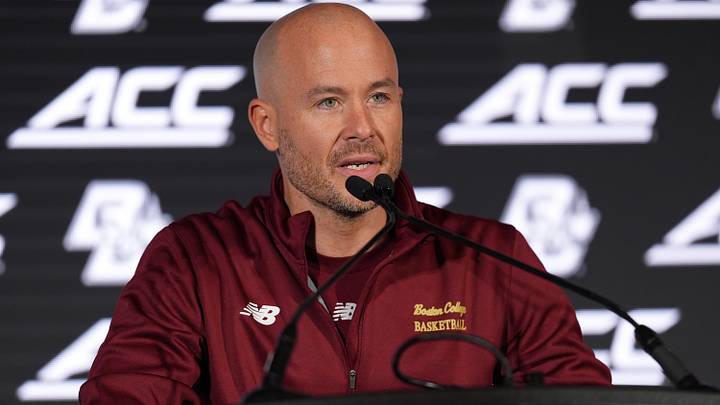
Luke Murray arrives at Boston College with one of the most impressive assistant coaching resumes in the country.
He helped UConn win consecutive national championships in 2023 and 2024, working alongside Dan Hurley as the Huskies established themselves among college basketball's elite programs. Murray developed a reputation for offensive creativity, recruiting and player development during his five seasons in Storrs.
Now he faces an entirely different assignment.
Boston College isn't attempting to defend a national championship. The Eagles are trying to become competitive in the ACC after another disappointing season.
The program finished 11-20 overall in 2025-26, including a 4-14 conference record.
Those numbers illustrate the size of the rebuilding project.
But one statistic might explain the challenge better than anything else.
Boston College shot just 29.4 percent from three-point range last season.
For a coach whose reputation was built partly around sophisticated offensive systems, that is an enormous problem to inherit.
Boston College's offensive numbers tell a difficult story
The Eagles averaged 67.4 points per game during the 2025-26 season.
They shot 40.8 percent from the field and made just 226 of their 769 three-point attempts.
That works out to a 29.4 percent conversion rate from beyond the arc.
The problems extended beyond perimeter accuracy.
Boston College averaged only 11.3 assists per game, a number that suggests the offense struggled to consistently create quality scoring opportunities.
Those statistics don't mean the Eagles lacked talented players. They do demonstrate that the team had difficulty generating the efficient possessions necessary to compete against stronger ACC opponents.
A struggling perimeter attack also creates problems elsewhere.
When opponents don't respect outside shooting, they can devote additional defenders to protecting the paint. Driving lanes become more difficult to find, interior players encounter more traffic and offensive possessions frequently end with contested attempts.
That creates a cycle in which every scoring opportunity becomes more difficult.
Murray's challenge is breaking that cycle.
Murray's UConn experience makes this a fascinating experiment
Boston College didn't hire Murray because he had already established himself as a successful Division I head coach.
This is his first opportunity to lead a program.
The Eagles hired him because of the work he performed as an assistant, particularly during UConn's championship seasons.
Murray was an important part of a coaching staff that emphasized movement, spacing and the ability to create advantages through coordinated offensive execution.
Those principles could be especially valuable at Boston College.
However, transferring an offensive system from one program to another isn't automatic.
UConn's championship teams possessed exceptional talent, experienced contributors and players who understood their responsibilities within the offense. Boston College must develop those qualities while competing in one of the country's most demanding conferences.
Murray also needs to establish how much of his previous approach fits the players available to him.
An offense becomes effective when the system matches the personnel.
That is the first major test of his coaching career.
The Eagles must improve without abandoning defense
Boston College's struggles weren't limited to shooting, but the defensive numbers provide a useful starting point.
Opponents averaged 70.7 points against the Eagles last season and shot 42.7 percent from the field.
Boston College also limited opponents to 31.8 percent from three-point range.
Those figures suggest the program wasn't completely incapable of competing defensively.
The more obvious problem was generating enough offense to take advantage of competitive defensive performances.
That distinction matters.
Murray doesn't necessarily need to transform Boston College into a team that plays at an extreme pace or attempts an extraordinary number of three-pointers.
He needs the Eagles to become more efficient.
Better spacing, stronger passing decisions and improved shot selection could produce meaningful progress even without a dramatic change in tempo.
The objective should be creating an offense that can consistently support the team's defensive effort.
If Boston College can accomplish that, close games become considerably more winnable.
The schedule won't give Murray much time to settle in
Boston College begins its new era with a home exhibition against MIT on October 25.
The Eagles then open the regular season against Wagner on November 3 before facing Massachusetts at TD Garden on November 6.
That matchup provides an early opportunity to generate excitement around the program.
The conference schedule presents a much more difficult challenge.
Boston College opens ACC competition against North Carolina on January 2. Clemson visits three days later, and Duke arrives at Conte Forum on January 16.
That is an unforgiving opening stretch for a team attempting to establish a new identity.
The Eagles must develop offensive chemistry during November and December because the ACC schedule won't provide many opportunities to experiment without consequences.
Murray's first conference games could quickly reveal how much progress Boston College has made.
They could also expose the areas that still require substantial improvement.
The coaching staff brings experience that should help
Murray won't be attempting this transformation alone.
Boston College assembled a staff that includes Tim O'Toole as chief of staff and assistants Kyle Griffin, Mathew Johnson and Brenden Straughn.
O'Toole brings extensive Division I experience, including time at Pittsburgh and several other major programs.
That experience could prove valuable for a first-time head coach attempting to manage the demands of ACC competition.
Murray must oversee recruiting, player development, game preparation and the daily responsibilities associated with leading an entire program.
The ability to delegate effectively will be important.
His previous experience working under successful head coaches should provide a foundation, but the final decisions now belong to him.
Boston College doesn't need a miracle to show progress
The Eagles haven't reached the NCAA Tournament since 2009.
That drought creates understandable frustration for a program that once competed regularly in March Madness.
However, expecting Murray to immediately transform Boston College into a tournament contender would be unrealistic.
The more useful question is whether the Eagles can establish an offensive identity that produces measurable improvement.
Can they shoot better than 29.4 percent from three-point range?
Can they create more than 11.3 assists per game?
Can they become more efficient without sacrificing the defensive qualities that occasionally kept them competitive?
Those questions will provide meaningful ways to evaluate Murray's first season.
The UConn championship experience makes him an intriguing hire.
But his success at Boston College will ultimately be determined by what happens on the floor in Chestnut Hill.
And the most important transformation might begin with something as simple as making more open shots.
 Add us as a preferred source on Google