

Now that the holidays are in the rearview mirror, it’s time to look ahead to the meat of the college basketball season. From a bracketology standpoint, the conference play is arguably the most exciting part of the regular season, where, especially with power conferences, there are resume implications every night. Now we get to see whose non-conference performances were the real thing and which were a mirage.
There are about two and a half months until Selection Sunday, and while that seems like a long time, it will almost certainly fly by. Smaller conferences have jumped right into conference play this week, and the positioning battle for their conference tournaments has begun. For these conferences, league play is even more important because, except in extreme cases, there is only one tournament bid available. Let’s take a look at the first bracket of 2026.
Midwest Region (Chicago)
Buffalo
1.) Michigan vs. 16.) Colgate
8.) Seton Hall vs. 9.) SMU
Oklahoma City
5.) Kansas vs. 12.) Tulsa
4.) Illinois vs. 13.) UC-San Diego
Tampa
6.) Iowa vs. 11.) California/Boise State
3.) Alabama vs. 14.) High Point
St. Louis
7.) Auburn vs. 10.) Ohio State
2.) Iowa State vs. 15.) Vermont
The No. 1 seed in the Midwest region remains the Michigan Wolverines. Dusty May’s squad moved to 13-0 after defeating USC on Saturday. The Wolverines are a top-3 team in every metric, and their margin of victory has been nothing short of impressive. Of the 13 wins, only two have been by fewer than 15 points. A team to watch in this region is the No. 5 seed Kansas. The Jayhawks have slipped to the No. 5 seed after falling at UCF on Saturday, with only one half of play from star freshman Darryn Peterson, who is slowly coming back from injury. Peterson had only played in four games before Saturday’s action. If the Jayhawks can get healthy, they become even more dangerous.
West Region (San Jose)
San Diego
1.) Mary vs. 16.) Grambling/Howard
8.) Miami vs. 9.) UCLA
Philadelphia
5.) Tennessee vs. 12.) Illinois State
4.) Texas Tech vs. 13.) William & Mary
Oklahoma City
6.) Florida vs. 11.) St. Louis
3.) Nebraska vs. 14.) St. Thomas
Portland
7.) Kentucky vs. 10.) Utah State
2.) Gonzaga vs. 15.) Montana State
Like the Midwest, the top seed in the West remains the same, with the Arizona Wildcats holding down the top spot. The Wildcats also have strong metrics, and their road win over UConn is one of the strongest wins of anyone this season. The biggest reason the Wildcats haven’t caught Michigan for the top overall seed is the seven quad 4 wins on their resume. The West Region has a couple of somewhat surprising disappointments this season as its No. 6 and No. 7 seeds. Defending champ Florida fell to 9-5 after losing at Missouri on Saturday, and No. 7 Kentucky’s defense struggled at Alabama, leaving them with more questions and the same 9-5 mark.
East Region (Washington, D.C.)
Philadelphia
1.) UConn vs. 16.) Tenn.-Martin/Long Island
8.) Georgia vs. 9.) NC State
San Diego
5.) Louisville vs. 12.) McNeese State
4.) Houston vs. 13.) Utah Valley
Buffalo
6.) Villanova vs. 11.) Yale
3.) Michigan State vs. 14.) Lipscomb
Greenville
7.) Virginia vs. 10.) St. John's
2.) Vanderbilt vs. 15.) East Tennessee State
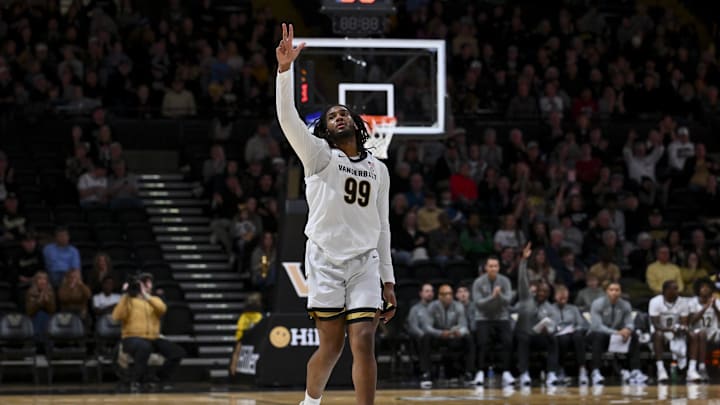
Speaking of UConn, the Huskies are the top seed in the East Region and enter Sunday’s game with Marquette on a nine-game winning streak. They have four quad 1A wins, giving them a resume metric average of 3.3, which, along with a top-10 strength of schedule, gives UConn a resume worthy of being on the top line. In the East, how can we not talk about three surprising starts? No. 6 Villanova is off to a 12-2 start and No. 7 Virginia is playing a more up-tempo style under Ryan Odom and the Cavaliers are off to a 12-2 start. But, one of the biggest surprises in the country is No. 2 Vanderbilt, which is undefeated at 14-0 with one of the best offenses in the country, averaging 93 points per game with five players scoring double figures.
South Region (Houston)
Greenville
1.) Duke vs. 16.) Troy
8.) Clemson vs. 9.) UCF
Tampa
5.) North Carolina vs. 12.) Akron
4.) Arkansas vs. 13.) Middle Tennessee State
Portland
6.) USC vs. 11.) Oklahoma/Butler
3.) BYU vs. 14.) Wright State
St. Louis
7.) Saint Mary's vs. 10.) LSU
2.) Purdue vs. 15.) Quinnipiac
The top seed in the South region is the Duke Blue Devils, who have begun ACC play 2-0 after beating Florida State on Saturday, before a huge game at Louisville on Tuesday. Even though Duke has wins over Michigan State, Kansas, Florida, and Arkansas, even with an improved ACC, the question remains whether Duke’s resume can hold off teams behind them, such as Iowa State, Purdue, and Gonzaga. Keep an eye on the No. 7 seed in the South Region, the Saint Mary’s Gaels. Randy Bennett’s trademark defense will keep the Gaels in any game, and with a 14-2 record and only allowing over 70 points 5 times, it looks like the WCC matchups between the Gaels and Gonzaga will be must-see TV one final time.
The Bubble
Last four in
In what seems to be a rarity these days, in this edition of the bracket, the last four teams in the field represent four different conferences. In one game, Oklahoma does battle with the Butler Bulldogs for the chance to move on in the South Region to face No. 6 USC. The other game in Dayton has California taking on a Boise State team that suffered a triple OT heartbreaker at San Diego State on Saturday. The winner gets to do battle with No. 6 Iowa in the Midwest.
On the outside looking in
The first four teams out of the field include Oklahoma State and Stanford, a couple of teams off to strong starts. The Cardinal picked up a huge home win over Louisville on Saturday to climb closer to inclusion. The other two teams that just missed are Baylor and Indiana. Baylor opened up a powder keg this week by adding former NBA draft pick James Nnaji to its roster. Speaking of the Big 12, two teams from that conference, TCU and Kansas State are among the next four teams out of the field. Rounding out this group are the Indiana Hoosiers and VCU out of the Atlantic 10, whose four losses have been to the Mountain West’s Utah State, New Mexico, and top-25 teams Vanderbilt and NC State.
 Add us as a preferred source on Google