

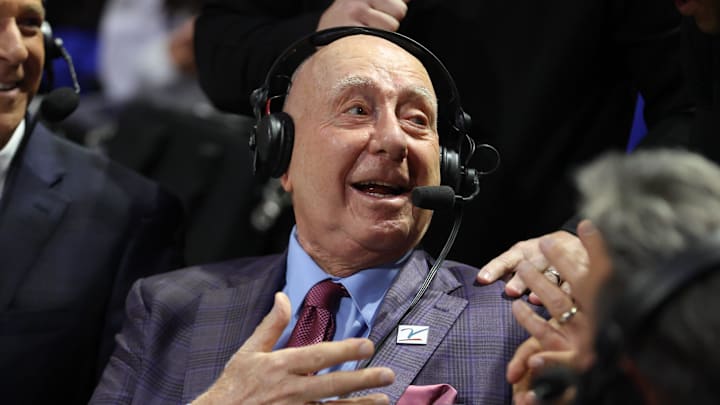
It only took one tweet to spark a conversation that feels much bigger than the moment itself. A fake post about Braylon Mullins being tied to an NIL “auction” began circulating online, and before long it reached Dick Vitale. His reaction came quickly and emotionally, calling out the state of college basketball and the chaos surrounding NIL. Except the post wasn’t real, and somehow that almost wasn’t the point.
This is college - sickening @NCAA must do something about the CHAOS GOING ON - how in the world can they write all about student - athletes in their NCAA manual - that is JOKE - put some rules together to end this wild Wild West
— Dick Vitale (@DickieV) April 13, 2026
How the moment went viral so quickly
The way this unfolded says a lot about the current landscape. The original account behind the viral post openly identifies itself as satire, but that detail didn’t travel nearly as fast as the headline idea. The concept spread first, and the context followed later. Vitale saw something that looked like another example of the sport pushing too far and responded the way he always has, with passion and urgency. It’s easy to focus on the mistake, but it’s just as important to understand why it happened.
The truth is, the scenario didn’t feel impossible. That’s what made it stick. If something like this surfaced even a few years ago, it likely would have been dismissed immediately. Now, it blends into the noise of everything else happening in college basketball. Player movement is constant, NIL deals are influencing decisions, and entire rosters are being reshaped in a matter of weeks. The structure that once defined the sport has shifted, and the boundaries are no longer as clear as they used to be.
Why Braylon Mullins was part of the conversation
That context matters when you look at why Mullins was even part of the conversation. His NCAA Tournament run with UConn Huskies men's basketball elevated his profile in a significant way. March has always been about moments, but now those moments carry financial implications as well. Players who perform on that stage don’t just build reputations, they build value. Even though the post itself wasn’t real, the attention surrounding Mullins absolutely is.
What makes this story resonate is that it isn’t really about one person getting fooled. It reflects how complicated the sport has become in real time. There’s more information, more movement, and more noise than ever before. Even experienced voices are reacting as things happen, trying to process a constantly evolving system. In that kind of environment, mistakes are going to happen, especially when something looks believable on the surface.
The bigger issue facing college basketball
College basketball is in a transitional phase where opportunity and uncertainty exist side by side. Players have more freedom than ever, but the framework around that freedom still feels unsettled. Without clear lines, it becomes harder to separate what’s real from what only sounds real. That’s how a situation like this gains traction so quickly and why it resonates with so many people.
In the end, this moment says more about the sport than it does about any individual. It highlights how quickly narratives can form, how easily perception can shift, and how thin the line has become between reality and exaggeration. Until there is more structure and clarity, moments like this will continue to surface, not because people aren’t paying attention, but because the game itself is still trying to figure out what it looks like in this new era.
 Add us as a preferred source on Google