

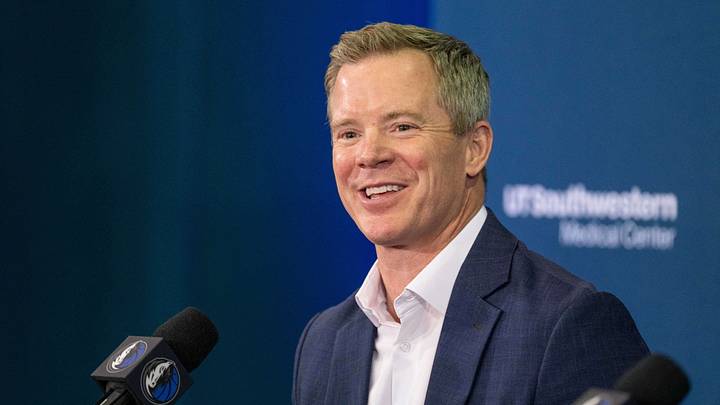
There was no bigger winner in college basketball last season than Dusty May.
May led Michigan to a national championship in only his second season in Ann Arbor. He developed three eventual NBA lottery picks, built a sustainable contender and positioned the Wolverines to chase another title in 2026-27.
Then he walked away.
It would be easy to explain May’s departure by pointing to the Dallas Mavericks, Cooper Flagg and his long-standing desire to coach in the NBA. Those were undeniably significant factors. But May’s revealing explanation also exposed a much larger problem for college basketball.
The sport is making it increasingly difficult for its best coaches to actually coach.
Dusty May reached his breaking point before Dallas called
In an extensive interview with CJ Moore of The Athletic, May said he expected to coach Michigan during the upcoming season when he attended the Big Ten’s spring meetings.
He arrived hoping the coaches and conference leaders could identify solutions to some of the sport’s biggest problems. Instead, May left convinced that meaningful change was not coming.
“Oh my God, nothing’s getting fixed. Ever,” May told The Athletic.
That frustration provided the backdrop when Mavericks general manager Mike Schmitz called May on May 24. The conversation began as an attempt to gather information about Michigan’s three NBA Draft prospects, but Schmitz eventually asked whether May had any interest in coaching Dallas.
The timing could not have been more consequential.
May had just left a meeting in which college basketball’s leaders were still discussing transfer-portal problems and other changes that he viewed as irreversible. Dallas was offering him a chance to coach a roster built around Flagg while working with respected executives Masai Ujiri and Schmitz.
For May, the decision was not simply college basketball versus the NBA. It was a job increasingly dominated by fundraising, roster negotiations and administrative responsibilities versus one that allowed him to concentrate more heavily on basketball.
“I just spent so much more of my time doing everything but coaching,” May said.
That should concern everyone invested in the college game.
Michigan could offer May almost everything except stability
Michigan did not lose May because it lacked money, resources or ambition.
When May informed school officials that he was considering the Mavericks’ offer, Michigan asked what it could do to keep him. His answer was telling.
“I don’t think there is anything,” May recalled telling the university.
That is the real warning contained in his departure.
Michigan is one of the biggest brands in college athletics. May had already assembled a championship team there, and he believed the program was becoming easier to operate as its success began selling itself to recruits. The Wolverines also retained nearly all of their committed players after Mike Boynton took over, with backup guard LJ Cason being the lone exception noted by The Athletic.
Yet even a program with Michigan’s resources could not protect May from the exhausting uncertainty surrounding modern roster construction.
May pointed to the lack of binding agreements as one of the sport’s biggest flaws. Players can sign revenue-sharing or NIL contracts and still explore better opportunities elsewhere. Coaches are expected to recruit high school prospects, evaluate the portal, retain their current roster, raise money and then repeat the entire process whenever circumstances change.
May did not object to players making money or exercising greater control over their careers. In fact, his success came partly because he adapted better than almost anyone. He built Michigan’s championship roster around Morez Johnson Jr., Yaxel Lendeborg and Aday Mara, three post players acquired through the portal who were all selected among the first 12 picks of the NBA Draft.
The issue is not movement itself. It is a system with few dependable rules.
May believes some form of collective bargaining and binding contracts are necessary. Whether those exact solutions are legally possible remains uncertain, but his broader point is difficult to dispute: College basketball cannot keep operating as though constant chaos is a sustainable business model.
College basketball cannot afford to ignore May’s warning
May’s move is unusual. He became the first coach since Larry Brown in 1988 to win a national championship and coach a different team the following season.
But it may not remain unusual for long.
Successful college coaches once treated the NBA as an enormous gamble. Now, the professional game can also offer something college basketball increasingly cannot: clearly defined contracts, established personnel departments and more time to coach the players already on the roster.
Dallas presented May with a rare combination of talent, trust and opportunity. He may have accepted the position regardless of college basketball’s problems.
Still, the sport should not dismiss the reasons he was willing to listen.
May reached the top of college basketball and discovered that winning did not free him from the dysfunction. If anything, it gave him more responsibilities and made his roster more expensive to maintain.
Michigan lost a championship coach just as his program appeared ready to become a lasting national power. The Wolverines survived the transition, but college basketball should not assume every program will be so fortunate.
May’s departure was a tremendous opportunity for the Mavericks. For the college game, it was a warning shot.
 Add us as a preferred source on Google