

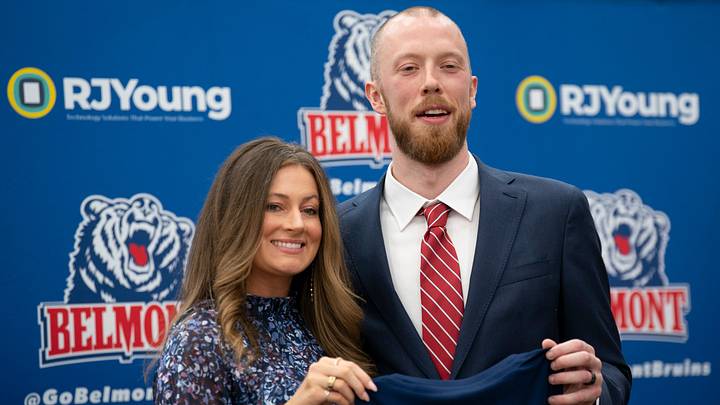
College basketball has welcomed several intriguing first-year head coaches entering the 2026-27 season, but Evan Bradds brings one of the most unusual backgrounds in the sport. At just 32 years old, Belmont's new head coach has already worked for two NBA franchises, served on the coaching staff of one of college basketball's most recognizable programs and developed relationships with some of basketball's most accomplished coaches. His career path would be impressive for someone considerably older, making his return to Belmont especially fascinating. Now Bradds must translate that experience into success as a Division I head coach.
Belmont officially hired Bradds on March 19, making him the 11th head coach in program history. The appointment also represented a homecoming for one of the most accomplished players ever to wear a Bruins uniform. Bradds starred at Belmont from 2013 through 2017, establishing himself as an exceptional offensive player while helping the program capture multiple conference championships. Nearly a decade after completing his playing career, he returns with the responsibility of maintaining one of college basketball's most consistent winning traditions.
His playing career was remarkable
Before beginning his coaching career, Bradds established himself as one of the most efficient scorers in college basketball history. The 6-foot-7 forward scored 1,921 career points, establishing Belmont's NCAA Division I era scoring record while helping the Bruins win 91 games during his four seasons. He earned consecutive Ohio Valley Conference Player of the Year awards in 2016 and 2017 and received Associated Press honorable mention All-America recognition twice. Those accomplishments made him one of the most decorated players in program history.
His shooting efficiency was particularly impressive. Bradds led the nation in field goal percentage during his sophomore and junior seasons, shooting 68.8 percent and 71.4 percent, respectively. He finished his college career with a remarkable 66.7 percent field goal percentage, an extraordinary accomplishment for a player who carried significant offensive responsibilities. His ability to score efficiently reflected an understanding of positioning, timing and decision-making that would later influence his coaching career.
Bradds also experienced memorable team success under legendary Belmont coach Rick Byrd. The Bruins captured four conference championships during his playing career and reached the 2015 NCAA Tournament, where they nearly upset second-seeded Virginia. Belmont also recorded notable victories against programs such as North Carolina, Georgia and Marquette during Bradds' tenure. Those experiences helped establish his connection to a program that has consistently competed successfully against larger opponents.
His NBA coaching experience began almost immediately
Bradds didn't spend years away from basketball before beginning his coaching career. After graduating from Belmont in 2017, he entered the professional coaching world and eventually spent five seasons working within the Boston Celtics organization. His responsibilities included video analysis and player development, providing exposure to the preparation and evaluation processes used by an NBA franchise. Working alongside experienced coaches also allowed him to develop a broader understanding of how professional organizations approach individual improvement.
His time in Boston included opportunities to work around coaches such as Brad Stevens, Joe Mazzulla and Ime Udoka. Bradds also gained experience working with established NBA players, including involvement in specialized development programs for Grant Williams and Gordon Hayward. Those assignments required attention to detail and the ability to communicate effectively with athletes competing at basketball's highest professional level. For a young coach beginning his career, the experience provided an unusual educational foundation.
Bradds subsequently joined the Utah Jazz, spending three seasons as an assistant coach after being hired by Will Hardy. His responsibilities included overseeing player development and working with young NBA contributors as they adjusted to professional competition. He also served as head coach of Utah's NBA Summer League team in 2023, providing valuable experience managing players and making decisions from the bench. That opportunity offered a glimpse of the leadership responsibilities he would eventually assume at Belmont.
Duke provided another important step
Bradds joined Jon Scheyer's coaching staff at Duke for the 2025-26 season, adding major-conference college basketball experience to his professional résumé. His responsibilities included offensive coordination, scouting reports, game planning and designing plays for specific situations. Those assignments placed him in an important strategic role for a program competing for ACC championships and national recognition. Working at Duke also introduced him to the recruiting and roster-management challenges that differ considerably from the professional basketball environment.
The experience helped prepare Bradds for his eventual return to college head coaching. At Duke, he worked within a program facing enormous expectations while competing against some of the country's most talented teams. His responsibilities required detailed preparation and the ability to help players execute under pressure. Those lessons should prove valuable as he attempts to establish his own approach at Belmont, where winning has become an expectation rather than an occasional accomplishment.
Belmont's winning tradition creates immediate expectations
Bradds inherits a program that has experienced remarkable consistency over the past two decades. Belmont has recorded at least 20 victories in 16 consecutive seasons, establishing itself as one of the country's most dependable mid-major programs. The Bruins also captured the 2026 Missouri Valley Conference regular-season championship under Casey Alexander, who subsequently accepted the head coaching position at Kansas State. Maintaining that standard will be a significant challenge for a first-year head coach, regardless of his previous experience.
Belmont's coaching history also makes Bradds' appointment unusual. He becomes only the third person to lead the program over approximately four decades, following Byrd and Alexander. Both predecessors established successful offensive systems while developing players who helped Belmont compete consistently against strong competition. Bradds must preserve the program's established identity while introducing ideas developed during his years in professional basketball and at Duke.
Fortunately, he won't have to navigate that challenge without experienced assistance. Belmont retained longtime associate head coach Brian Ayers, who previously coached Bradds during his playing career and enters his 29th season with the program. The Bruins also added Brendan Mullins as an associate head coach, providing another experienced voice familiar with Missouri Valley Conference basketball. That combination gives Bradds a staff capable of helping him manage the responsibilities associated with his first head coaching position.
Duke already provided an early reality check
Bradds received an immediate reminder of the challenge awaiting him when Belmont visited Duke for an October 8 exhibition. The Blue Devils earned a 102-62 victory, demonstrating the considerable difference between a nationally prominent program and a Bruins team adjusting to a new coaching staff. Belmont entered the exhibition with nine newcomers, creating additional challenges involving chemistry and execution. The result provided Bradds with valuable information about his roster before the regular season begins.
The exhibition also carried personal significance because Bradds had worked on Scheyer's staff the previous season. Returning to Cameron Indoor Stadium as an opposing head coach represented another milestone in his rapid coaching progression. Although the 40-point defeat was disappointing, exhibition games provide opportunities to identify weaknesses without affecting regular-season standings. Bradds can use that experience to evaluate his team's development and determine which adjustments are necessary before Missouri Valley Conference competition begins.
Can Bradds build on what his predecessors created?
Belmont doesn't need Bradds to completely reinvent its basketball program. The Bruins already possess an established winning tradition, experienced institutional leadership and a reputation for developing efficient offensive teams. His challenge involves preserving those strengths while adapting to the realities of modern college basketball, including increased roster movement and financial competition. The transition from assistant coach to head coach will also require him to make difficult decisions that previously belonged to someone else.
However, few coaches his age can match the diversity of Bradds' experience. He has competed at a high level as a college player, worked with NBA organizations and contributed to the preparation of one of college basketball's most prominent programs. Those experiences don't guarantee success, but they provide an unusually broad foundation for someone beginning his first season as a head coach. If Bradds successfully combines those lessons with Belmont's established culture, his return could become one of the most interesting coaching stories in college basketball.
 Add us as a preferred source on Google