

Illinois isn't particularly difficult to understand.
If David Mirkovic is healthy, the Illini should be very good. They return five rotation players from a Final Four team, have extraordinary size and enter the season with one of the country's strongest rosters.
Michigan State isn't especially mysterious, either.
Jeremy Fears Jr. gives Tom Izzo an elite point guard, and the Spartans have enough returning pieces around him to establish a relatively high floor.
The middle of the Big Ten is different.
Several teams possess enough talent to finish near the top of the league while carrying enough roster questions to end up much closer to the NCAA Tournament bubble. Injuries, transfers, expanded roles and chemistry will determine enormous portions of the conference race.
These five teams may have the widest range of outcomes.
1. Michigan
How often does a defending national champion enter the next season as one of its conference's biggest wildcards?
That's where Michigan finds itself.
The Wolverines went 37-3 last season, won the Big Ten with a remarkable 19-1 conference record and defeated UConn to claim the national championship. That establishes an enormous standard for what Dusty May's program has become.
Then September complicated everything.
McCoy suffered a torn ACL during Michigan's European tour and will miss the entire season. The five-star freshman was expected to become an important part of Michigan's backcourt immediately.
Gayle's successful eligibility case helped enormously. Michigan officially lists him as a fifth-year player, restoring an experienced member of the championship rotation. Cadeau, McKenney, Moustapha Thiam, Jalen Reed and J.P. Estrella give May additional pieces capable of keeping Michigan nationally relevant.
The best-case outcome is another Big Ten championship challenge and Final Four run.
The downside is that McCoy's absence proves too significant, the perimeter rotation loses some of last season's explosiveness and Michigan becomes merely a good NCAA Tournament team.
That's an enormous range for the defending champion.
2. Purdue
Purdue might be the most fascinating roster-construction experiment in the conference.
Painter no longer has the veteran star-driven group that defined recent Purdue teams. Instead, he's building around players such as Cox, Harris, Jacobsen, Pierce, Omer Mayer and several younger pieces.
There's plenty to like.
Pierce brings a former Ivy League Player of the Year résumé and showed his all-around ability during Purdue's exhibition trip. Jacobsen's 7-foot-4 size creates obvious defensive possibilities, and his summer production suggested he may be ready for substantially more responsibility.
The uncertainty comes from hierarchy.
Who becomes Purdue's late-game scorer? Which guard consistently creates advantages? How quickly does the new frontcourt fit together?
If Painter finds those answers, Purdue could finish near the top of the Big Ten again.
If he doesn't, this could become more of a developmental season than Purdue fans have grown accustomed to.
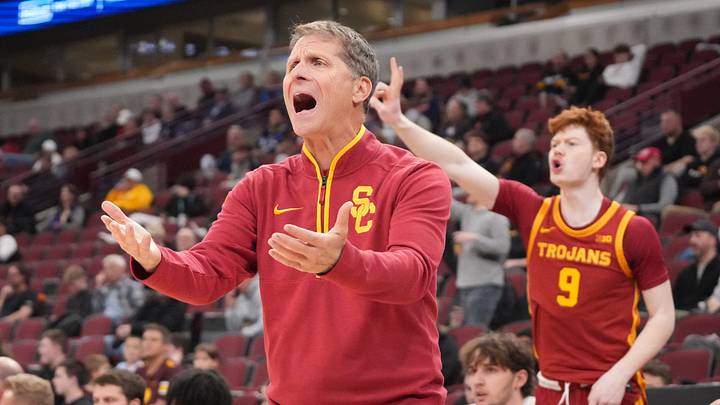
3. USC
USC's upside is easy to understand because preseason evaluators consistently view the Trojans as one of the Big Ten's better teams.
The difficult part is determining exactly how high the ceiling goes.
The league's West Coast transition is no longer new, but the logistical demands remain real. USC will face physical Midwest opponents, long trips and dramatically different playing styles throughout the conference schedule.
Talent can solve plenty of those problems.
Consistency solves the rest.
If USC establishes a dependable defense and handles the league's travel demands, the Trojans could push into the top four and earn an excellent NCAA Tournament seed.
If their performance fluctuates from week to week, the conference is too deep to forgive it. USC could be good and still finish in the middle of the standings.
4. Indiana
Indiana always generates attention because the program's history makes indifference nearly impossible.
This season's uncertainty is basketball-specific rather than historical.
The Hoosiers have enough talent to make the NCAA Tournament and challenge the Big Ten's better teams. What they need is a clear identity capable of surviving difficult stretches.
Conference games eventually become scouting-report battles. Opponents know every action, every preferred matchup and every defensive tendency. Teams without a dependable late-clock creator or defensive foundation become increasingly vulnerable.
Indiana's best-case scenario involves establishing those answers early and turning talent into an upper-half Big Ten finish.
The alternative is another season spent around the bubble while searching for consistency.
5. Wisconsin
Losing Blackwell to Duke changes Wisconsin significantly.
Blackwell wasn't simply the Badgers' leading scorer. He averaged 18.3 points, 4.8 rebounds, 2.3 assists and 1.2 steals while earning third-team All-Big Ten honors. He also gave Wisconsin a dependable player who could create offense when possessions broke down.
That's difficult to replace.
The reason Wisconsin belongs on this list rather than simply being projected near the bottom is program stability. The Badgers understand how they want to play, historically protect home court and rarely require a roster filled with elite recruits to become competitive.
Somebody has to become the new offensive centerpiece.
If that happens quickly, Wisconsin could once again become an NCAA Tournament team that nobody particularly enjoys playing.
If it doesn't, the Badgers could spend much of the season trying to manufacture offense against one of the country's deepest conferences.
The Big Ten middle could decide everything
Conference championships aren't determined only by what happens when Illinois plays Michigan State or Michigan.
They're also determined on Tuesday nights when contenders travel to Purdue, Wisconsin, Indiana or USC and discover that the team sitting sixth or ninth in the standings is considerably better than its record suggests.
That's why the Big Ten's uncertainty matters.
Michigan could remain a national championship contender despite losing McCoy. Purdue could develop rapidly under Painter. USC could become one of the league's best teams, while Indiana and Wisconsin have enough upside to significantly outperform cautious preseason expectations.
Some of those outcomes will happen.
Others won't.
Figuring out which is one of the most interesting parts of the 2026-27 Big Ten season.
 Add us as a preferred source on Google