

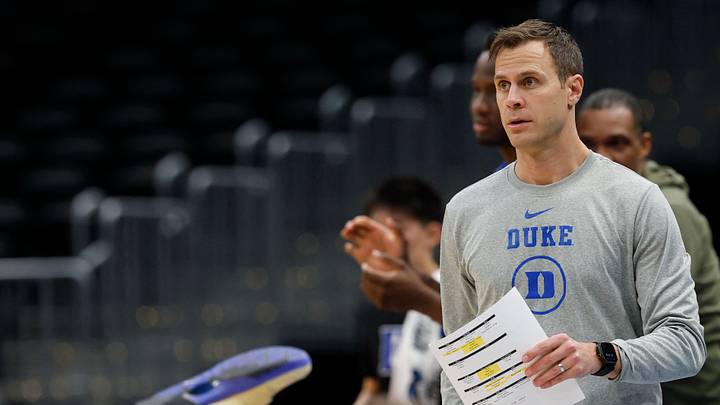
Duke has made winning the ACC look easier than it actually is.
The Blue Devils have controlled the conference over the last two seasons, but the collection of challengers entering 2026-27 is considerably more interesting. Louisville has loaded its roster with proven high-major players. Virginia returns the foundation of a 30-win team. Miami possesses one of the league's best young backcourts, while North Carolina begins the Michael Malone era with an almost entirely reconstructed roster.
The conference also has dangerous teams beyond that group, including Clemson, NC State, SMU and Pitt.
Duke remains the favorite.
These five questions will help determine whether anyone can catch the Blue Devils.
1. Does Duke simply have too many answers?
Start with Blackwell.
The Wisconsin transfer averaged 18.3 points last season and gives Duke an experienced scorer who has already spent three years playing high-major basketball. Foster returns for his senior season, Ngongba provides an experienced center and Sarr and Boozer enter their sophomore seasons.
That's before getting to the freshmen.
Rippey gives Duke another elite guard prospect. Williams is a 7-foot forward with enormous upside, while Boumtje Boumtje provides another 7-foot-2 option in the frontcourt.
The important part is that Scheyer doesn't need all of those freshmen to become stars immediately. Duke's veterans can carry the team while the younger players develop.
If two or three freshmen become major contributors anyway, Duke may simply have more quality options than anyone else in the conference.
2. Can Louisville turn its transfer haul into chemistry?
The Cardinals' roster looks spectacular on paper.
Bidunga provides elite interior defense. Shelstad gives Louisville an experienced point guard. Trimble has played four seasons of ACC basketball at North Carolina, while Knox, Folgueiras, Wooley and Montgomery give Kelsey even more proven college production.
That's the good news.
The challenge is that Louisville has to turn all those individual résumés into a coherent basketball team.
Touches have to be distributed. Roles have to become clear. Players who were important offensive options elsewhere may have to accept smaller responsibilities. Defensive communication has to develop.
If that process happens quickly, Louisville can win the ACC and become a Final Four threat.
If it takes several months, Duke and Virginia may create separation before Louisville completely figures itself out.
3. Is Virginia's continuity the conference's greatest advantage?
Virginia has something increasingly rare in college basketball.
Its best players already know each other.
De Ridder, Grünloh, Lewis and Mallory return from a team that won 30 games. De Ridder was first-team All-ACC, Grünloh blocked 80 shots, Lewis provided shooting and size on the perimeter and Mallory handled significant playmaking responsibilities.
Odom didn't have to rebuild the foundation. He was able to supplement it.
Harmon and Dixon provide additional experience without forcing Virginia to redefine everything that made last season successful.
That matters in November, but it could matter even more in January when conference games become possession-by-possession battles. Louisville and North Carolina may have more newcomers with impressive individual résumés.
Virginia has players who already know exactly how to win together.
4. Can Acaden Lewis and Shelton Henderson push Miami into the championship tier?
Miami doesn't lack talent.
The question is whether Lewis and Henderson are ready to become one of the ACC's best perimeter combinations.
Lewis averaged 5.3 assists and 1.9 steals as a Villanova freshman and now takes control of the Hurricanes' offense. Henderson already averaged 13.8 points and 4.9 rebounds during his first season at Miami.
Their skill sets complement each other.
Lewis can organize the offense and create opportunities. Henderson can use his 6-foot-6, 240-pound frame to attack mismatches and pressure defenses physically.
Cyril gives Miami another presence around the basket, while Gaskins adds additional young talent.
If Lewis becomes an elite ACC point guard and Henderson takes the expected sophomore jump, Miami can move from interesting contender to legitimate championship threat.
5. How quickly can Michael Malone solve North Carolina's enormous chemistry puzzle?
North Carolina's roster almost demands patience.
Only five players return from last season, while 11 newcomers enter Malone's first year in Chapel Hill. That means UNC isn't simply learning a new coach's system. Most of the roster is learning one another at the same time.
Avdalas may become the most important piece because his 6-foot-9 frame and playmaking ability give Malone unusual flexibility. Stevenson provides valuable continuity, while Brown, Able, Adams, Samodurov and the rest of the newcomers give North Carolina a variety of lineup possibilities.
The talent isn't the concern.
Time is.
Duke and Virginia begin the season with important players who already understand their systems and teammates. North Carolina may still be discovering its best combinations when ACC play begins.
If Malone accelerates that process, UNC could become one of the league's most dangerous teams by February.
If it takes longer, the Tar Heels may surrender too much ground early to realistically win the regular-season title.
Duke is still first, but the chase is legitimate
Duke enters the season with the fewest obvious questions.
That's why the Blue Devils remain No. 1.
Louisville may have the roster most capable of matching Duke's talent. Virginia may have the conference's greatest continuity advantage. Miami has an exciting young core, while North Carolina could improve dramatically as Malone's first season develops.
The ACC doesn't need Duke to regress to produce a great championship race.
It needs the teams chasing the Blue Devils to become as good as their rosters suggest they can be.
This season, several of them have a legitimate chance.
 Add us as a preferred source on Google