

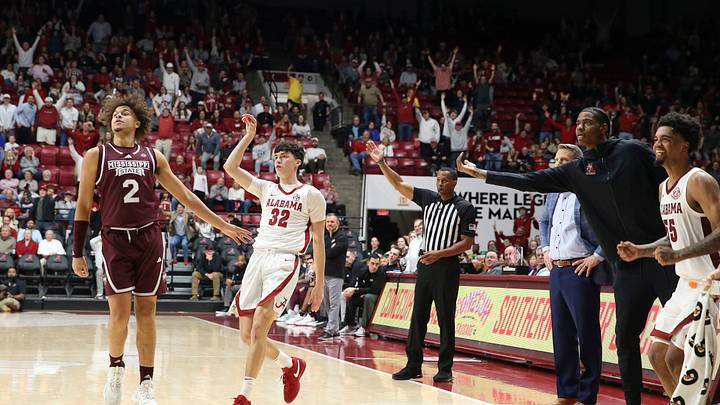
The former Crimson Tide walk-on was incorrectly identified in reporting connected to the fatal 2023 shooting that killed Jamea Harris.
Former Alabama basketball player Kai Spears spent years trying to clear his name after an inaccurate report linked him to the scene of a fatal shooting. An Alabama jury has now delivered a powerful verdict in his favor.
An eight-person jury awarded Spears $9.25 million in damages Thursday after finding that The New York Times defamed him, according to reports from CBS Sports and The Guardian.
The case centered on a March 2023 article that incorrectly reported Spears was a passenger in a vehicle present at the January 2023 shooting that killed Jamea Harris, a 23-year-old mother.
Spears repeatedly denied being at the scene. It was later determined that an Alabama team manager, not Spears, had been in the vehicle. That team manager was not implicated in or charged in connection with the shooting.
Kai Spears immediately challenged the inaccurate report
Spears did not stay silent when the story was initially published.
“The report in the New York Times was 100% inaccurate and the writer had complete disregard for the truth,” Spears said in a 2023 statement, via CBS Sports.
Spears also expressed his heartbreak over Harris’ death while attempting to separate himself from a tragedy with which he had been wrongly associated.
The Times added an editor’s note and corrected its original story shortly after Spears filed his lawsuit on May 30, 2023. By that point, however, his name had already been circulated nationally in connection with one of the darkest moments in Alabama basketball history.
Spears’ lawsuit argued that the inaccurate report caused him emotional distress and permanently linked his name to a murder. Following a nine-day trial, the jury agreed that the damage warranted a substantial financial award.
The Times said in a statement that it was disappointed by the decision and described the original report as an “honest mistake.” The newspaper also said it was reviewing its legal options.
The verdict carries significance well beyond basketball
Spears arrived at Alabama as a walk-on and was never one of the most recognizable players on Nate Oats’ roster. That did not make the effect of the report any less serious.
College athletes live increasingly public lives. Their names, photographs and personal information can travel across the internet within minutes, especially when attached to a nationally relevant program such as Alabama. A correction can repair the public record, but it cannot guarantee that every reader who saw the original claim will also see the correction.
That reality is what makes this case so important. The damage was not about statistics, playing time or how Spears’ career developed on the court. It was about a young athlete having his identity connected to a fatal incident despite not being present.
Spears’ father, Christian, told Patch that the family initially wanted a straightforward retraction.
“Our goal was a simple retraction from The New York Times,” Christian Spears said. “The Alabama jury made it clear to the New York Times that they were wrong to do what they did.”
The Times reportedly had not lost a defamation lawsuit in the United States involving one of its articles in more than 50 years before the Spears verdict.
Spears continued his college basketball career
Spears eventually transferred from Alabama following the 2023-24 season. He spent the next two seasons at Marshall before transferring to Division II power West Liberty during the 2026 offseason.
His basketball journey continued, but the lawsuit followed him through multiple stops and stretched across more than three years.
No financial award can erase the original association or return the time Spears and his family spent fighting to establish what should have been clear from the beginning. The jury’s $9.25 million verdict, however, represents a forceful acknowledgment of the harm an inaccurate report can cause.
For Spears, this was never simply a dispute over one incorrect detail. It was a fight to reclaim his name.
 Add us as a preferred source on Google