

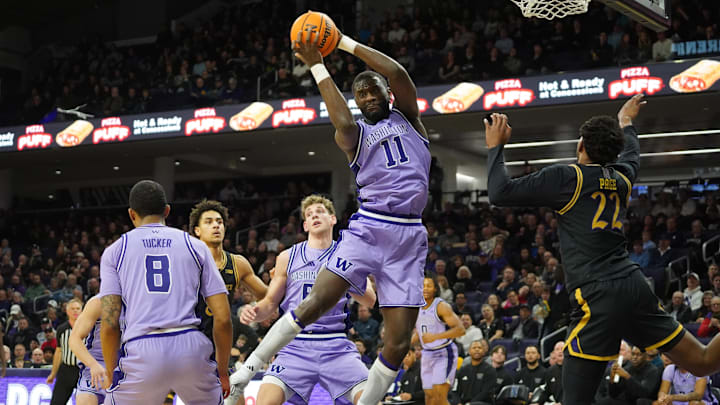
Kentucky did not add Franck Kepnang expecting a long and complicated waiting game.
The Wildcats moved aggressively to land the 6-foot-11 Washington transfer because Mark Pope’s staff clearly believes Kepnang will suit up in Lexington next season. And when you look at how the NCAA has handled similar situations in recent years, it becomes easier to understand why Kentucky fans probably should not panic about the eligibility questions surrounding the veteran big man.
Kepnang arrives at Kentucky after six college seasons split between Oregon and Washington. On paper, that immediately raises eyebrows. He originally entered college basketball as part of the 2020 recruiting class and will turn 25 years old during next season.
But modern college basketball eligibility rules are no longer as straightforward as they once were.
The COVID-19 waiver granted athletes an extra season across the board, and the growing use of medical hardship waivers has created several cases where players extend their careers into sixth or even seventh seasons. Kepnang’s situation falls directly into that category after multiple injury-shortened years, including a torn ACL suffered during the 2022-23 season.
Despite all the setbacks, Kepnang still managed to appear in 27 games and make 25 starts for Washington last season, averaging 6.2 points, 6.3 rebounds, and 2.1 blocks per game while shooting 51.5% from the field. His rim protection and experience immediately address one of Kentucky’s biggest roster needs entering next year.
Cam’Ron Fletcher may have already provided Kentucky with the blueprint
The most interesting comparison for Kentucky fans might actually come from a former Wildcat.
Cam’Ron Fletcher, another member of the 2020 recruiting class, recently received approval for a seventh season of eligibility at High Point after dealing with his own stretch of injury-plagued years. Fletcher was limited to just 28 games over a three-season span because of injuries that included a torn ACL in December 2023.
Kepnang’s injury history is remarkably similar.
Between 2022 and 2025, the Washington center played only 32 games because of recurring knee problems and recovery setbacks. Cases like Fletcher’s make it much easier to see a path toward NCAA approval for Kepnang’s final season.
And perhaps the biggest clue is Kentucky’s own confidence level throughout the recruiting process.
Programs at this level are not blindly handing out roster spots in today’s transfer portal era. Scholarship management has become too important, especially with roster limits tightening across college athletics. If Kentucky’s staff believed Kepnang faced major hurdles to play next season, it is hard to imagine the Wildcats making him such a clear priority addition.
Why Franck Kepnang still matters even beyond the eligibility discussion
The eligibility debate has almost overshadowed the actual basketball fit.
Kepnang gives Kentucky a physically mature defensive center who understands high-major basketball. At 6-foot-11 with legitimate shot-blocking instincts, he adds a dimension Kentucky lacked consistently at times last season.
He also reunites with former Washington teammate Zoom Diallo, another one of Kentucky’s offseason portal additions. That existing chemistry could help ease the transition into Pope’s system immediately.
Kentucky is not asking Kepnang to carry the offense. The Wildcats simply need interior defense, rebounding, depth, and veteran stability in the frontcourt rotation. When healthy, Kepnang has shown he can provide all four.
The Wildcats still have roster flexibility remaining, but adding an experienced center was clearly one of the biggest priorities of the offseason. That alone explains why Kentucky pursued Kepnang so aggressively despite the inevitable eligibility questions.
Right now, all signs point toward Kentucky expecting the NCAA to approve his waiver request.
And based on recent precedent around college basketball, there is a very real chance the Wildcats are right.
 Add us as a preferred source on Google