

For years, Nebraska Cornhuskers basketball carried an unusual reputation.
Nebraska finally delivered the season fans had waited decades to see
The program had passionate support, a strong home environment at Pinnacle Bank Arena, and plenty of investment, but almost no NCAA Tournament success to show for it. Nebraska was famously the last major-conference program to win an NCAA Tournament game, a statistic that followed the program everywhere.
That finally changed in 2026.
Fred Hoiberg led Nebraska to one of the best seasons in school history, finishing 28-7, reaching the Sweet 16 for the first time ever, and climbing as high as No. 5 in the AP Poll during a season-opening 20-game winning streak that completely changed the national perception of the program.
The Huskers beat Troy for the program’s first NCAA Tournament win, followed it with a second-round victory over Vanderbilt, and suddenly Nebraska basketball was no longer discussed as a historical footnote.
It became a real Big Ten contender.
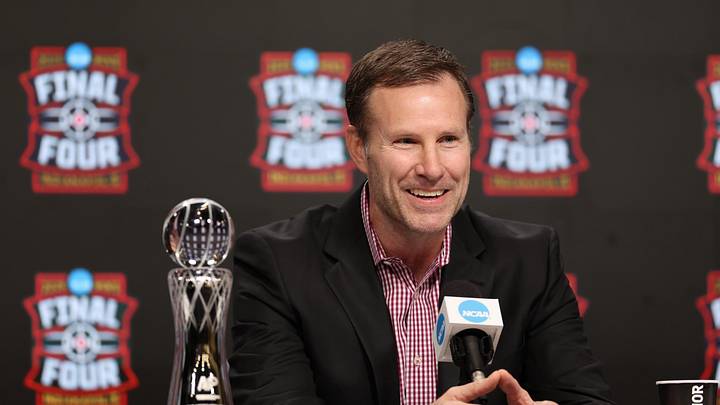
That breakthrough also earned Hoiberg Associated Press National Coach of the Year honors, another milestone moment for a program that has spent decades trying to establish consistent national relevance.
Now the question becomes far more difficult.
Can Nebraska sustain it?
Fred Hoiberg finally has Nebraska looking like his Iowa State teams again
When Hoiberg arrived in Lincoln in 2019, the rebuild looked overwhelming.
Nebraska lost at least 20 games in each of his first three seasons, and there were real questions about whether the program could ever consistently compete in the modern Big Ten.
But over the last three years, the vision finally started to take shape.
The pace increased. The spacing improved. Nebraska became more dangerous offensively while also developing enough defensive toughness to survive Big Ten play. The roster-building strategy also became clearer, especially through transfer portal additions and experienced perimeter scoring.
It started with Nebraska’s NCAA Tournament appearance in 2024. Then came the 2025 College Basketball Crown title. Finally, the 2026 Sweet 16 run pushed the program into entirely different territory.
Hoiberg deserves enormous credit for that transformation.
His background has always been unique compared to most college coaches. He was an NBA player, NBA executive, NBA head coach, and previously rebuilt Iowa State Cyclones into one of the most entertaining teams in college basketball during the early transfer portal era before the portal even truly existed.
Now he has done something Nebraska coaches before him struggled to accomplish consistently.
He made Nebraska basketball nationally relevant.
The 2026-27 roster looks very different after major departures
As exciting as last season became, Nebraska still lost a significant amount of production.
Rienk Mast, Sam Hoiberg, Jamarques Lawrence, and Berke Buyuktuncel are all gone, removing leadership, versatility, and experience from a team that relied heavily on chemistry and continuity during its breakthrough year.
Sam Hoiberg’s departure especially feels symbolic. Fred Hoiberg’s son became one of the emotional leaders of the program and embodied much of the toughness and identity Nebraska fans embraced during the Sweet 16 season.
Still, Nebraska returns enough talent to remain dangerous.
Pryce Sandfort immediately becomes one of the Big Ten’s most important returning scorers after averaging 17.9 points per game. His shooting ability and offensive versatility fit perfectly within Hoiberg’s system.
Braden Frager also returns after averaging 11.7 points per game, while Connor Essegian remains an intriguing offensive weapon after injuries limited his season. Cale Jacobsen and Leo Curtis add continuity pieces to the rotation as well.
The transfer portal additions again reveal exactly how Hoiberg wants to build this roster.
Damon Wilkinson arrives from South Dakota State after averaging 13.9 points per game and should immediately help Nebraska’s frontcourt scoring. Belmont transfer Sam Orme brings another experienced double-digit scorer, while Trevan Leonhardt gives Nebraska additional perimeter production after a strong year at Utah Valley.
Former Boston College forward Boden Kapke adds size and floor spacing, while Taj DeGourville and Kadyn Betts provide depth pieces with upside.
Nebraska also added top-100 freshman Colin Rice and four-star prospect Jacob Lanier, giving the roster more long-term talent than previous versions of the program often carried.
The Big Ten doesn’t allow programs to stay comfortable for long
That may be the biggest challenge facing Nebraska entering this season.
The Big Ten is relentless.
Programs like Michigan, Purdue, Michigan State, Illinois, and Wisconsin consistently reload. Oregon, UCLA, USC, and Washington joining the conference only made the league deeper and more physically demanding across a full season.
The schedule becomes exhausting quickly.
Winning in the Big Ten requires depth, physicality, experience, and lineup flexibility over four months. One strong season does not guarantee another in this league. Nebraska learned that firsthand after its 2024 NCAA Tournament appearance when the program took a step back the following season before rebounding again.
That is why last season mattered so much.
It proved Nebraska could break through nationally. But sustaining that success is an entirely different challenge.
The good news for the Huskers is that the infrastructure finally looks stable. Hoiberg signed an extension through 2032, the staff continuity remains largely intact, and Nebraska has embraced modern roster construction in the NIL and portal era.
For a program that spent decades chasing relevance, that alone feels like significant progress.
Now Nebraska has to prove 2026 was not the peak.
It has to become the expectation.
 Add us as a preferred source on Google