

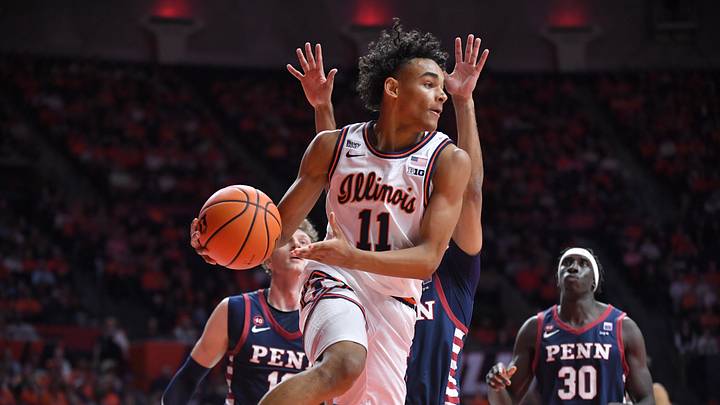
Illinois entered the 2026–27 college basketball season with the expectations that come with a Final Four appearance and a roster full of intriguing talent. Through two games, Brad Underwood's team has given opponents plenty of reasons to be concerned. The third-ranked Fighting Illini defeated Penn 112–70 Thursday night at State Farm Center, following their 120–45 season-opening victory over Fairleigh Dickinson. That's 232 points in two games, an extraordinary offensive start even when accounting for the level of competition.
The competition will become significantly tougher, but Illinois isn't simply relying on one hot shooter or one dominant scorer. The Illini are getting production from multiple players, creating high-percentage opportunities and overwhelming opponents with their size. Their offensive versatility has been particularly impressive, allowing them to score effectively from different areas of the floor. Thursday's performance offered another indication of how difficult this team could become to defend once Big Ten competition begins.
Won together. pic.twitter.com/DQgTP62CJZ
— Illinois Men's Basketball (@IlliniMBB) November 6, 2026
Six players in double figures tell the real story
Andrej Stojakovic led Illinois with 25 points against Penn, continuing an impressive opening week. Freshman Quentin Coleman contributed 19 points on eight-of-nine shooting, while Zavier Zens added 18. Ethan Brown finished with 13 points and 10 rebounds, providing another example of the balanced production within Underwood's rotation. Six Illinois players reached double figures, making it difficult for Penn to concentrate its defensive attention on any single scorer.
That distribution matters because it makes defensive adjustments considerably more complicated. Opponents can prepare to limit Stojakovic, but doing so creates opportunities for other players to contribute. Coleman demonstrated that he can convert efficiently around the basket, while Zens provided another scoring option. Illinois shot 58.9% from the field and scored 66 points in the paint, demonstrating that its offensive production wasn't dependent on an unusually high number of three-pointers.
The rebounding numbers should concern future opponents
The offensive production attracted attention, but Illinois' rebounding advantage was equally impressive. The Illini outrebounded Penn 62–33, creating a substantial advantage in possessions and limiting the Quakers' opportunities to generate momentum. Penn shot only 29.1% from the field, its lowest percentage under coach Fran McCaffery, as Illinois combined defensive pressure with effective interior protection. The Illini also demonstrated their ability to turn defensive stops into offensive opportunities.
Penn remained within 23–22 during the first half before Illinois began pulling away. By halftime, the Illini led 53–30, and their advantage eventually reached 49 points during the second half. Illinois also received valuable contributions beyond scoring, including seven assists and three blocked shots from Tomislav Ivisic. The combination of size, passing ability and interior defense creates problems for opponents attempting to compete with conventional lineups.
The real examination arrives next week
Illinois' first two opponents haven't provided the kind of resistance the Illini will encounter against nationally ranked competition. Fairleigh Dickinson and Penn both struggled to handle Illinois' size, depth and offensive execution, but the next assignment will be considerably more demanding. The Illini travel to face No. 19 Texas Tech on Tuesday, providing an early opportunity to evaluate whether their remarkable scoring production can translate against a stronger opponent.
Texas Tech should offer a much more physical and competitive challenge, particularly when it comes to limiting easy baskets and contesting shots around the rim. Still, Illinois' opening performances shouldn't be dismissed simply because of the competition. Scoring 120 points in one game is impressive, but following it with 112 points and six double-figure scorers suggests the Illini have built an offensive system capable of generating production from several different positions. The Big Ten season remains months away from its decisive stretch, but Illinois has already provided an early warning about how difficult it might be to stop.
 Add us as a preferred source on Google