

College sports has been drifting for years. Not collapsing, not thriving, just drifting. Rules changing in real time, power shifting without a clear destination. Coaches are adjusting on the fly while players finally gain leverage they never had before. It has created a version of the sport that feels both modern and unstable at the same time.
And now, suddenly, someone is trying to grab the wheel.
When Donald Trump signed an executive order aimed at regulating NIL, transfers, and the broader structure of college athletics, it didn’t just spark debate. It exposed something deeper. It forced the sport to confront a question it has been avoiding for years.
Who is actually in charge?
Calipari isn’t resisting change. He’s pushing back on chaos
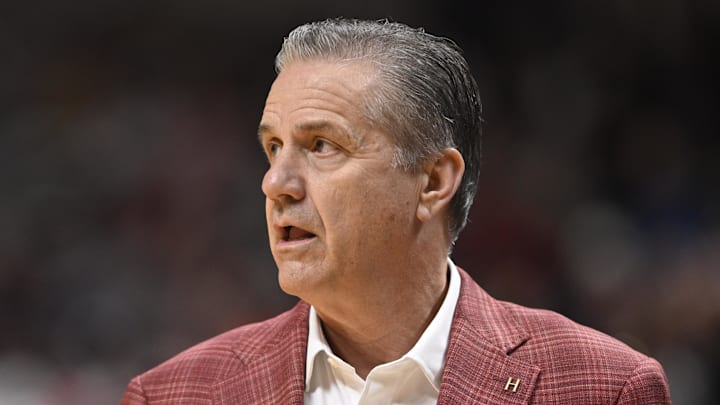
John Calipari has never been anti-player empowerment, even if that nuance gets lost in the reaction. For years, he has openly supported athletes getting paid and has built his programs around evolving realities in recruiting and development. He was not caught off guard by NIL. He adapted to it.
But his response to this executive order was not about resisting progress. It was about resisting instability. His message was clear in tone even if measured in wording. The current system is becoming unsustainable. Unlimited transfers, loosely regulated NIL collectives, constant roster turnover, and a lack of centralized authority have created a version of college sports that feels unpredictable at its core.
From Calipari’s perspective, this is not freedom. It is fragmentation. His support of federal involvement signals something important. Coaches at the highest level are no longer debating whether change should happen. They are asking for structure around the change that has already taken place.
This isn’t about politics. It’s about power
Much of the reaction online has centered on politics, but that framing misses the larger story. This moment is about control of a multi-billion dollar ecosystem that no longer has a clearly defined rulebook.
For decades, the NCAA dictated nearly every aspect of college sports. That authority has steadily eroded through legal challenges, shifting public sentiment, and the rise of athlete empowerment. What replaced it has not been a new system, but rather a vacuum where multiple entities now operate with overlapping influence.
Conferences are gaining power, schools are acting more independently, collectives are functioning like open-market agencies, and athletes are navigating opportunities with fewer restrictions than ever before. Into that environment, the federal government is now stepping, at least symbolically, in an attempt to stabilize what has become a constantly shifting landscape.
Calipari’s support reflects that reality. It is less about endorsing a political figure and more about acknowledging that some form of order is likely inevitable.
The uncomfortable truth coaches aren’t saying out loud
There is a tension at the center of all of this that rarely gets stated directly. Coaches benefited from the old system. Players benefit more from the new one. But neither side is fully protected in the current structure.
Fans often see freedom and opportunity, while coaches see volatility and unpredictability. The truth exists somewhere between those perspectives. The current version of college sports has opened doors for athletes while also introducing uncertainty that affects development, roster continuity, competitive balance, and the long-term identity of programs.
Calipari did not spell all of that out in detail, but his statement pointed toward it. College sports is no longer evolving in a controlled way. It is shifting rapidly without a clear long-term framework guiding it.
What happens next could reshape everything
This executive order may not create immediate change, and it may face legal challenges that limit its impact. But it represents something more important than its immediate effect. It signals that the next phase of college sports is beginning.
That phase is likely to involve some form of structured regulation, whether it comes from Congress, a newly formed governing body, or a reimagined version of the NCAA. The exact path remains uncertain, but the direction is becoming clearer.
The era of constant, unchecked change is approaching a breaking point. Voices like Calipari’s are not just reacting anymore. They are beginning to push toward what comes next.
Not because they want to take control back, but because right now, control does not truly belong to anyone.
 Add us as a preferred source on Google