

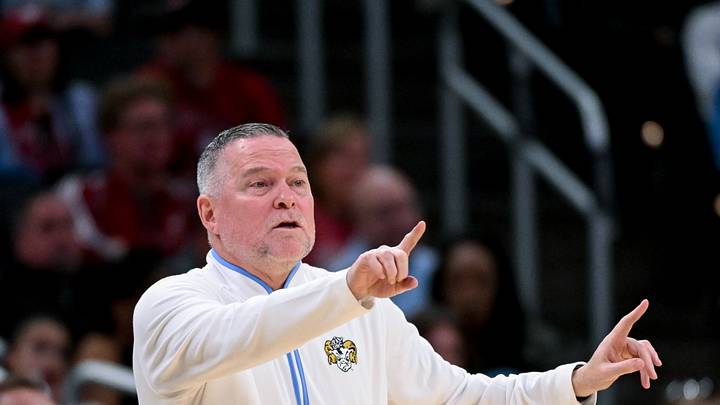
Michael Malone has coached some of the greatest basketball players in the world, won an NBA championship and established himself as one of the most respected coaches in professional basketball. None of those accomplishments made Sunday's exhibition against Indiana any easier.
North Carolina suffered a 76-58 defeat against the Hoosiers in Indianapolis, providing an uncomfortable reminder that rebuilding one of college basketball's most recognizable programs will take more than an impressive coaching résumé.
The Tar Heels had entered the matchup with momentum following an 88-70 exhibition victory over USC on October 9. However, Indiana presented a different challenge, particularly around the basket, and North Carolina struggled to find answers throughout the afternoon.
The loss won't count toward the regular-season standings, but the problems revealed during the exhibition deserve attention.
Indiana exposed a problem North Carolina cannot ignore
The most concerning statistic from Sunday's exhibition wasn't the final score. It was Indiana's overwhelming advantage on the glass.
The Hoosiers outrebounded North Carolina 53-31, controlling the interior and creating additional scoring opportunities. Indiana also finished with a 17-7 advantage in second-chance points, illustrating how frequently the Tar Heels struggled to finish defensive possessions.
North Carolina shot just 35 percent from the field and 32 percent from three-point range. The Tar Heels also converted only 54 percent of their free throws, making it difficult to establish any consistent offensive rhythm.
Those numbers are especially concerning because Malone's roster features several experienced transfers and talented newcomers. The individual pieces have potential, but Sunday's performance demonstrated how far the team remains from functioning as a cohesive unit.
Freshman center Sayon Keita provided one of the few encouraging performances, finishing with 12 points, nine rebounds and five blocked shots. His effort was impressive against Indiana's imposing frontcourt, but North Carolina didn't receive enough support around him.
The Tar Heels were also without sophomore guard Isaiah Denis, while graduate center Cameron Fens remained unavailable as he awaited NCAA eligibility clearance. Those absences affected the team's depth, although they don't entirely explain Indiana's dominance.
An NBA championship doesn't automatically translate to college basketball
Malone's decision to accept the North Carolina job was one of the most surprising coaching developments of the offseason.
He spent 12 seasons as an NBA head coach, including 10 with the Denver Nuggets. His greatest accomplishment came in 2023 when Denver captured the franchise's first NBA championship behind Nikola Jokic and an outstanding supporting cast.
Malone also became the winningest head coach in Nuggets history, collecting 471 regular-season victories during his time in Denver. His ability to develop players, establish defensive standards and manage demanding personalities made him a respected figure throughout professional basketball.
However, college basketball presents different challenges.
Malone inherited a North Carolina program that needed significant roster reconstruction. The Tar Heels brought back only five players from last season and added 11 newcomers, creating a team that must develop chemistry while adjusting to an entirely new coaching philosophy.
His professional experience provides valuable advantages, particularly when it comes to player development and understanding offensive spacing. However, recruiting, roster management and the limited preparation time available before the season present a different set of responsibilities.
Sunday's exhibition demonstrated that those adjustments remain a work in progress.
North Carolina's new backcourt must become more consistent
The Tar Heels entered the preseason with considerable excitement surrounding their reconstructed backcourt.
Terrence Brown arrived from Utah, Matt Able transferred from NC State and Neo Avdalas joined the program after playing at Virginia Tech. The three guards offer different strengths, including scoring, shooting and playmaking.
However, the Indiana exhibition exposed some concerns about how those abilities fit together.
Brown and Avdalas combined for seven turnovers and six assists while shooting 6-for-20 from the field. North Carolina struggled to create consistent offensive opportunities, particularly when Indiana controlled the paint and limited second-chance possessions.
Able provided an encouraging performance with 11 points, including three three-pointers. Still, the Tar Heels need more consistent production throughout their rotation if they hope to compete with the ACC's strongest teams.
Malone's challenge involves developing an offense that allows his guards to play to their strengths without becoming overly dependent on individual scoring opportunities.
That process takes time, especially with a roster featuring so many unfamiliar combinations.
The next exhibition suddenly carries greater importance
North Carolina has one remaining preseason exhibition before the regular season begins.
The Tar Heels will host Charlotte on October 27 at the Dean Smith Center. That matchup provides another opportunity to address the problems Indiana exposed before the November 2 opener against Western Carolina.
The immediate priorities appear clear. North Carolina needs to improve its rebounding, establish greater consistency in its half-court offense and develop stronger defensive communication.
Malone also needs to determine which lineup combinations provide the best balance between offensive production and interior defense.
The encouraging news is that the season hasn't officially started. Exhibition games exist partly to expose weaknesses before results begin affecting conference standings and postseason positioning.
North Carolina's victory over USC demonstrated the team's potential. The loss to Indiana revealed the work required to realize it.
For Malone, that contrast may prove more valuable than two comfortable preseason victories.
The former NBA champion came to Chapel Hill hoping to restore North Carolina to national championship contention. Sunday's performance didn't eliminate that possibility, but it showed that his most important work is still ahead.
 Add us as a preferred source on Google