

Winning a national championship changes the way everyone looks at a college basketball program. Every performance becomes a measuring stick, every roster decision receives additional attention and every defeat produces questions about whether the magic can happen again.
Michigan discovered that reality Sunday afternoon.
The defending national champions suffered an 83-66 exhibition loss against No. 10 Houston at Van Andel Arena in Grand Rapids, Michigan. The Wolverines entered the matchup ranked No. 16 nationally, but they struggled to generate consistent offense against a Cougars team that looked considerably more comfortable throughout the afternoon.
An exhibition defeat won't damage Michigan's NCAA Tournament resume. However, the numbers from Sunday's game suggest the Wolverines have several important issues to address before beginning their title defense.
And perhaps the biggest concern has little to do with the final score.
Michigan's championship roster isn't coming back
The Wolverines captured the 2026 national championship with a 69-63 victory over UConn, ending a 37-year drought between national titles.
That team finished 37-3 and established itself as one of the most successful groups in program history.
However, the roster that delivered the championship has changed dramatically.
Morez Johnson Jr., Yaxel Lendeborg and Aday Mara were selected among the first 12 picks in the 2026 NBA Draft, removing three important contributors from Michigan's championship frontcourt.
There has also been a significant coaching change.
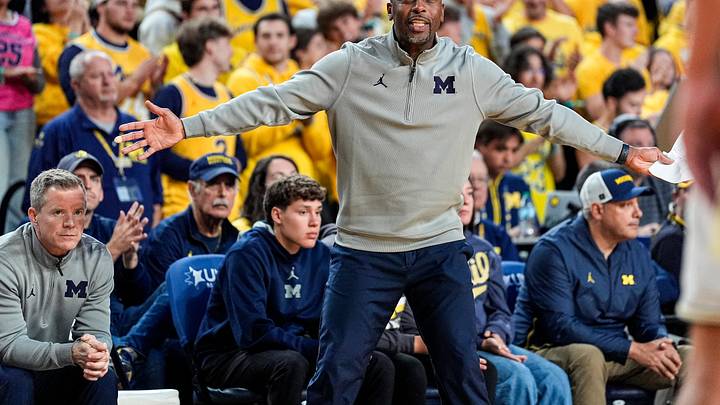
Dusty May departed for the NBA's Dallas Mavericks, leaving Mike Boynton Jr. to take over the program after previously serving on Michigan's coaching staff.
Boynton inherits a national championship banner, but he also inherits the challenge of constructing a new team capable of meeting expectations created by its predecessor.
Sunday's matchup against Houston provided an early indication of how difficult that process could become.
The Cougars didn't treat Michigan like a defending champion deserving special consideration. They attacked the Wolverines physically, controlled the rebounding battle and repeatedly disrupted their offensive rhythm.
Those are exactly the kinds of challenges Michigan will encounter when the regular season begins.
Houston dominated the numbers that matter most
The most concerning statistic for Michigan wasn't the 17-point margin.
It was the difference in efficiency and physicality.
The Wolverines shot just 34 percent from the field, making 17 of their 50 attempts. They also connected on only nine of 33 three-pointers, finishing at 27.3 percent from beyond the arc.
Those numbers made it extremely difficult to establish offensive consistency.
Michigan also lost the rebounding battle 42-30, allowing Houston to control a significant portion of the game's physical action.
The Cougars outscored the Wolverines 26-14 in the paint, another indication that Michigan struggled to match Houston's interior production.
That combination creates a particularly difficult situation.
When a team isn't shooting efficiently from the perimeter, it often needs offensive rebounds and interior scoring to compensate. Michigan struggled in those areas as well, leaving the Wolverines without a dependable alternative when their outside shots weren't falling.
Houston took advantage.
The Cougars finished with four players scoring in double figures and consistently found ways to maintain offensive pressure.
For a Michigan team replacing several important frontcourt contributors, Sunday's performance demonstrated that rebuilding its physical identity remains a work in progress.
Dedan Thomas Jr. looked like Houston's missing piece
Houston's most impressive individual performance came from Dedan Thomas Jr.
The senior guard, who transferred from LSU, finished with 25 points and seven assists while shooting eight-for-14 from the field.
He also contributed three rebounds and two steals, delivering an efficient all-around performance against one of the nation's most recognizable programs.
Thomas wasn't alone.
Delrecco Gillespie added 16 points, Chase McCarty contributed 15 and Mercy Miller finished with 13.
That balance made Houston difficult to defend because Michigan couldn't focus exclusively on one scorer.
The Cougars demonstrated the ability to attack through their guards while maintaining an advantage around the basket.
For Houston, Sunday's victory offered encouraging evidence that its newest pieces are becoming comfortable within the program's demanding style.
For Michigan, it was a reminder that experienced, physical opponents will challenge the Wolverines in ways that require more than individual talent to overcome.
Michigan showed flashes, but couldn't sustain them
The Wolverines weren't completely overwhelmed from the opening possession.
Houston built a 24-14 advantage during the first half, but Michigan responded with an impressive 15-1 run.
Oscar Goodman capped that stretch with a three-pointer, giving the Wolverines a 29-25 lead with just over five minutes remaining before halftime.
For a brief period, Michigan looked capable of controlling the game.
Houston responded with 13 consecutive points, however, and entered halftime leading 38-31.
The Wolverines made another push early in the second half.
A dunk from J.P. Estrella brought Michigan within two points at 40-38, creating another opportunity to reclaim momentum.
Once again, Houston had the answer.
The Cougars eventually extended their lead to 60-44, establishing a cushion that Michigan couldn't completely erase.
Roddy Gayle Jr. led the Wolverines with 14 points in his first appearance after being cleared to return for a fifth season of eligibility.
Moustapha Thiam contributed 12 points and eight rebounds, while Elliot Cadeau finished with nine points and three assists.
Those individual contributions provided encouraging moments, but Michigan never developed the sustained offensive production necessary to challenge Houston during the closing minutes.
The defending champions have one week to respond
Michigan completed its exhibition schedule with two victories and one defeat.
The Wolverines previously defeated Eastern Michigan 87-62 and Oregon State 98-93 before encountering Houston's physical defense.
Those three games offered a revealing progression.
Michigan demonstrated its scoring potential against Eastern Michigan, survived a competitive matchup against Oregon State and then struggled against a nationally ranked opponent capable of exploiting its weaknesses.
The regular season begins November 2, when the Wolverines host Oakland.
That gives Boynton and his staff a short window to evaluate what went wrong against Houston and determine which adjustments deserve immediate attention.
The encouraging news is that Michigan doesn't need to recreate its championship team overnight. The Wolverines have talented players, experienced contributors and an opportunity to improve throughout the season.
However, Sunday's game demonstrated that championship expectations alone won't win the rebounding battle, generate efficient offense or prevent opponents from controlling the paint.
Michigan's national championship banner isn't going anywhere.
The question now is how quickly the new Wolverines can develop the identity required to defend it.
 Add us as a preferred source on Google