

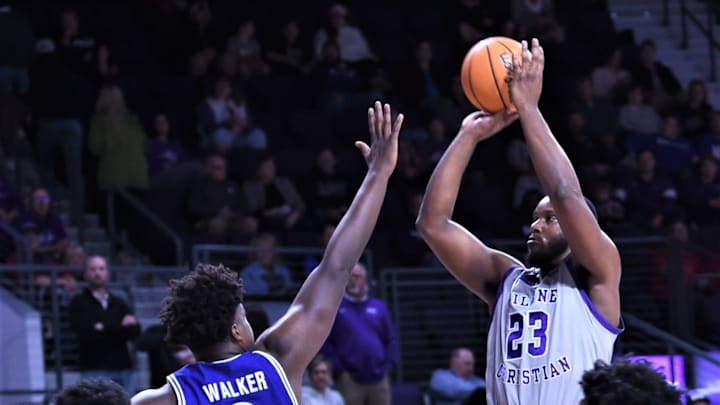
College basketball has spent the last few years embracing the sports betting boom. Now the sport is dealing with the consequences that many people feared were eventually coming.
Former Abilene Christian guard Airion Simmons was permanently banned by the NCAA this week after investigators concluded he participated in a scheme tied to sports bettors during the 2023-24 season. According to the NCAA’s findings, Simmons agreed to manipulate his performance in a March 2024 game against Tarleton State and shared insider information with bettors connected to the scheme.
The details are ugly. And honestly, they read less like a college sports story and more like something out of a gambling crime documentary.
According to the NCAA, Simmons accepted $3,500 to “play bad” in the game, informed bettors about injuries and lineup situations, and later met someone in a Dallas parking lot to receive cash after the game. Federal prosecutors later included Simmons and two bettors in a larger indictment involving bribery, conspiracy, and wire fraud charges connected to college basketball gambling activity.
This is no longer hypothetical danger for the NCAA.
It is here.
College basketball’s gambling problem keeps getting closer to the game
For years, gambling scandals in sports often felt distant from the athletes themselves. That line has completely disappeared in modern college athletics.
Players now live in a world where sportsbooks are advertised constantly during games, betting lines are discussed on television broadcasts, and social media exposes athletes to gamblers almost immediately after tip-off. The accessibility is unprecedented.
That does not excuse what happened at Abilene Christian.
Not even close.
But it does explain why the NCAA is increasingly worried about integrity issues surrounding college basketball specifically. The sport creates thousands of games every season, massive betting volume, and endless opportunities for point-shaving schemes involving spreads, player props, and live betting markets.
The frightening part for the NCAA is that this case likely only surfaced because another player eventually reported it.
That should make everybody uncomfortable.
The details surrounding Airion Simmons are deeply troubling
According to NCAA investigators, Simmons and another teammate attempted to convince a fellow player to intentionally lose a game for money. The reporting player later participated in a FaceTime call involving Simmons, another teammate, and a bettor discussing the plan.
The NCAA also said Simmons admitted that another bettor contacted him separately about throwing the game.
Then came the March 2024 matchup against Tarleton State.
Simmons reportedly told bettors he was dealing with a hand injury and informed them another teammate would not play. He ultimately played only 11 minutes before exiting with the injury while Abilene Christian lost by more than the betting spread tied to the allegations.
Federal prosecutors later charged Simmons with conspiracy to commit wire fraud and bribery involving sporting contests. Those are not minor accusations tied to NCAA eligibility rules.
Those are criminal charges.
And that changes the tone of this story entirely.
This is becoming a massive issue for the NCAA
The Simmons case is not isolated anymore.
Former Fordham players have already received permanent NCAA bans connected to gambling investigations, and other cases continue surfacing across college athletics. The NCAA has repeatedly pushed state regulators to eliminate high-risk betting options involving college athletes, especially prop bets that can be manipulated more easily by individual performance.
NCAA president Charlie Baker has openly warned about “predatory bettors” targeting athletes.
The concern is understandable.
College athletes are younger, more accessible through social media, and far less protected than professional athletes. Some are also navigating NIL realities, financial pressure, and public attention simultaneously. That combination creates vulnerabilities the NCAA is still struggling to address.
Meanwhile, the gambling industry continues growing rapidly alongside college sports.
That tension is only getting worse.
The biggest fear for college basketball is trust
Fans can survive almost anything in sports except believing games are not legitimate.
That is the danger here.
College basketball already deals with constant roster turnover, transfer portal chaos, and growing concerns about the sport becoming overly transactional. Gambling scandals attack something even more important: competitive trust.
Once fans start wondering whether performances, late-game decisions, or strange outcomes are connected to betting influence, the damage spreads quickly.
Most college athletes will never come close to crossing that line.
But stories like this create doubt anyway.
That is why the NCAA came down so aggressively with a permanent ban for Simmons. The organization knows it has to send a message, even as the larger gambling ecosystem surrounding sports continues expanding every year.
The scary part for college basketball is this probably will not be the last story like this.
 Add us as a preferred source on Google