

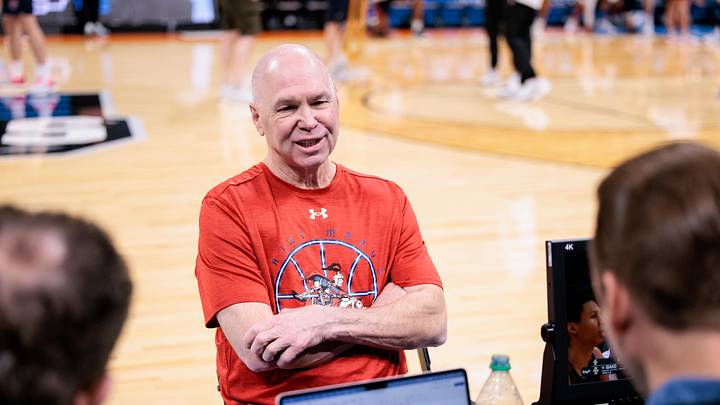
For more than two decades, Randy Bennett built one of the most respected mid-major programs in the country at Saint Mary's Gaels.
Arizona State turned to one of college basketball’s safest program builders
He won consistently. He developed overlooked players. He built veteran teams that defended, executed, and frustrated opponents every March. Most importantly, he made Saint Mary’s nationally relevant in a conference dominated by Gonzaga.
Now he is attempting something very different.
Arizona State did not hire Bennett simply to stabilize the program after the end of the Bobby Hurley era. The Sun Devils hired him because they believe his structure, patience, and roster-building philosophy can finally create long-term consistency inside the brutal reality of the Big 12.
That is a massive challenge.
The league is loaded with programs that regularly operate at Sweet 16 and Final Four levels. Arizona, Houston, Iowa State, Kansas, Baylor, and Texas Tech all expect to compete nationally every season. There are very few easy nights in the conference, especially for a program trying to rebuild almost entirely from scratch.
And make no mistake, this is a full rebuild.
The Bobby Hurley era had moments, but consistency never fully arrived
Bobby Hurley brought energy and visibility back to Arizona State basketball when he arrived in Tempe.
There were NCAA Tournament appearances, ranked wins, and memorable stretches. The Sun Devils reached the NCAA Tournament in 2018, 2019, and 2023, and at one point climbed as high as No. 3 nationally during the 2017-18 season behind Tra Holder, Shannon Evans, and future NBA superstar James Harden’s growing influence around the program.
Hurley also helped modernize the program’s identity and made Arizona State feel relevant nationally again after some uneven years.
But the consistency never truly materialized.
The Sun Devils often struggled defensively, roster continuity became difficult to maintain, and Arizona State never fully established itself near the top of the Pac-12 before moving into the even tougher Big 12 environment.
That made the transition to Bennett especially interesting.
Arizona State moved away from volatility and toward one of the sport’s most proven culture-builders.
Randy Bennett immediately reshaped the roster in his image
Very little remains from last year’s team.
Maurice Odum, Massamba Diop, Anthony Johnson, Santiago Trouet, Andrija Grbovic, Noah Meeusen, Allen Mukeba, and Marcus Adams Jr. are all gone. That is an enormous amount of production and experience leaving the roster all at once.
Only Bryce Ford and Vijay Wallace are confirmed returners from the core rotation.
Instead of slowly rebuilding the roster, Bennett essentially imported a completely new foundation.
That starts with former Saint Mary’s star Paulius Murauskas, who averaged 18.4 points per game and already understands Bennett’s demanding system. His addition gives Arizona State an immediate centerpiece around whom the offense can operate.
Dillan Shaw also followed Bennett from Saint Mary’s, bringing more familiarity and frontcourt toughness.
The rest of the portal haul reveals exactly what Bennett prioritized.
Joel Foxwell arrives after averaging 15.6 points at Portland and should immediately help stabilize the perimeter offense. Ben Defty comes from Boston University after averaging 15.1 points per game, while Gonzaga transfer Emmanuel Innocenti adds athleticism and defensive versatility.
Nate Garcia and Marcus Vaughn provide developmental upside pieces, while four-star freshman JRob Croy gives the program a high school building block for the future.
This is not a typical Arizona State roster.
It looks far more like a Randy Bennett roster transplanted into a power-conference environment.
The biggest question is whether the Saint Mary’s formula translates to the Big 12
That is the fascinating part of this rebuild.
At Saint Mary’s, Bennett built elite teams through execution, discipline, experience, and efficiency. His teams rarely beat themselves. They controlled tempo, defended physically, and forced opponents to play uncomfortable games.
That style worked brilliantly in the WCC.
But the Big 12 presents entirely different challenges.
The athleticism is better. The depth is stronger. The travel is harder. Nearly every team can pressure defensively and score in transition. Surviving the conference schedule requires not only toughness, but also roster depth and high-end talent.
Arizona State’s rebuild may ultimately depend on whether Bennett can evolve some of his formulas without losing the identity that made him successful.
The good news is the early roster construction actually makes sense for that transition.
Murauskas gives Arizona State a proven star. Foxwell and Defty add scoring punch. Innocenti adds length and versatility. Bryce Ford, assuming he returns healthy after offseason surgery, provides another perimeter weapon with Big 12 experience.
There is still work to do, especially regarding depth and overall athleticism, but Arizona State suddenly looks far more organized than it did entering last offseason.
Arizona State is betting stability can finally win in Tempe
That may be the most important part of this entire transition.
For years, Arizona State basketball often felt unpredictable. Some nights the Sun Devils looked capable of beating elite teams. Other nights the structure completely disappeared.
Bennett’s reputation is the opposite.
His teams are reliable. Older. Tougher. Connected. His Saint Mary’s program became one of the clearest examples in college basketball of culture outweighing recruiting rankings.
Now Arizona State is betting that same formula can work in Tempe.
It will not happen overnight, especially in the Big 12. But Arizona State finally appears to have a long-term basketball identity in place.
That alone makes this rebuild feel very different from the ones that came before it.
 Add us as a preferred source on Google