

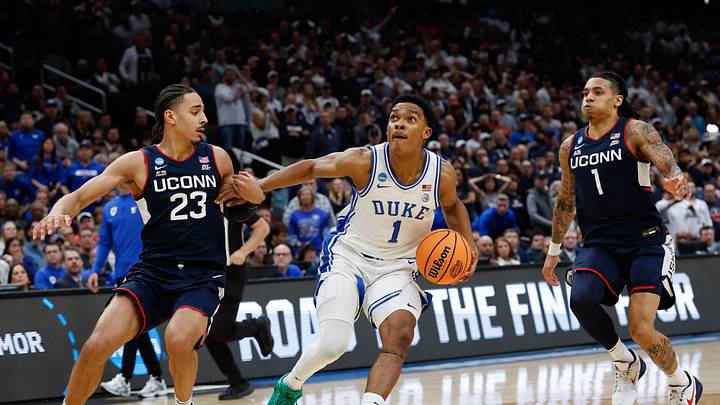
March has a way of simplifying college basketball.
When possessions become difficult, who can handle pressure? Who can create a shot with seven seconds remaining? Who can make the correct read when an opponent takes away the first option?
That's why backcourts matter so much.
The 2026-27 season features fascinating combinations of returning stars, established transfers and elite freshmen.
Here are the 15 backcourts we like most entering the season.
1. Duke
Key guards: Caleb Foster, John Blackwell, Dame Sarr, Deron Rippey Jr.
John Blackwell gives Duke something enormously valuable: proven high-major scoring.
Blackwell averaged 19.1 points at Wisconsin last season before transferring to Durham. Caleb Foster supplies continuity, while Dame Sarr gives the Blue Devils size and versatility on the perimeter.
Then there is Deron Rippey Jr., another elite freshman guard capable of forcing his way into Jon Scheyer's rotation.
There may be backcourts with more continuity.
Few possess Duke's combination of experience, scoring and upside.
2. UConn
Key guards: Silas Demary Jr., Braylon Mullins, Nils Machowski
UConn has multiple ways to hurt opponents.
Demary averaged 10.1 points and 5.9 assists last season and gives Dan Hurley a genuine distributor.
Mullins averaged 12.0 points and made 2.2 3-pointers per game.
Machowski adds another scoring dimension after averaging 17.2 points at Wofford.
That's creation, shooting and depth surrounding a coach who consistently finds ways to maximize guard play.
3. Florida
Key guards: Boogie Fland, Urban Klavzar, Alex Lloyd
Florida's overwhelming frontcourt will receive much of the attention, but the Gators aren't reaching their ceiling without quality guard play.
Fland is the central figure.
His ability to create offense and organize the Gators allows Florida's size to become even more difficult to handle.
Klavzar provides another experienced option, while Lloyd offers additional size and versatility.
Florida doesn't require its guards to carry the roster.
It requires them to make an already imposing roster function.
4. Louisville
Key guards: Jackson Shelstad, De'Shayne Montgomery
Jackson Shelstad could become one of the defining transfers of the season.
Before suffering a hand injury at Oregon, Shelstad averaged 15.6 points and 4.9 assists through 12 games.
Now Pat Kelsey gets to put him in space and let him operate.
Montgomery gives Louisville another versatile perimeter weapon.
The Cardinals' frontcourt additions generated plenty of attention, but Shelstad may ultimately determine how high this team's ceiling rises.
5. Iowa State
Key guards: Tamin Lipsey and the Cyclones' evolving perimeter rotation
This ranking changed dramatically last week.
Lipsey was granted a preliminary injunction allowing him to return for another season. The NCAA is expected to appeal, so the legal situation remains worth following, but for basketball purposes Iowa State can currently plan around its veteran point guard.
Lipsey is a three-time All-Big 12 selection and four-year starter.
His presence provides leadership, defense and creation.
The significant shoulder injury expected to sideline Killyan Toure until midseason hurts Iowa State's perimeter depth, but Lipsey's return prevents that problem from becoming considerably larger.
6. Texas
Key guards: Isaiah Johnson, Mikey Lewis and Texas' perimeter newcomers
Johnson's freshman season at Colorado established him as one of the most exciting young guards available in the portal.
He scored 24 points in his college debut against Montana State and eventually earned All-Big 12 honorable mention recognition.
Texas needs him to create.
Sean Miller surrounded him with a roster featuring considerable length and athleticism, which should allow Johnson to attack without carrying every responsibility.
7. Michigan State
Key guards: Jeremy Fears Jr., Kur Teng
Experience matters here.
Fears is the headliner and gives Tom Izzo a veteran point guard capable of controlling games.
Teng adds returning familiarity.
Michigan State won't have to teach an entirely new collection of guards how Izzo wants possessions handled in January and February.
That matters.
8. Tennessee
Key guards: Terrence Hill Jr., Dai Dai Ames, Juke Harris, Jalen Haralson
Few backcourts have changed more.
Hill arrives from VCU. Ames comes from California. Harris comes from Wake Forest. Haralson arrives from Notre Dame.
The upside is obvious.
So is the challenge.
Rick Barnes needs four talented players from different backgrounds to develop chemistry quickly.
If that happens, Tennessee could eventually rank much higher than eighth.
9. Miami
Key guards: Acaden Lewis, Dante Allen, Shelton Henderson
Lewis gives Miami an important lead guard after transferring from Villanova.
The larger reason to like this group is what's around it.
With Malik Reneau now eligible to return, opposing defenses cannot simply load up on Miami's perimeter creators.
That should create better driving lanes and cleaner perimeter opportunities.
Jai Lucas has a potentially excellent starting five.
10. Illinois
Key guards/wings: Stefan Vaaks, Quentin Coleman, Andrej Stojakovic
Illinois is unconventional.
That might be precisely why the Illini are so dangerous.
Vaaks arrives from Providence, Coleman provides another perimeter option and Stojakovic can function as a big scoring wing.
The projected lineup has size everywhere.
That gives Brad Underwood the ability to create mismatches without relying on a traditional small backcourt.
11. Kansas
Key guards: Taylen Kinney, Tre White and Kansas' perimeter rotation
Tre White's return changes this group.
White isn't a traditional point guard, but he gives Kansas a proven perimeter veteran who averaged 13.5 points and 6.7 rebounds while shooting better than 40% from 3 last season.
Kinney supplies youth and creation.
And with Tyran Stokes attracting enormous defensive attention elsewhere, Kansas' guards should have room to operate.
12. Gonzaga
Key guards: Xaivian Lee, Isiah Harwell
Lee's move from Florida gives Mark Few another high-level creator.
Harwell provides additional talent in a backcourt that underwent meaningful offseason change.
The Bulldogs lost projected starter Mario Saint-Supery to Spain's EuroLeague, forcing another adjustment.
Few has rebuilt guard rotations before.
This one still possesses a significant ceiling.
13. Kentucky
Kentucky's exact guard hierarchy is one of the preseason questions Mark Pope needs to solve.
But the reason the Wildcats remain on this list is the environment those guards will operate within.
Milan Momcilovic's shooting stretches defenses to absurd distances. He made 136 3-pointers last season.
That spacing should make Kentucky's ball handlers better.
14. Arizona
Tommy Lloyd consistently creates offenses that make guards difficult to defend.
Arizona's personnel has changed, but its offensive principles haven't.
The Wildcats want pace, movement and efficient decisions before defenses can settle.
Arizona's backcourt doesn't need to dominate the ball to dominate games.
15. Houston
Houston guards have responsibilities that don't always appear in scoring averages.
They defend.
They pressure.
They rebound.
They create the physical tone Kelvin Sampson expects.
Dedan Thomas Jr. gives the Cougars another important piece as Houston reconstructs its perimeter rotation.
Don't be surprised if this group looks significantly better in February than it does in November.
Guard play will decide plenty in March
There are more talented big men in college basketball than there were a few seasons ago. The sport is getting older in some places and younger in others.
But March still eventually puts the ball in somebody's hands and asks him to make a decision. Duke has the deepest combination of proven scoring and upside entering the season.
UConn isn't far behind.
And teams such as Louisville and Iowa State have experienced point guards capable of changing games.
Those are precisely the players we'll want to remember when the bracket arrives.
 Add us as a preferred source on Google