

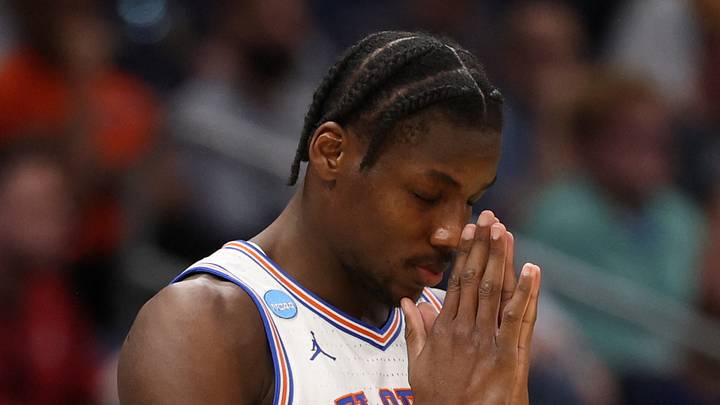
Small-ball basketball hasn't disappeared, but college basketball is getting awfully big again. Several of the country's leading national championship contenders enter 2026-27 with enormous frontcourts capable of controlling the glass, protecting the rim and creating difficult offensive mismatches.
Nobody has more proven talent than Florida. The Gators can put Thomas Haugh, Alex Condon and Rueben Chinyelu on the floor, three players who could individually earn major postseason recognition. Illinois isn't far behind, Arizona has one of the country's premier defensive centers and Louisville added one of the portal's most imposing big men.
The rankings below consider star power, depth, complementary skill sets, rebounding, rim protection and how important each frontcourt could become to its team's championship ceiling.
1. Florida
Key players: Thomas Haugh, Alex Condon, Rueben Chinyelu
This isn't particularly complicated. Florida enters the season with the best frontcourt in college basketball because its three primary big men bring different high-level skills to the same lineup.
Haugh averaged 17.1 points and 6.1 rebounds last season and enters the year as a legitimate national player of the year candidate. Condon gives the Gators another skilled big capable of passing, running the floor and contributing offensively in multiple areas. Chinyelu provides elite rebounding, physicality and interior defense.
Florida doesn't merely have size. It has complementary size. Haugh can create, Condon can facilitate and Chinyelu can dominate the dirty work around the basket. That combination gives opponents very few obvious solutions.
2. Illinois
Key players: David Mirkovic, Tomislav Ivisic, Zvonimir Ivisic
Brad Underwood can put some enormous lineups on the floor, but Illinois' appeal goes beyond height. Mirkovic is particularly important because he isn't limited to functioning as a traditional power forward. The Illini can put the ball in his hands and allow him to create offense.
Tomislav Ivisic provides another skilled big, while Zvonimir Ivisic gives Underwood additional size and shooting. Mirkovic's recovery from offseason foot surgery is worth monitoring, but a healthy Illinois frontcourt has the versatility to punish smaller teams without sacrificing skill. After reaching the Final Four last season, the Illini have enough returning interior talent to make another run realistic.
3. Arizona
Key players: Motiejus Krivas, RJ Godfrey and Arizona's frontcourt rotation
Krivas gives Arizona an extraordinary starting point. The veteran center enters the season with a legitimate argument as one of the best defensive big men in the country after helping anchor a Wildcats team that reached the Final Four.
His rim protection can change the geometry of an opponent's offense before he even blocks a shot. Godfrey adds experience after transferring from Clemson, giving Tommy Lloyd another physical option around Krivas. Arizona doesn't need its center to average 20 points per game. If Krivas continues controlling the paint while becoming a more consistent offensive threat, the Wildcats will have one of the nation's most impactful frontcourts.
4. Louisville
Key players: Flory Bidunga, Alvaro Folgueiras, Karter Knox
Bidunga changes games vertically. He finished with 82 dunks last season at Kansas, but reducing him to a lob threat would undersell what he can bring to Pat Kelsey's team.
His athleticism gives Louisville a rim protector capable of covering significant space, while Folgueiras provides another skilled frontcourt option and Knox adds positional versatility. Louisville's portal class received plenty of attention because the pieces fit together rather than simply looking impressive individually. This frontcourt could help transform the Cardinals from an interesting ACC contender into a legitimate Final Four threat.
5. Gonzaga
Key players: Braden Huff and Gonzaga's frontcourt rotation
Huff is the centerpiece here. Before his season was interrupted by injury, he demonstrated why he's one of the country's most efficient offensive big men when healthy.
He can score on the block, finish with excellent touch and operate comfortably away from the basket. His ability to play within Gonzaga's flowing offense gives Mark Few another interior player who doesn't stop ball movement. Health is the obvious variable, but a full season from Huff would give the Bulldogs an offensive anchor capable of carrying significant stretches.
6. Texas
Key players: Matas Vokietaitis, David Punch, Elyjah Freeman
Vokietaitis gives Texas something many transfer-heavy rosters lack: continuity. That's particularly valuable for Sean Miller because so many other pieces are new.
Punch brings defensive versatility after transferring from TCU, while Freeman adds athleticism after arriving from Auburn. The result is a group Miller can configure in several different ways depending on the matchup. Texas can play bigger, quicker or more defensively without completely changing its identity, and that flexibility is one reason the Longhorns enter the season with substantial national expectations.
7. Duke
Key players: Patrick Ngongba II, Drew Scharnowski and Duke's young frontcourt talent
Duke's guards will receive enormous attention because John Blackwell, Caleb Foster and the Blue Devils' young perimeter talent create obvious excitement. The interior shouldn't be overlooked.
Ngongba provides experience and familiarity with Scheyer's system, while Scharnowski arrives from Belmont as another experienced option. Duke also has young frontcourt talent capable of earning larger roles as the season develops. The Blue Devils don't need this group to carry the offense. They need reliable rebounding, defense and finishing around a perimeter unit capable of creating excellent opportunities.
8. Houston
Key player: Joseph Tugler and Houston's interior rotation
Tugler fits Houston basketball almost perfectly because his value begins with physicality, rebounding and defense. Kelvin Sampson doesn't require his big men to produce enormous scoring averages to dominate games.
Houston's interior players are expected to protect the rim, create second opportunities and make every opponent work for anything around the basket. That style becomes especially valuable in March, when easy offense becomes increasingly difficult to find. Tugler gives Houston another frontcourt centerpiece capable of establishing the physical tone Sampson demands.
9. Kentucky
Key player: Milan Momcilovic and Kentucky's frontcourt rotation
Momcilovic isn't a traditional interior player, and that's precisely what makes Kentucky's frontcourt so intriguing. At 6-foot-8, he made 136 3-pointers last season at Iowa State.
Defenses have to follow him far away from the basket, opening space for Kentucky's guards and traditional interior players. Mark Pope values spacing and offensive movement, and few frontcourt additions in the country provide more of both than Momcilovic. Kentucky's frontcourt may look different from Florida's or Arizona's, but it can create equally frustrating matchup problems.
10. Michigan State
Key players: Coen Carr, Cam Ward and Michigan State's interior rotation
Carr's athleticism gives Michigan State a unique weapon, while Ward adds another returning piece from a team that reached the Sweet 16. Their familiarity with Tom Izzo's expectations should matter as the Spartans attempt to build on last season.
This isn't necessarily the country's most skilled offensive frontcourt, but that's not the only measurement that matters. Michigan State needs its bigs and forwards to defend, rebound, run the floor and create physical advantages. Izzo has enough returning options to make those strengths a central part of the Spartans' identity.
11. UConn
Key players: Najai Hines, Oskar Giltay, Nikolas Khamenia
Dan Hurley reconstructed much of UConn's interior through the portal. That introduces some uncertainty, but the individual pieces are intriguing.
Hines averaged 5.5 rebounds and 2.2 blocks last season at Seton Hall, giving the Huskies a proven rim protector. Giltay arrives from Stanford, while Khamenia comes from Duke with an opportunity to expand his role. The biggest question is how quickly the group develops chemistry, because UConn's perimeter talent should give its frontcourt plenty of chances to contribute without carrying the entire offense.
12. Texas Tech
Key player: JT Toppin and the Red Raiders' frontcourt rotation
Sometimes one player dramatically elevates an entire unit. Toppin is that kind of player for Texas Tech.
The Red Raiders can run significant portions of their offense through him, and opposing defenses will spend enormous amounts of preparation time figuring out how to limit his touches and efficiency. That attention creates opportunities for everyone around him. If Texas Tech remains near the top of the Big 12 conversation, Toppin's production will likely be one of the biggest reasons.
13. North Carolina
Key players: Henri Veesaar, Jarin Stevenson and the Tar Heels' frontcourt rotation
North Carolina enters the season with multiple proven frontcourt pieces capable of giving Hubert Davis a stable foundation. Veesaar provides size and experience, while Stevenson adds another versatile option.
UNC's overall ceiling may ultimately depend more heavily on how its perimeter group develops, but the frontcourt shouldn't require the same level of uncertainty. If the Tar Heels rebound consistently and get reliable interior scoring, their bigs can give the backcourt time to settle into its roles.
14. BYU
Key players: Khadim Mboup, Jaxon Kohler, Jake Wahlin
Kohler arrives from Michigan State and brings proven Big Ten experience, while Mboup provides continuity and Wahlin adds another portal option after transferring from Clemson.
The Big 12 demands frontcourt depth because teams encounter different styles and high-level physicality throughout the conference schedule. BYU has assembled enough options to adjust from matchup to matchup. The Cougars may not have the single most famous big man in the league, but collectively the group should give them a chance to survive one of the country's most demanding conference schedules.
15. Purdue
Key players: Daniel Jacobsen, Caden Pierce and Purdue's frontcourt rotation
Purdue looks different without the star-driven frontcourts that have defined some of Matt Painter's recent teams, but the Boilermakers haven't suddenly abandoned size.
Jacobsen returns as part of the core from an Elite Eight team, while Pierce adds experience after previously earning Ivy League Player of the Year honors. Painter understands how to build offenses around skilled big men as well as almost anyone in college basketball. That history, combined with Purdue's returning size, makes this a frontcourt worth watching closely as roles develop.
Florida sets an imposing standard
There are excellent frontcourts throughout college basketball, but Florida's still stands apart. Haugh gives the Gators a legitimate national player of the year candidate, Condon provides another potential professional prospect and Chinyelu handles the rebounding and defensive work championship teams require.
Illinois may possess the best chance to challenge Florida's combination of size and skill, while Arizona has an elite defensive anchor and Louisville owns one of the most exciting new frontcourt combinations in the country.
The common theme is difficult to miss. Many of the teams expected to compete deep into March are enormous, versatile and capable of controlling the game around the basket.
Big men are firmly back at the center of college basketball's championship conversation.
 Add us as a preferred source on Google