

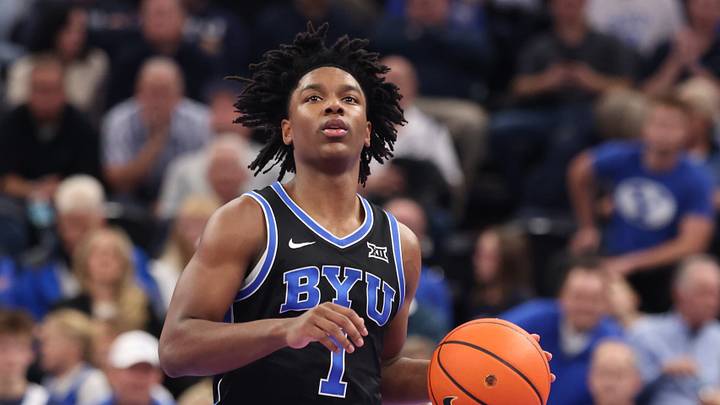
College basketball has become increasingly dependent on guards capable of controlling everything.
Elite teams need players who can initiate offense, create shots late in possessions and survive defensively against opponents constantly searching for mismatches. March makes those qualities even more important. When scouting becomes more detailed and possessions become more valuable, having the best guard on the floor can change an entire tournament game.
The 2026-27 season has no shortage of candidates.
Michigan State returns the nation's assist leader. Vanderbilt has one of the most productive two-way guards in America. BYU has an established scorer ready to become the unquestioned centerpiece of its offense, while UConn possesses two guards capable of becoming All-Americans.
Here are our 25 best guards entering the season.
1. Jeremy Fears Jr., Michigan State
Fears enters the season with a legitimate argument as the most valuable guard in college basketball.
He averaged 15.2 points and a nation-leading 9.4 assists last season while earning second-team All-America and first-team All-Big Ten honors. He started all 35 games and became the engine of Tom Izzo's offense.
Michigan State's expectations are enormous again, and Fears is the primary reason. His combination of passing, experience and command of the offense separates him from nearly everyone else at the position.
2. Tyler Tanner, Vanderbilt
Tanner's sophomore season was extraordinary.
The 6-foot guard averaged 19.5 points, 5.1 assists and 2.4 steals while setting Vanderbilt single-season records with 184 assists and 86 steals. He was the only player nationally to average better than 19 points, five assists and two steals.
Tanner isn't merely a high-usage scorer. His ability to pressure defenses without consistently turning the ball over makes him one of the country's most complete offensive guards. Another jump could put him directly into the national player of the year race.
3. Rob Wright III, BYU
Wright gets the opportunity to become the unquestioned face of BYU's offense.
He averaged 18.1 points, 4.6 assists and 3.5 rebounds last season while shooting 46.7% from the floor and 41% from 3-point range. Those efficiency numbers become particularly impressive considering how frequently Wright had the basketball.
BYU has surrounded him with an intriguing collection of size and young talent. Wright's ability to create quality offense in difficult Big 12 environments makes the Cougars dangerous against almost anyone.
4. Silas Demary Jr., UConn
Demary doesn't need to score 20 points every night to control a basketball game.
The UConn senior averaged 10.1 points, 5.9 assists, 4.5 rebounds and 1.6 steals last season while earning first-team All-Big East and All-Defensive honors. He enters the season as the Big East preseason Player of the Year.
With Solo Ball expected to miss the season, Demary becomes even more important. His ability to organize Dan Hurley's offense while setting the tone defensively makes him one of America's premier two-way guards.
5. John Blackwell, Duke
Blackwell arrives at Duke after scoring 1,505 points during three seasons at Wisconsin.
His junior season was his best, with Blackwell averaging 18.3 points, 4.8 rebounds, 2.3 assists and 1.2 steals. He produced 24 career 20-point games at Wisconsin and five games with at least 30.
Now he gets to play on a Duke roster where opponents can't focus exclusively on stopping him. Blackwell may sacrifice some raw scoring volume, but his efficiency and national profile could increase dramatically.
6. Braylon Mullins, UConn
Mullins already owns the kind of March moment most players spend their careers chasing.
His dramatic shot against Duke helped send UConn to the Final Four, but his freshman season was much more than one highlight. Mullins averaged 12.0 points, hit 72 3-pointers and reached double figures in five of UConn's six NCAA Tournament games.
Ball's injury creates even more offensive responsibility. Mullins could make one of the largest sophomore jumps in the country.
7. Nigel James Jr., Marquette
James went from intriguing freshman to Big East star in a matter of months.
The Marquette guard earned Big East Freshman of the Year honors after averaging 16.4 points, 4.9 assists and 2.0 steals. He also produced three 30-point performances during conference play.
Now opponents have an entire offseason to build scouting reports around him. If James handles that additional attention while improving his efficiency, he could become an All-American.
8. Trey McKenney, Michigan
Michigan's championship defense changed dramatically when Brandon McCoy Jr. suffered a season-ending ACL injury.
That creates an enormous opportunity for McKenney.
The 6-foot-4 sophomore is officially back on Michigan's roster and should receive considerably more responsibility in the Wolverines' perimeter attack. His strength and scoring instincts make him a natural candidate for a major second-year jump.
9. Juke Harris, Tennessee
Tennessee's reconstructed backcourt contains several fascinating pieces, but Harris may have the highest ceiling.
The 6-foot-7 Wake Forest transfer gives Rick Barnes unusual size on the perimeter and enters a system built around physical defense and disciplined offense. Harris can score, rebound and attack mismatches that smaller guards simply can't handle.
If his efficiency improves, Tennessee may have found its next national star.
10. Jackson Shelstad, Louisville
Shelstad gives Pat Kelsey an experienced lead guard for a roster with Final Four expectations.
He averaged 15.6 points and 4.9 assists during an injury-shortened final season at Oregon and started 77 of his 79 games with the Ducks. That experience should matter enormously on a Louisville team filled with newcomers.
The potential pick-and-roll partnership with Flory Bidunga could become one of the ACC's most difficult actions to defend.
11. Tahaad Pettiford, Auburn
Pettiford averaged 15.4 points and 3.8 assists last season while scoring at least 20 points 13 times.
He also produced big performances against elite opponents, including 30 points at Arizona, 25 against Alabama and 29 at Arkansas. That résumé makes him one of the most proven scoring guards in the SEC.
Auburn needs Pettiford to become even more efficient and consistent as a junior. The offensive ability is unquestioned.
12. Dedan Thomas Jr., Houston
Thomas doesn't need to become Houston's leading scorer to become one of the country's most important guards.
The former UNLV and LSU guard brings experience to Kelvin Sampson's reconstructed backcourt and is officially listed as a senior on Houston's current roster.
Houston's system demands defensive commitment, decision-making and toughness from its guards. If Thomas masters those responsibilities while providing reliable offense, the Cougars will again be extremely difficult to beat.
13. Acaden Lewis, Miami
Lewis was one of the country's most productive freshman point guards at Villanova.
He averaged 12.2 points, 5.3 assists and 1.9 steals while setting Villanova freshman records for assists and steals. Now he takes over a Miami offense with plenty of talent around him.
Lewis doesn't need to force scoring opportunities. His greatest value may come from making Shelton Henderson, Somto Cyril and Miami's other weapons better.
14. Andrej Stojakovic, Illinois
Stojakovic enters his senior season on an Illinois roster with national championship expectations.
At 6-foot-7, he provides Brad Underwood with size and scoring versatility on the perimeter. His ability to attack smaller guards and shoot over defenders gives Illinois another dimension alongside its enormous frontcourt.
The next step is becoming consistently dominant rather than merely dangerous. If that happens, Stojakovic could emerge as one of the Big Ten's best guards.
15. Markus Burton, Indiana
Burton gives Indiana an established scorer after transferring from Notre Dame.
The 6-foot guard has already demonstrated the ability to create offense against ACC competition and now becomes an important piece for an Indiana program trying to climb in the Big Ten.
His size creates defensive challenges, but his ability to manufacture offense is valuable. Indiana will need that production immediately.
16. Miles Byrd, Providence
Byrd's value extends far beyond scoring.
The San Diego State transfer earned Mountain West Defensive Player of the Year honors after averaging 10.4 points, 4.7 rebounds, 2.6 assists, 1.9 steals and 1.2 blocks.
At 6-foot-6, he gives Providence a guard capable of affecting nearly every matchup. Byrd could become one of the Big East's most valuable players without ever leading the league in scoring.
17. Adam Clark, Ole Miss
Clark arrives at Ole Miss after averaging 12.7 points, 4.9 assists and 1.9 steals at Seton Hall.
He earned second-team All-Big East and All-Defensive honors, giving Chris Beard an experienced point guard capable of impacting both ends.
Clark's ability to create offense while applying pressure defensively should translate naturally to the SEC.
18. Chance Mallory, Virginia
Mallory was one of the quiet reasons Virginia won 30 games last season.
He averaged 9.3 points, 3.7 rebounds, 3.4 assists and 1.6 steals while posting a 3.0 assist-to-turnover ratio. His ability to control games without wasting possessions fits perfectly with Ryan Odom's experienced roster.
Virginia has bigger scorers, but Mallory may be the player who keeps everything connected.
19. Jordan Smith Jr., Arkansas
Smith hasn't played a college game yet.
That won't keep expectations low.
The Arkansas freshman enters a John Calipari system with a long history of giving talented guards freedom and responsibility. Smith's athleticism, defensive ability and capacity to attack the paint give him the tools to become one of the SEC's most impactful newcomers.
Arkansas lost several prominent guards from last season. Smith now gets his opportunity.
20. Jason Crowe Jr., Missouri
Crowe scored 4,718 points in high school, setting California's career scoring record.
His senior season was almost absurd: 43.3 points, 5.8 assists, 4.3 rebounds and 3.5 steals per game. He also scored a Hoophall Classic-record 48 points and shared MVP honors at the McDonald's All-American Game.
College defenses will be different. The scoring instincts won't disappear.
21. Trent Perry, UCLA
Perry enters the season with an opportunity to become the leader of UCLA's backcourt.
He shot 39.2% from 3-point range and 85.8% from the free-throw line last season, giving Mick Cronin a dependable perimeter shooter around whom to build.
UCLA needs more than shooting now. Perry's ability to expand as a creator could determine how high the Bruins climb in the Big Ten.
22. Dai Dai Ames, Tennessee
Ames brings extensive college experience to Tennessee after previous stops at Kansas State, Virginia and Cal.
The 6-foot-2 senior joins a backcourt that also includes Harris and Terrence Hill Jr., giving Barnes several different ways to initiate offense.
Ames doesn't need to become Tennessee's star. If he protects the basketball, creates quality possessions and makes open shots, his experience could become invaluable.
23. John Mobley Jr., Ohio State
Mobley returns for his junior season as one of the most dangerous shooters in the Big Ten.
Ohio State has rebuilt significant portions of its roster around him, adding Curtis Givens III, Justin Pippen and other pieces.
Mobley's ability to stretch defenses gives the Buckeyes an offensive foundation. The question is whether he can expand his game enough to become the centerpiece of an NCAA Tournament team.
24. Miles Sadler, West Virginia
Sadler may be the most fascinating freshman point guard outside the traditional national powers.
The five-star recruit arrives as the highest-rated prospect ever signed by West Virginia according to the school's 247Sports recruiting rankings. He averaged 23.3 points and 8.3 assists during the Chipotle Nationals and helped Bella Vista Prep win the championship.
Freshman point guards make mistakes.
Sadler has enough talent to make spectacular plays between them.
25. Terrence Hill Jr., Tennessee
Tennessee's backcourt depth earns another spot.
Hill arrives from VCU and gives Barnes another experienced creator alongside Harris and Ames. The 6-foot-2 junior won't need to dominate the ball because Tennessee can distribute responsibilities across multiple guards.
That depth is exactly what could make Hill dangerous. He should receive opportunities to attack defenses already occupied with several other threats.
Guards will decide plenty in March
Fears begins No. 1 because nobody combines his passing production, experience and team expectations quite like he does.
Tanner is close behind. Wright has a chance to become one of America's premier scorers, while UConn's Demary-Mullins combination could be the best guard pairing in the country.
Then come the freshmen and breakout candidates.
Smith, Crowe and Sadler could look dramatically different by February than they do in October.
That's the beauty of ranking guards before the season.
The list won't stay this way for long.
 Add us as a preferred source on Google