

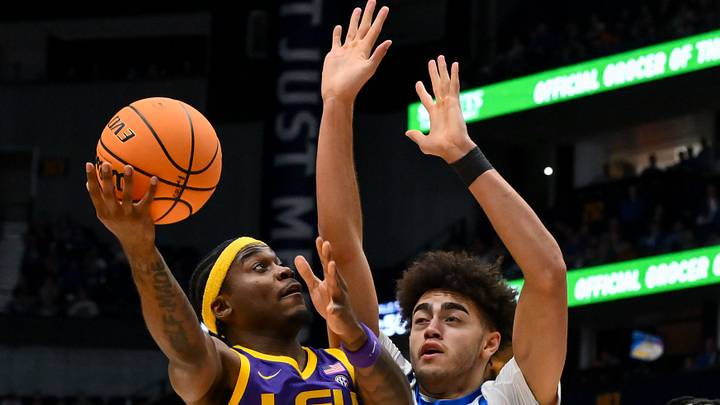
The SEC spent years fighting for respect as a basketball conference. That argument feels increasingly outdated.
College basketball's most recognizable football league has become brutally difficult on the hardwood, too, and the 2026-27 season should provide another example. Florida enters October with a legitimate argument as the best team in America, but the conference's depth is what makes the race particularly interesting.
Tennessee has reconstructed another roster capable of winning at a high level. Arkansas has John Calipari and a collection of young talent. Vanderbilt returns one of the country's best guards in Tyler Tanner. Kentucky added elite shooting around an intriguing returning core, while Alabama remains capable of overwhelming opponents offensively.
There are questions throughout the league, particularly because so many programs incorporated major transfer classes. But if the pieces fit, the SEC should again send a significant collection of dangerous teams into March.
Here's our first SEC power ranking entering October.
1. Florida
There isn't a more logical place to start.
Florida returns Thomas Haugh, Alex Condon, Rueben Chinyelu and much of the foundation from a 27-win team. Haugh averaged 17.1 points and 6.1 rebounds last season and enters 2026-27 as one of the leading national player of the year candidates. Condon gives the Gators another skilled frontcourt creator, while Chinyelu provides rebounding and interior defense.
The biggest reason Florida sits first isn't simply star power. It's the lack of an obvious weakness. The Gators have size, experience and enough offensive skill to play through several different players. Opponents can't build an entire defensive strategy around removing one scorer because Florida can attack elsewhere.
Preseason No. 1 rankings don't win championships, but Florida has earned the expectations. The Gators are the SEC standard until somebody proves otherwise.
2. Tennessee
Rick Barnes has built Tennessee into a program that rarely requires much imagination to understand. The Volunteers are going to defend, they're going to play physically and they're going to make opponents work for comfortable possessions.
The intrigue comes from a significantly reconstructed perimeter group. Dai Dai Ames, Juke Harris, Jalen Haralson and Terrence Hill Jr. give Tennessee a collection of talented guards, but figuring out roles and chemistry will take time. Barnes doesn't need every newcomer to become a star. He needs enough offensive creation to complement a defensive identity that should remain reliable.
Blue Ribbon placed Tennessee sixth nationally in its preseason rankings, ahead of every SEC team except Florida. That's a substantial endorsement of what Barnes has assembled. If the backcourt comes together quickly, Tennessee can absolutely win this league.
3. Arkansas
John Calipari's third season at Arkansas has a different feel because the Razorbacks now have a foundation rather than beginning entirely from scratch.
Gone to the NBA is Meleek Thomas. Thomas was a major reason for the optimism. He averaged 15.6 points, 3.8 rebounds and 2.5 assists as a freshman while shooting 41.6% from 3-point range. Thomas wasn't merely a promising young player. He was a chance to be the best guards in the SEC.
The Razorbacks will have to fill that void. Arkansas also brings in another collection of talented newcomers, giving Calipari the depth to create different lineups. The challenge will be finding consistency early rather than spending half the season discovering which combinations work. If that happens quickly, Arkansas has enough talent to challenge Florida.
4. Vanderbilt
Tyler Tanner changes the ceiling of this team.
He averaged 19.5 points, 5.1 assists and 2.4 steals last season, becoming the only player nationally to average more than 19 points, five assists and two steals. He also set Vanderbilt single-season records with 184 assists and 86 steals.
That's an extraordinary foundation for a program trying to move from interesting SEC team to legitimate conference contender.
The next step is proving Vanderbilt can consistently win the games that separate NCAA Tournament teams from conference-title threats. Tanner will draw enormous defensive attention, so the Commodores need secondary scorers to punish teams for loading up against him. If that support emerges, Vanderbilt's ceiling becomes extremely interesting.
5. Kentucky
Kentucky may have one of the most fascinating offensive pieces in the conference.
Milan Momcilovic arrives from Iowa State after averaging 16.9 points and making a school-record 136 3-pointers while shooting 48.7% from behind the arc. Those numbers are ridiculous enough before considering that he's 6-foot-8.
Mark Pope now gets to design an offense around that shooting gravity.
Kentucky also returns Malachi Moreno, who averaged a team-leading 6.3 rebounds and 1.47 blocks while shooting 58.2% from the field as a freshman. Moreno's interior presence combined with Momcilovic's perimeter shooting gives the Wildcats an intriguing inside-out foundation.
The Wildcats need their other newcomers to settle into roles, but the pieces fit Pope's preferred style. Kentucky could rise considerably higher than fifth.
6. Alabama
Nate Oats has established one of college basketball's clearest identities.
Alabama wants to play quickly, create layups and generate 3-point attempts. When the Crimson Tide are making shots, the mathematical pressure they place on opponents can become overwhelming.
That's why Alabama remains dangerous regardless of roster turnover. Oats recruits specifically for his system rather than attempting to reinvent his approach around each new group.
The question is familiar: Can Alabama defend well enough when the offense isn't operating at maximum efficiency? The Crimson Tide don't need an elite defense to contend for the SEC title. They need one capable of creating enough stops to let their offensive advantages take over.
7. Missouri
Missouri enters the season with a roster capable of outperforming this ranking.
Freshman Jason Crowe Jr. provides significant upside because he could give the Tigers another dynamic scoring option immediately. His transition to SEC basketball will matter, but Missouri shouldn't need him to solve every offensive problem from the opening game.
The Tigers' larger challenge is turning talent into consistency. The SEC punishes teams that go through extended stretches without reliable half-court offense or defensive rebounding. Missouri has enough individual ability to climb toward the top five, but it must prove it can win consistently against the league's more physical teams.
8. Texas
Sean Miller's first Texas roster is fascinating because so much of it is new.
The Longhorns added Amari Evans from Tennessee, Elyjah Freeman from Auburn, Isaiah Johnson from Colorado, Mikey Lewis from Saint Mary's and David Punch from TCU. They also signed a highly regarded freshman class featuring Marcus Spears Jr. and Austin Goosby.
Johnson could become the breakout name. He produced nine 20-point performances as a freshman at Colorado and gives Texas a proven young scorer around whom Miller can build.
The talent is obvious. The uncertainty comes from asking so many players to establish chemistry simultaneously. By February, Texas could look considerably better than it does in November.
9. Auburn
Auburn's place in the preseason conversation isn't as secure as it has been during some recent seasons, but dismissing the Tigers would be dangerous.
The SEC schedule rewards programs that can defend physically, rebound and survive difficult road environments. Auburn has developed a culture capable of doing all three.
The question is whether enough high-level offensive creation emerges to push the Tigers into the conference's upper tier. They don't need one player to dominate the ball every night, but somebody has to become the reliable option when transition opportunities disappear and games turn into half-court possessions.
10. Ole Miss
Ole Miss belongs in the broad NCAA Tournament conversation, but the margin between the middle of the SEC and the bottom half is incredibly thin.
The Rebels need their perimeter play to become a strength rather than merely adequate. SEC teams will expose shaky ball handling and inconsistent shooting quickly, particularly on the road.
There is enough talent here to finish several spots higher. The challenge is avoiding the losing stretches that can occur when a difficult conference schedule begins stacking quality opponents one after another.
11. LSU
LSU is one of the more difficult teams to place because roster construction and eligibility developments have created moving pieces throughout the offseason.
That uncertainty shouldn't be confused with a lack of talent. The Tigers have enough athleticism to cause problems, and a strong start could change the perception surrounding them quickly.
For now, they belong in the middle-to-lower portion of the league because other SEC programs have more established returning production. LSU's early nonconference games will tell us whether this ranking is too conservative.
12. Oklahoma
Oklahoma has enough pieces to make the middle of the SEC extremely uncomfortable.
The Sooners' challenge is separating themselves in a league where simply being solid isn't enough. Teams ranked seventh through 12th could be relatively close in overall ability, making home-court performance and close-game execution especially important.
If Oklahoma gets dependable guard play and avoids prolonged offensive droughts, the Sooners can move several spots higher. There simply isn't enough separation yet to place them above the more proven teams.
13. Mississippi State
Mississippi State's formula needs to begin with defense and physicality.
The Bulldogs aren't likely to win an SEC track meet every night, so their best path is making games uncomfortable and controlling the glass. That's a sustainable identity if the offense produces enough.
The concern is scoring consistency. In a conference with Florida, Alabama, Kentucky and other teams capable of generating points quickly, Mississippi State can't afford repeated six-minute stretches without offense.
14. Texas A&M
Texas A&M begins lower than its recent program reputation might suggest because the league has become so deep and the Aggies have questions to answer.
That doesn't mean they're incapable of climbing.
Rebounding and physicality have historically traveled well in the SEC, and those characteristics can keep a team competitive while its offensive identity develops. The Aggies need to establish dependable creators before conference play arrives.
15. Georgia
Georgia has recruited enough talent to make this ranking uncomfortable.
That's a good thing for the SEC.
The Bulldogs don't need to jump immediately into the top half to have a successful season, but they do need to show that their talent is translating into consistent winning. Establishing an offensive hierarchy will be especially important once conference scouting becomes more detailed.
16. South Carolina
Somebody has to start last in a league this deep, and South Carolina enters October with more questions than the teams above it.
That shouldn't be interpreted as a prediction of disaster. The difference between 12th and 16th may ultimately be only a handful of possessions across an 18-game conference schedule.
South Carolina's opportunity is straightforward: defend well enough to stay in games, identify reliable scoring options and protect its home floor. If the Gamecocks accomplish those things, this ranking will change quickly.
Florida starts first, but this race should change
Florida deserves the top spot because the Gators combine elite returning talent with continuity and a roster constructed to contend for the national championship.
Everything behind them is considerably less settled.
Tennessee has the defensive identity to challenge. Arkansas has one of the conference's most exciting young guards. Vanderbilt has a legitimate national star in Tanner. Kentucky added an extraordinary shooter, and Alabama remains capable of scoring with almost anybody.
Then comes a middle class filled with teams talented enough to beat the league's favorites on the right night.
The SEC basketball argument isn't about whether the conference is good anymore.
It's about how many of these teams will still be playing when March gets serious.
 Add us as a preferred source on Google