

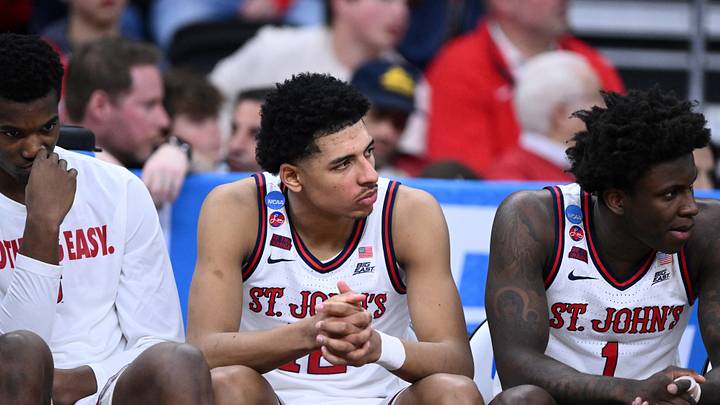
College basketball is approaching another season filled with talented transfers, international prospects and experienced players attempting to extend their careers.
But the biggest question surrounding several prominent programs isn't necessarily how their new players will perform.
It's whether those players will be permitted to compete.
The 2026-27 preseason has become increasingly complicated as NCAA eligibility rules, court decisions and conference regulations produce different outcomes for athletes facing seemingly similar questions.
St. John's received encouraging news this week involving two important additions.
LSU, meanwhile, is preparing to move forward without a former Big East Player of the Year.
And on October 13, Ohio Governor Mike DeWine signed an executive order that could further complicate the national eligibility debate.
These developments aren't simply administrative details.
They could influence conference championship races and NCAA Tournament expectations before the regular season even begins.
St. John's receives two important developments
Rick Pitino has assembled an intriguing roster at St. John's, but several eligibility questions have complicated the team's preseason preparations.
One of the most significant involved Quinn Ellis.
The British guard arrived after playing professionally in Italy, including time with Olimpia Milano in the EuroLeague.
St. John's announced his signing in May, highlighting his playmaking ability and international experience.
Ellis averaged 8.3 points and 4.5 assists in EuroLeague competition last season, providing evidence that he could become an important offensive contributor.
His eligibility, however, required NCAA review.
That uncertainty ended this week when Ellis received clearance to compete during the 2026-27 season.
For St. John's, the decision provides an important measure of stability at point guard.
The Red Storm can now prepare for the season knowing that one of their most experienced newcomers is available.
The situation involving Keyshawn Hall is more complicated.
Keyshawn Hall's legal victory doesn't end his eligibility case
Hall transferred to St. John's after an outstanding season at Auburn.
The 6-foot-7 forward averaged 19.3 points and 7.1 rebounds while earning third-team All-SEC recognition.
His scoring ability could make him one of the most important additions in the Big East.
However, Hall's eligibility has become part of a broader legal dispute involving athletes who graduated from high school in 2022.
A New York judge declined to vacate a temporary restraining order that permits Hall to participate while his case continues.
That represents a meaningful development for St. John's.
It does not mean every legal question surrounding Hall has been permanently resolved.
The distinction matters because temporary court protection can allow an athlete to compete while the underlying eligibility dispute remains unsettled.
Pitino can prepare to use Hall, but the program must continue following developments in the case.
For a team attempting to defend its Big East championships, that uncertainty is significant.
LSU faces a completely different outcome with RJ Luis
LSU's situation illustrates how complicated the eligibility landscape has become.
Will Wade on RJ Luis' current status 👀
— The Field of 68 (@TheFieldOf68) October 13, 2026
"We're going to follow all the SEC protocols with him. I think it's been pretty clear what the SEC protocols are on that. He didn’t travel with us to McNeese, and he hasn't been rostered."
(🎥: @ScarboroughMike) pic.twitter.com/PzDBlD9OgR
RJ Luis previously starred at St. John's, earning Big East Player of the Year recognition before pursuing a professional basketball career.
After going undrafted in 2025, Luis signed professional contracts involving NBA organizations and spent time with the Maine Celtics in the G League system.
He later attempted to return to college basketball by joining LSU.
However, the SEC adopted restrictions preventing players with certain professional experience from returning to compete at conference institutions.
On October 13, LSU coach Will Wade indicated that the Tigers would follow the conference's rules rather than challenge the decision involving Luis.
The result is significant.
A player who previously established himself as one of the Big East's best performers will not be part of LSU's active roster under the current circumstances.
That removes a potentially important offensive contributor from a program attempting to rebuild under Wade.
It also demonstrates that NCAA eligibility and conference-specific restrictions can produce different obstacles.
Receiving favorable treatment under one set of rules doesn't necessarily eliminate problems created by another.
Ohio's executive order introduces another complication
The situation became even more interesting on October 13.
Ohio Governor Mike DeWine signed Executive Order 2026-04D, allowing colleges and universities in the state to consider permitting otherwise eligible athletes from the high school class of 2022 to compete for a fifth season.
The order challenges the NCAA's implementation of its new eligibility model.
Earlier this year, the NCAA adopted an age-based framework that generally provides eligible athletes with a five-year competition window.
However, the implementation rules did not automatically restore eligibility to athletes who had already completed four seasons under the previous system.
That distinction has created legal challenges involving members of the 2022 graduating class.
Ohio's action adds another layer of uncertainty because the NCAA maintains national eligibility standards while individual states are attempting to influence how those standards apply.
The executive order doesn't automatically settle every athlete's eligibility.
It does create additional questions about consistency across different states and institutions.
The biggest concern is competitive consistency
College basketball has always involved complicated eligibility decisions.
Transfers, redshirts, academic requirements and professional experience have created difficult situations for decades.
However, the current environment presents an especially challenging combination of issues.
Some athletes are receiving NCAA clearance. Others are competing under temporary court orders. Still others face conference restrictions that could prevent participation even if they receive favorable decisions elsewhere.
That creates uncertainty for coaches attempting to establish rotations.
It also complicates roster construction.
A program might spend months preparing for a player to occupy an important role, only to discover shortly before the season that the player cannot compete.
Other teams might receive unexpected additions after their preseason preparation is already underway.
The result is a competitive environment in which legal and administrative developments can influence basketball decisions.
That is hardly an ideal situation for programs attempting to establish stability.
The uncertainty could extend into the regular season
St. John's opens its exhibition schedule against Drexel on October 14.
LSU faces UCF in another exhibition that same evening.
Both programs will use those games to evaluate their rosters, but their eligibility situations have already influenced which players are available.
For St. John's, the developments involving Ellis and Hall provide reasons for optimism.
For LSU, the decision involving Luis removes a significant potential contributor.
Ohio's executive order raises additional questions that could extend beyond those programs.
The NCAA and its member institutions must now navigate an environment in which legal rulings and conference regulations are increasingly important parts of roster management.
That could make eligibility one of the defining stories of the 2026-27 season.
Fans usually spend October debating which transfers will become stars and which teams have championship potential.
This year, another question might be just as important.
Who will actually be allowed to play?
 Add us as a preferred source on Google