

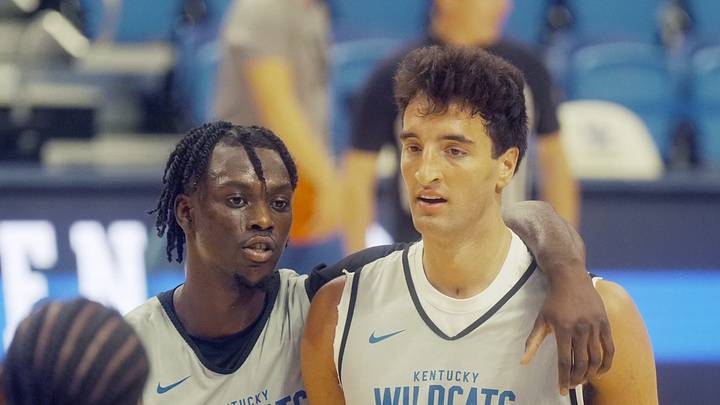
There are plenty of ways to dominate a college basketball game. Some players control the paint. Others create opportunities through passing, defense or relentless rebounding.
Then there are the shooters who can completely change a game in three minutes.
College basketball enters the 2026-27 season with an extraordinary collection of perimeter talent. Several returning players made more than 100 three-pointers last season, while others combined remarkable efficiency with the ability to create difficult shots.
Kentucky's Milan Momcilovic headlines the group after shooting 48.7 percent from beyond the arc at Iowa State. Texas Tech's Donovan Atwell returns after making 130 three-pointers, while Nebraska's Pryce Sandfort is coming off one of the most prolific shooting seasons in Big Ten history.
This ranking considers three-point accuracy, volume, shot difficulty, versatility and the ability to maintain production against defensive pressure. It also considers broader shot-making skill, which means the final few positions include players whose midrange scoring or projected development adds to their value.
Here are the 25 best shooters entering the 2026-27 college basketball season.
No. 25: David Mirkovic, Illinois
Mirkovic offers Illinois an intriguing combination of frontcourt size and offensive skill. At 6-foot-9, he can operate away from the basket and force opposing defenders to make decisions about how aggressively to protect the paint.
He isn't being ranked as one of the nation's most prolific three-point specialists. Instead, his inclusion reflects the value of shooting touch and offensive versatility from a frontcourt position. His development as a perimeter threat could make Illinois particularly difficult to defend.
No. 24: Darrion Williams, Texas Tech
Williams returns to Texas Tech after spending last season at NC State, where he averaged 14.0 points. He is more accurately described as a versatile offensive creator than a pure catch-and-shoot specialist.
That distinction matters because Williams can produce difficult baskets when a possession breaks down. His ability to create from different areas of the floor gives Texas Tech an additional offensive option alongside its established perimeter shooters. He could become particularly valuable late in close games.
No. 23: Caleb Foster, Duke
Foster returns to Duke as an experienced guard who understands how to contribute alongside talented teammates. His shooting value comes from his ability to recognize opportunities, operate within the offense and punish defenses that devote too much attention to other players.
Duke won't need Foster to become its leading scorer. However, the Blue Devils will benefit from having another guard capable of making perimeter shots and maintaining offensive spacing. His experience should help the team's new rotation develop chemistry.
No. 22: Braylon Mullins, UConn
Mullins produced 72 three-pointers during his freshman season and established himself as a player willing to take important shots. His overall three-point percentage still needs improvement, so this ranking reflects shot-making potential rather than elite established efficiency.
The sophomore's confidence is particularly valuable for a UConn team replacing several experienced contributors. Defenses must respect his willingness to shoot, even when he experiences difficult stretches. A meaningful improvement in accuracy could push him much higher.
No. 21: Rodney Rice, USC
Rice demonstrated impressive offensive ability before an injury ended his 2025-26 season after six games. He averaged 20.3 points and 6.0 assists during that limited stretch, showing the ability to create offense while handling substantial responsibility.
His health and shooting consistency remain important considerations entering the new season. However, Rice has the skill to manufacture difficult baskets rather than relying exclusively on open opportunities. USC could benefit enormously if he returns to form.
No. 20: Rowan Brumbaugh, SMU
Brumbaugh averaged 19.2 points at Tulane last season while shooting 36 percent from three-point range. His production came with significant offensive responsibility, meaning he frequently faced defenses focused on limiting his scoring.
SMU should benefit from his ability to create shots off the dribble and operate late in possessions. He isn't the most accurate perimeter shooter on this list, but his broader scoring versatility gives him value. The transition to ACC competition will test his efficiency.
No. 19: Juke Harris, Tennessee
Harris arrives at Tennessee after becoming one of the ACC's most improved players at Wake Forest. His scoring ability includes the capacity to create perimeter opportunities against defensive pressure, highlighted by a seven-three-pointer performance against West Virginia last season.
At 6-foot-7, Harris can shoot over smaller defenders and create difficult matchups on the wing. Tennessee should provide a different offensive environment, potentially allowing him to become more selective with his attempts. His combination of size and scoring confidence makes him dangerous.
No. 18: Stefan Vaaks, Illinois
Vaaks joins Illinois after beginning his college career at Providence. The 6-foot-7 guard provides the Illini with another perimeter-oriented offensive option who can contribute without being limited to traditional spot-up opportunities.
His size gives him an advantage when shooting over smaller defenders. Illinois will need to determine how his scoring fits alongside its returning contributors, but his offensive versatility creates interesting possibilities. A strong sophomore season could establish him as one of the Big Ten's better perimeter weapons.
No. 17: Aden Holloway, Alabama
Holloway averaged 16.8 points and 3.8 assists last season while earning third-team All-SEC recognition. His ability to create offense from the perimeter makes him an important part of Alabama's attack.
He is especially dangerous when defenders allow him space to operate off the dribble. Alabama's offensive system encourages quick decisions and aggressive perimeter play, creating opportunities for guards with Holloway's skill set. His experience should help him remain productive against difficult SEC competition.
No. 16: John Blackwell, Duke
Blackwell averaged 19.1 points at Wisconsin while shooting 38.9 percent from three-point range. He demonstrated the ability to score efficiently while handling substantial offensive responsibility against Big Ten opponents.
At Duke, Blackwell should benefit from playing alongside talented frontcourt contributors who demand defensive attention. That could create cleaner perimeter opportunities than he regularly received at Wisconsin. His combination of shooting and shot creation makes him one of the country's most complete offensive guards.
No. 15: Nick Townsend, Stanford
Townsend shot 46.3 percent from three-point range at Yale last season while averaging 16.3 points, 7.4 rebounds and 4.3 assists. Those numbers illustrate his unusual versatility for a 6-foot-7 forward.
His perimeter shooting becomes particularly valuable because defenders must also respect his ability to pass and attack the basket. Stanford will face stronger competition in the ACC, making it difficult to assume that his shooting percentage will remain unchanged. However, his established touch and offensive intelligence should translate.
No. 14: Ethan Copeland, Virginia Tech
Copeland arrives at Virginia Tech after making 109 three-pointers at Stetson last season. He shot better than 42 percent from beyond the arc while averaging 15.0 points per game.
Those numbers demonstrate both accuracy and volume, two qualities that don't always appear together. Copeland will encounter stronger perimeter defenders in the ACC, but his ability to convert shots consistently should help Virginia Tech stretch the floor. He gives the Hokies another dependable scoring option.
No. 13: Ben Hammond, Virginia Tech
Hammond shot 43.1 percent from three-point range last season while averaging 13.2 points. He also handled significant ball-handling responsibility, making his efficiency particularly impressive.
The Virginia Tech guard can punish defenses that leave him open while contributing as a distributor and defender. His shooting provides valuable spacing for the Hokies' frontcourt. With Copeland joining the roster, opposing teams could have difficulty deciding which perimeter threat deserves the most attention.
No. 12: Paul McNeil Jr., NC State
McNeil made 105 three-pointers last season while shooting 42.7 percent from beyond the arc. He averaged 13.8 points and established himself as one of the ACC's most dangerous perimeter scorers.
The impressive part of his production is that opponents frequently knew exactly what NC State wanted to accomplish. McNeil still found ways to create shooting opportunities and convert at an outstanding rate. His ability to sustain that efficiency with significant defensive attention makes him one of the country's premier shooters.
No. 11: John Mobley Jr., Ohio State
Mobley connected on 97 three-pointers last season while shooting better than 41 percent from beyond the arc. He averaged 15.7 points and produced nine games with at least five made three-pointers.
Those performances demonstrate his ability to generate offense in bunches. Mobley doesn't need many possessions to change the direction of a game, particularly when he begins finding rhythm. Ohio State should continue relying on his perimeter scoring throughout the season.
No. 10: Tyler Lundblade, Tennessee
Lundblade arrives at Tennessee after making 115 three-pointers at Belmont last season. He shot 40.6 percent from beyond the arc while averaging 15.6 points and 3.6 made three-pointers per game.
His production was built on substantial volume rather than occasional open opportunities. Tennessee gains a proven perimeter specialist who can force defenses to extend well beyond the three-point line. If Lundblade maintains his efficiency against SEC opponents, he could become one of the league's most valuable transfers.
No. 9: Trey Green, Saint Louis
Green shot 44.2 percent from three-point range last season while making 92 attempts from beyond the arc. He also helped Saint Louis win 29 games and reach the second round of the NCAA Tournament.
His shooting efficiency was among the best in the Atlantic 10. Green has demonstrated that he can punish defensive mistakes while contributing within a successful team offense. His return gives Saint Louis an established perimeter threat entering another season with significant expectations.
No. 8: Nyle Ralph-Beyer, VCU
Ralph-Beyer arrives at VCU after making 92 three-pointers on 209 attempts at Sacred Heart. His 44.0 percent shooting mark was among the country's best, and he demonstrated impressive consistency throughout the season.
This wasn't an isolated breakout. Ralph-Beyer shot 43 percent from three-point range during his freshman season, giving him an established record of perimeter efficiency. VCU is gaining a shooter who has already demonstrated that he can sustain excellent accuracy across multiple seasons.
No. 7: Abdi Bashir Jr., LSU
Bashir shot 44.4 percent from three-point range during his injury-shortened season at Kansas State. He made 67 three-pointers in 18 games, averaging more than 3.7 successful attempts per appearance.
His earlier production at Monmouth provides additional evidence of his shooting ability. Bashir made 127 three-pointers during the 2024-25 season while averaging 20.1 points. LSU gains an experienced scorer who has demonstrated that he can produce against different levels of competition.
No. 6: Mike McNair Jr., Maryland
McNair arrives at Maryland after an outstanding season at Boston University. He made 109 three-pointers while shooting 44.4 percent from beyond the arc, providing the Terrapins with a proven perimeter specialist.
His shooting should be particularly valuable for a program attempting to improve its offensive efficiency. McNair has demonstrated the ability to maintain accuracy while attempting a substantial number of three-pointers. The transition to Big Ten competition will be challenging, but his skill addresses an important need.
No. 5: Ryan Sabol, Providence
Sabol made 122 three-pointers at Buffalo last season while shooting 39.9 percent from beyond the arc. He averaged 18.8 points and regularly carried significant offensive responsibility for the Bulls.
His volume is particularly impressive. Sabol attempted 306 three-pointers, demonstrating the confidence and stamina required to remain productive while facing consistent defensive attention. Providence gains a shooter who can change a game quickly when he establishes rhythm.
No. 4: Brett Decker Jr., Baylor
Decker shot 47.1 percent from three-point range at Liberty last season while making 114 three-pointers. He also averaged 16.9 points, proving that his offensive value extended beyond occasional spot-up opportunities.
His efficiency was exceptional considering the number of attempts he took. Baylor should benefit from having a guard capable of punishing defenses that collapse toward the basket. If Decker maintains anything close to his previous accuracy, he could become one of the Big 12's most dangerous offensive additions.
No. 3: Pryce Sandfort, Nebraska
Sandfort made 129 three-pointers last season while shooting 41.6 percent from beyond the arc. His production helped Nebraska reach the Sweet 16 and established a new school single-season record.
At 6-foot-7, Sandfort can shoot over smaller defenders while contributing in other offensive areas. He averaged 18.1 points and demonstrated the ability to produce against elite Big Ten competition. Few players combine his size, shooting volume and established production.
No. 2: Donovan Atwell, Texas Tech
Atwell made 130 three-pointers last season while shooting 45.8 percent from beyond the arc. His production established a Texas Tech single-season record and included 81 successful three-pointers during Big 12 competition.
Those numbers are extraordinary considering the quality of opponents he faced. Atwell averaged 3.82 made three-pointers per game, consistently creating scoring opportunities through his perimeter accuracy. He enters the season as one of the country's most reliable high-volume shooters.
No. 1: Milan Momcilovic, Kentucky
Momcilovic earns the top position after one of the greatest three-point shooting seasons in recent college basketball history.
At Iowa State, he made 136 three-pointers while shooting 48.7 percent from beyond the arc. He averaged 16.9 points and maintained extraordinary efficiency despite taking nearly eight three-point attempts per game.
That combination of volume and accuracy separates him from the competition. Momcilovic isn't simply an effective shooter who benefits from occasional open opportunities. He is an established offensive weapon capable of changing defensive game plans.
Kentucky gains a 6-foot-9 forward who can stretch defenses and create space for teammates. His arrival should immediately improve the Wildcats' offensive possibilities.
For now, Momcilovic is the standard every other college basketball shooter is chasing.
Who could challenge Momcilovic?
Atwell and Sandfort have already demonstrated that they can make more than 125 three-pointers in a season. Decker and Ralph-Beyer bring remarkable efficiency, while Sabol and Bashir have experience carrying substantial offensive responsibility.
The most interesting question is whether anybody can match Momcilovic's combination of accuracy and volume.
Shooting nearly 49 percent from three-point range is difficult enough. Doing it while attempting almost eight shots per game is extraordinary.
That's why Kentucky's newest perimeter weapon begins the season at No. 1.
 Add us as a preferred source on Google