

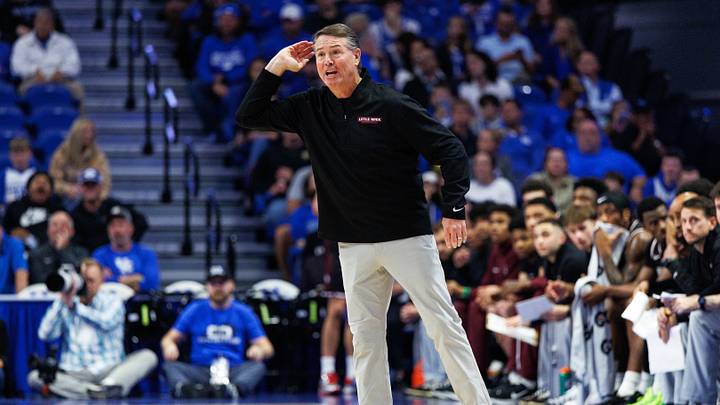
College basketball coaches frequently talk about rebuilding programs, but Travis Ford is experiencing something considerably more extreme at Little Rock. The Trojans enter the 2026-27 season with 15 players on their official roster, including 14 newcomers and just one returning player. For a coach who has spent nearly three decades leading Division I programs, this represents one of the most unusual challenges of his career. Ford isn't simply attempting to improve a struggling team. He's essentially constructing an entirely new program while preparing to compete in a new conference.
The situation becomes even more fascinating when considering Ford's extensive coaching background. He has led programs in several conferences, guided teams to the NCAA Tournament and developed a reputation for assembling competitive rosters. However, previous success doesn't automatically solve the problems associated with having almost no returning experience. Little Rock must establish an identity, develop chemistry and identify dependable contributors before the regular season begins. That's an enormous assignment for any coaching staff, regardless of experience.
A familiar name returns to an unfamiliar situation
Ford arrived at Little Rock in March 2026 with an impressive basketball resume and nearly 500 career coaching victories. The former Kentucky guard helped the Wildcats reach the 1993 Final Four under Rick Pitino before beginning a coaching career that included stops at Eastern Kentucky, Massachusetts, Oklahoma State and Saint Louis. He entered the Little Rock job with 491 career victories and seven NCAA Tournament appearances as a head coach. Those accomplishments made him an attractive candidate for a program searching for a new direction, particularly because Ford has previously demonstrated the ability to build successful teams.
His accomplishments at Eastern Kentucky remain especially noteworthy. Ford guided the Colonels to the 2005 NCAA Tournament, ending a 26-year absence from the event, before eventually moving to Massachusetts and Oklahoma State. He later took the Cowboys to five NCAA Tournaments and led Saint Louis to the 2019 Atlantic 10 Tournament championship. Those experiences provide valuable perspective for his latest assignment, but Little Rock presents circumstances unlike anything he encountered at those previous stops. Instead of adjusting an existing foundation, Ford must create one with almost entirely new personnel.
Fourteen newcomers and almost no continuity
The most remarkable aspect of Little Rock's roster is the absence of established returning players. Sophomore forward Terrion Burgess is the only holdover from the 2025-26 team, and even his experience is limited because a knee injury ended his freshman season after six appearances. Burgess averaged 7.5 points and 3.2 rebounds while shooting 65.4 percent from the field during those games, demonstrating promising ability in a small sample. However, six college appearances hardly provide the experience normally associated with a veteran leader. That leaves Ford depending heavily on newcomers to establish the team's identity.
The Trojans have assembled players from several different basketball backgrounds, including Division I transfers, junior college additions and incoming freshmen. Guard Jah'Likai King previously played at New Haven and UMBC, while Aaron Clark arrives after spending time at Wake Forest and Pepperdine. Forward Papa Amadou Kante previously attended Pittsburgh, and Ayomide Bamisile brings experience from Utah and Louisiana-Monroe. Each player arrives with different experiences, strengths and expectations, creating both opportunities and potential complications. Ford must determine which combinations complement one another while introducing a consistent offensive and defensive philosophy.
Building chemistry under those circumstances requires more than installing plays during practice. Players must learn where teammates prefer receiving passes, how they respond to defensive pressure and which combinations provide the best balance of scoring, rebounding and perimeter defense. Those details often develop naturally when programs return several experienced players, but Little Rock doesn't have that luxury. The Trojans will need to accelerate the process while accepting that mistakes are inevitable. How quickly they develop trust and communication could ultimately determine whether Ford's first season becomes a pleasant surprise or a difficult transition.
Little Rock's international roster adds another dimension
Little Rock's roster also features players with international backgrounds, adding another interesting element to the rebuilding process. Tyrese Lacey is from Birmingham, England, while Kante is a native of Dakar, Senegal. Bamisile comes from Lagos, Nigeria, and forward Roee Oselka is from Giv'atayim, Israel. That geographical diversity gives the Trojans players who developed through different basketball environments, potentially bringing contrasting approaches to offensive execution, defensive positioning and overall decision-making.
Those differences could eventually become an advantage if Ford successfully blends the roster into a cohesive group. International players frequently arrive with varied experiences involving professional development systems, youth academies and different styles of competition. However, Little Rock's challenge isn't simply collecting different skill sets. The coaching staff must identify how those abilities fit together within one system while establishing expectations that apply equally to every player. With so many newcomers, communication and consistency will be particularly important throughout the opening months.
Kentucky provided an early reminder of the challenge
Little Rock received an immediate opportunity to measure its progress against major-conference competition when the Trojans visited Kentucky for an October 16 exhibition. The Wildcats earned a 69-49 victory at Rupp Arena, providing Ford with an early evaluation of his developing roster. Although the result wasn't especially surprising considering the difference in resources and experience, the game offered valuable information about Little Rock's strengths and weaknesses. Facing a nationally recognized opponent also exposed the Trojans to the type of defensive pressure and physical competition they must learn to handle more effectively.
Exhibition results don't count toward regular-season records, making the evaluation process more important than the final score. Ford and his assistants could study how players responded to adversity, which lineups functioned effectively and where the team struggled with execution. Those observations should influence decisions about rotations and responsibilities before conference competition begins. For a roster featuring 14 newcomers, even a difficult exhibition can become a productive experience if the coaching staff identifies areas that need improvement. Little Rock's development will depend partly on how effectively it turns those lessons into progress.
Familiar coaching connections could accelerate the process
One potential advantage for Little Rock is that Ford has assembled a staff containing several familiar faces from his previous coaching stops. Associate head coach Van Macon brings extensive recruiting experience, while Christian Nunez and Jordon Kedrowski have connections to Ford's time at Saint Louis. Ted Crass adds local knowledge and familiarity with the Little Rock program. That combination provides continuity among the coaches even though the playing roster has undergone an almost complete transformation.
Having assistants who understand Ford's expectations could prove particularly valuable during the early stages of the season. Rather than spending months establishing a shared coaching philosophy, the staff can focus on teaching players the details of its offensive and defensive systems. Ford has emphasized an aggressive approach built around toughness, defensive pressure and an up-tempo playing style. Those principles require consistent effort and communication, especially when players are unfamiliar with one another. If the coaching staff can establish those habits early, Little Rock may develop a recognizable identity faster than expected.
A new conference makes the challenge even more interesting
Little Rock's rebuilding project coincides with its transition into the United Athletic Conference, adding another layer of uncertainty to Ford's first season. The Trojans must prepare for unfamiliar opponents while establishing chemistry among players who have barely competed together. That combination makes predicting their immediate success difficult, particularly because previous conference results offer limited insight into how the new roster will perform. Ford's experience suggests the program has capable leadership, but his accomplishments elsewhere don't guarantee immediate victories in a new environment.
Leadership within the roster will also be important. Burgess is the only returning player, but his limited experience means much of that responsibility must come from newcomers. Ford has identified King and Clark as team captains, giving the Trojans two players expected to help establish accountability and communication. Their ability to set expectations and respond to adversity could become just as valuable as their individual production. A team with this much turnover needs dependable voices in the locker room, especially when inevitable setbacks occur.
Ford's latest project could become one of the season's best stories
There are plenty of college basketball programs entering 2026-27 with significant roster turnover, but few have experienced anything resembling Little Rock's transformation. Fourteen newcomers, one returning player, a veteran coach beginning another chapter and a new conference create a fascinating combination. Ford has demonstrated throughout his career that he can build successful teams, yet this assignment may require more patience than any of his previous rebuilding efforts. The Trojans must develop chemistry, establish a consistent identity and determine which players can deliver against Division I competition.
Little Rock doesn't need to become an immediate national contender for the season to represent progress. Developing dependable offensive options, improving defensive communication and establishing a foundation for future success would all be meaningful accomplishments. However, the possibility of exceeding expectations makes the program worth watching throughout the season. If Ford transforms this collection of newcomers into a competitive conference team sooner than expected, his first year at Little Rock could become one of college basketball's most impressive rebuilding stories.
 Add us as a preferred source on Google