

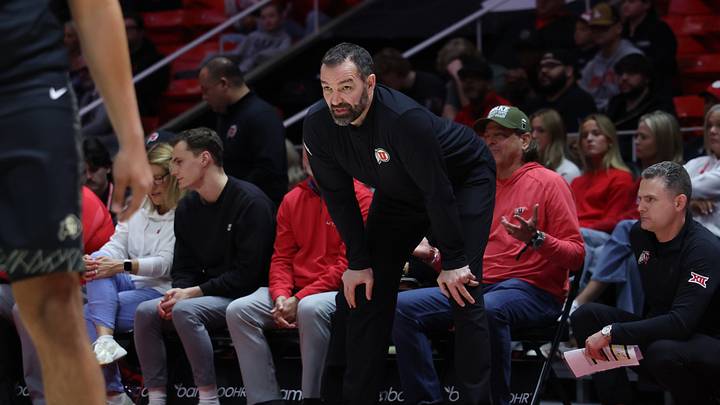
Basketball at Utah hasn’t exactly been an art form in recent years. The Utes have struggled to turn things around and this was when the program was still in the Pac-12. Life in the Big 12 hasn’t been easy by any means and cost Craig Smith his head coaching job back in 2025. Unfortunately, new coach Alex Jensen hasn’t exactly had the easiest time in his first 18 months running the show.
His Utes struggled considerably last season, finishing just 10-22 and ending up in dead last in a very talented Big 12. Make no mistake that there was talent on this roster, though the former NBA assistant couldn’t quite find his footing and his team was overmatched against some of the great programs in this conference. What doesn’t make matters any better is how this past offseason unfolded.
Massive exit for the Utes
Not only did Utah lose a few seniors, but there were a flurry of exits into the transfer portal, losing top scorer Terrence Brown and important pieces like Keanu Dawes, Kendyl Sanders, and Seydou Traore among others. They didn’t lose everybody, though it’s mostly a complete reload for Utah’s lineup, with Jensen and his staff leaning heavily on the portal while also plucking a few recruits and international prospects from unexpected places.
An entire decade has suddenly passed since Utah was in the NCAA Tournament and things aren’t headed in a great direction. Last season was the program’s worst record in nearly 15 years while the departures in the offseason weren’t exactly what you wanted to see, with so many promising players finding new homes. Regardless, we’ll run through the new playmakers and try to figure out just what this Utah squad will look like in the season ahead.
Projected Starters
Guard – Trey Campbell (Senior)
His eligibility is still very much a question mark, but Campbell is a veteran point guard and an important piece on both sides of the ball if he’s in Utah’s lineup. A four-year starter at Northern Iowa, Campbell averaged 13.7 points, 3.8 assists, and 1.7 steals per game and was also MVC Tournament MVP, helping get the Panthers into the Big Dance. His crafty work on defense and his shot-making ability reveal his importance if eligible.
Guard – Taison Chatman (Sophomore)
A former Top 40 prospect who just hasn’t found his footing, Chatman went from Minneapolis to three seasons with Ohio State, though the results were underwhelming. He barely saw the court in his first few seasons and battled with injuries before averaging 4.3 points and 1.2 rebounds largely off the bench last season. His work with the Buckeyes didn’t show it but Chatman is a productive scorer who’s hoping to live up to that earlier hype and be a top scorer for the Utes.
Guard – Jackson Holcombe (Junior)
Following three years at Utah Valley, Holcombe makes the quick journey over to Salt Lake City and hopes to be a major playmaker with the Utes. After redshirting and then playing a bench role, he emerged in a big way as a sophomore, averaging 16.0 points, 7.0 rebounds, 3.6 assists, and a WAC-leading 2.2 steals per game. Holcombe does a bit of everything and has positional versatility, with Utah excited about his defense as much as his game around the rim.
Forward – Babacar Faye (Senior)
An injury before the season kept Faye off the court last year, though the Utes are excited to see what he can produce in this frontcourt. A big previously for Charleston and Western Kentucky, he showed what he’s capable of with 15.2 points and 7.8 rebounds per game in an injury-shortened final season with the Hilltoppers and should be one of Utah’s best rebounders with nice interior presence.
Center – Fynn Schott (Freshman)
A 6-11 center from Austria, Schott enters the fold with significant international experience already under his belt. He’s still a relatively young prospect at just 19 years old who’s known for his defensive intensity and reliability in the paint. Schott’s role right off the bat seems to be playing significant minutes at the 5, though we’ll see just how Jensen and this staff want to ease him into his first collegiate experience.
Key Reserves
Guard – Styles Clemmons (Freshman)
A 3-star combo guard from Virginia Beach, Clemmons is a notable backcourt recruit who committed to the Utes over a year ago and still figures to factor into this lineup. He does a bit of everything, with his ability to run the point and manage the floor while also being an above average shooter who can affect the game in multiple ways, though his initial role in this backcourt is uncertain.
Center – Malek Gomma (Senior)
The first two seasons for Gomma were spent largely as a reserve at Seattle before finding his place at Weber State last year. Gomma averaged 8.0 points and 6.9 rebounds per game as a full-time starter for the Wildcats and is hoping that production follows him to Salt Lake City. Gomma figures to play important depth minutes in the frontcourt, though he doesn’t quite have the size to be a game wrecker at the 5.
Guard – TJ Burch (Junior)
There really is a lot to love about Burch’s game and there’s a major role waiting for him if everything goes right this season. A former backup at Ball State, he rose to the occasion at Wright State as a sophomore, averaging 12.4 points, 3.6 assists, and 2.6 steals per game. Burch was the Horizon League Defensive Player of the Game and Tournament MVP as a star for the Raiders and at the very least becomes the backup point guard and one of the better defensive players for these Utes.
Guard – Obomate Abbey (Sophomore)
A 6-0 guard out of Finland, Abbey had a rotation role as a freshman with the Utes last season and is looking for even more in year two. He put up 2.5 points and 2.2 assists per game, though his work was far more impressive running the point than as a scorer. If Abbey can improve some of those shooting figures, he can earn more run on a program that’s added quite the depth at the point.
Guard – Lucas Langarita (Sophomore)
Another returning player hoping for a larger role, Langarita joined the Utes midseason from Spain and is hoping for more consistency in his first full year in Utah. The 6-5 guard appeared in just five games due to his late arrival and injury struggles, averaging 2.6 points and 1.2 rebounds, but is a very potent shooter who might be among the best pure scorers in this backcourt when given the opportunity.
Forward – Alec Anigbata (Freshman)
There’s even more international flavor in this lineup with Anigbata coming to town after his work in Germany. A 6-8 forward with plenty of overseas experience, Anigbata is an above average shooter and at 21 years old is a bit more experienced than your typical raw frontcourt prospect. His development has been solid in recent years, though we’ll see how that translates into college basketball, with the Utes hoping he’s a more complete scorer and defender.
Forward – Zati Loubaki (Junior)
A 6-9 power forward out of France, Loubaki did solid work at the junior college level and is hoping his skill translates into a notable role this season at Utah. He’s another experienced player who has both international experience and some college ball under his belt, showcasing his ability to score, rebound, and affect the game in multiple ways. He brings necessary depth to a frontcourt searching for answers.
Schedule Outlook
You’ll be seeing a lot of the Utes home at the Huntsman Center early and often this season, beginning with five straight games to start the season. That stretch does include former conference rival Washington on November 14 around some winnable matchups. The Utes then end November with a trip to South Carolina, playing Dayton and Minnesota as part of the Charleston Classic.
Utah comes back home and hosts another former rival in California on December 2nd, but that’s honestly it for matchups that jump off the page. They follow that up with six more home games against mid-majors in December and the most exciting of these are either Portland or Sam Houston, with the Utes playing one of the weakest nonconference schedules among power conference programs.
Regardless of how things go during that easy stretch, Big 12 play will be a menacing battle from beginning to end. The Utes get two looks at BYU, Colorado, and Oklahoma State, but have rough road tests against Arizona in late January and at Houston in mid-February. There are winnable home games sprinkled throughout the season, before the home finale against Texas Tech and the season finale at Colorado on March 6th.
Season Outlook
No season has ever been won or lost on paper, but it’s hard to really compared this Utah squad to the rest of a very talented Big 12. Last season, the Utes finished in dead last but at least had some exciting younger pieces leading the charge. None of those rising stars are back in Salt Lake City, though it’s still an interesting group they’ve put together to try to get back into fighting shape.
One thing that’s easy to note at first is the flurry of point guards in this lineup. No matter how you feel about the level of talent, there are plenty of options in this backcourt. Campbell’s playmaking ability is outstanding but even if he’s unavailable then there are great options like Burch or Abbey from the bench. It’ll be interesting to see where this team finds their scoring though someone like Langarita could be in line for a major step forward.
Holcombe is a fantastic and versatile athlete, but you wonder how his game will translate into the Big 12. That’s a question we can ask about most of this talent, even if we’re excited about Anigbata and Loubaki as international faces in this frontcourt. It’s unlikely that everyone takes their big steps forward in this lineup, though Utah really needs stability in the paint and might be asking a lot from Schott and Gomma.
Nobody in the Big 12 will be surprised if Utah finishes last place once again, but we’re not all doom and gloom. Even though it appears like there’s less talent, there’s a lot of deep potential with some of these players, especially the international additions. Someone like Chatman could really emerge after struggling early in his career and it just takes one or two standouts to pull Utah out of the cellar in this league. Is that destined to happen or are Jensen and company headed for another year of struggling?
 Add us as a preferred source on Google