

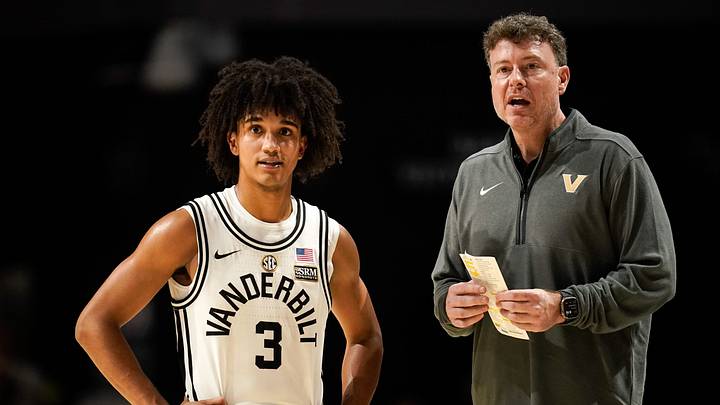
Vanderbilt entered the 2026–27 college basketball season with expectations that have become increasingly familiar under Mark Byington. The Commodores are no longer simply hoping to become competitive in the Southeastern Conference. They are attempting to establish themselves as a program capable of consistently challenging the league's strongest teams, and Thursday night's performance against Wake Forest provided another encouraging indication of their progress.
The No. 24 Commodores defeated Wake Forest 74–51 at Memorial Gymnasium, improving to 2–0 and extending the nation's longest active nonconference winning streak to 21 games. Tyler Tanner delivered 17 points and 10 rebounds, while Ace Glass III contributed 16 points and seven rebounds.
The victory wasn't a flawless offensive performance. Vanderbilt shot only 38.9% from the field and experienced several stretches when scoring became difficult. However, the Commodores compensated with rebounding, defensive pressure and an ability to capitalize on Wake Forest's offensive struggles.
Those characteristics could become particularly important once SEC competition begins.
Twenty-one consecutive victories tell a bigger story
Vanderbilt's nonconference winning streak has become one of the most impressive accomplishments of Byington's tenure. The Commodores have now won 21 consecutive games against opponents outside the SEC, a run that demonstrates their ability to consistently handle different styles of competition.
Wake Forest presented an interesting early test because the Demon Deacons entered the season hoping to establish themselves as an improved ACC program. Vanderbilt responded by controlling the rebounding battle and limiting the visitors to 51 points.
The Commodores outrebounded Wake Forest 48–33, including a 14–7 advantage on the offensive glass. Those additional possessions helped Vanderbilt overcome its own shooting difficulties and prevented Wake Forest from generating sustained momentum.
The Demon Deacons made only 19 of their 54 field-goal attempts and connected on six of 26 shots from three-point range. They also finished with just eight assists, reflecting how difficult it was to establish consistent offensive execution against Vanderbilt's defense.
Vanderbilt wasn't particularly efficient from the field, either. But the Commodores made 10 three-pointers, committed only six turnovers and consistently created second-chance opportunities.
That combination eventually produced a comfortable victory.
Tyler Tanner is becoming an important piece of Vanderbilt's identity
Tanner provided the most complete individual performance Thursday, finishing with 17 points, 10 rebounds and two assists. He made six field goals and converted all five of his free-throw attempts, helping Vanderbilt maintain control as Wake Forest attempted to reduce the deficit.
Glass also delivered an important contribution, connecting on four three-pointers while scoring 16 points. Anthony Brown Jr. added 14 points off the bench, making four shots from beyond the arc, while Chandler Bing finished with 13.
The balanced production gave Vanderbilt several different scoring options. Four players reached double figures, and the Commodores didn't need one individual to carry the entire offense.
That depth could become especially valuable during SEC play, when opponents are better equipped to limit a team's primary scoring options.
Vanderbilt also demonstrated that it can win without exceptional shooting percentages. The Commodores' ability to generate offensive rebounds and avoid turnovers provided a substantial advantage, particularly during the second half.
The Commodores have a chance to make another statement
Vanderbilt led 39–27 at halftime, but Wake Forest briefly threatened to make the game interesting after the break. Kevair Kennedy scored 20 points for the Demon Deacons, providing much of their offensive production.
The Commodores responded by maintaining their defensive intensity and eventually pulling away. Tanner's layup with 3:43 remaining pushed Vanderbilt's advantage to 65–47, effectively eliminating any realistic comeback opportunity.
The final margin was impressive, particularly against an opponent from another power conference.
Vanderbilt now turns its attention to Memphis, which visits Memorial Gymnasium on Tuesday. That game should provide another opportunity to evaluate the Commodores before the schedule becomes more demanding.
The SEC will present significantly greater challenges than Vanderbilt has encountered through its first two games. Maintaining the same rebounding advantage and defensive consistency against the conference's strongest teams won't be easy.
But Thursday offered another reason to believe the Commodores are building something sustainable.
A 21-game nonconference winning streak doesn't guarantee an SEC championship or a deep NCAA Tournament run. It does, however, demonstrate that Vanderbilt has developed a standard of consistency that deserves national attention.
The Commodores are no longer simply trying to surprise opponents. They're beginning to look like a program that expects to win.
 Add us as a preferred source on Google