

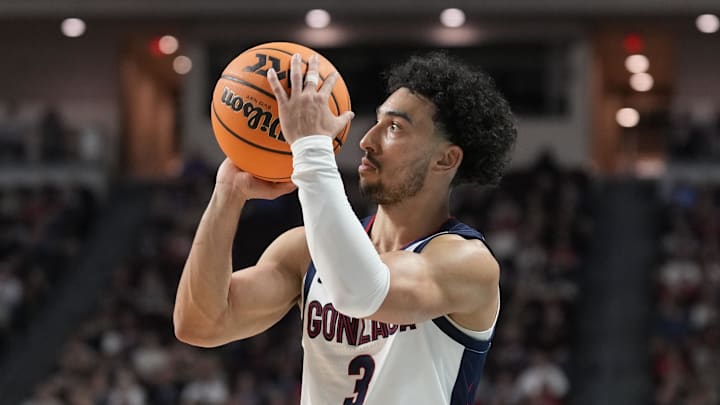
This is not about raw production. Smith averaged just 5.1 points and 3.6 assists last season. On the surface, those numbers suggest a rotational guard, someone replaceable in a program that consistently attracts talent.
But that misses the point.
Smith was a system guard. He was brought in to organize the offense, to make the right reads, and to keep everything on schedule. Those players rarely dominate box scores, but they shape how an offense functions possession by possession.
That role now disappears.
The value of a true floor general
Before arriving at Gonzaga, Smith had already proven what he could be.
At Colgate, he was a Patriot League Player of the Year and one of the most efficient playmakers in the country. He controlled tempo, created for others, and kept turnovers low.
That skill set translated in flashes at Gonzaga.
Even in limited minutes, Smith posted one of the best assist-to-turnover ratios on the team. He made quick decisions, avoided mistakes, and kept the offense connected.
Those traits matter more than scoring totals.
A shift away from structure
Gonzaga’s identity has long been built on offensive flow.
The Bulldogs typically rely on guards who can initiate sets, read defenses, and move seamlessly from one action to the next. Smith was built for that system.
Without him, the offense risks becoming more dependent on individual creation.
That is not necessarily a negative, especially with talented players capable of making plays. But it does change the rhythm. Instead of flowing through a primary organizer, possessions can become more reactive.
Smith provided structure. That structure is now gone.
Experience and feel are harder to replace
One of the most overlooked parts of Smith’s game was his experience.
He had already led a program before arriving at Gonzaga. He understood how to manage a game, when to push tempo, and when to slow things down. Those instincts are not easily replicated by younger guards or players still adjusting to larger roles.
In close games, those decisions matter.
Gonzaga is now asking someone else to fill that role, likely without the same level of experience or patience.
Why the move still made sense
This departure is not about failure on either side.
It is about fit.
As the season evolved, Gonzaga’s roster and offensive approach shifted. Injuries and personnel changes pushed the team toward a more improvisational style, one that relied less on a traditional facilitator and more on shot creation.
That shift did not align with Smith’s strengths.
For him, moving to a situation where he can control the offense makes sense. For Gonzaga, it opens the door to continue reshaping its identity.
The bigger picture for Gonzaga
Programs like Gonzaga rarely feel one departure in isolation.
But this one is different in a subtle way.
Smith was a connector. A player who tied possessions together, reduced mistakes, and made others more effective. Those players often go unnoticed until they are gone.
Now, Gonzaga has to decide what it wants to be.
A more free-flowing, creator-driven offense can work. So can returning to a system built around structure and precision. But without Smith, the balance shifts.
And sometimes, those quiet shifts end up defining a season.
 Add us as a preferred source on Google