

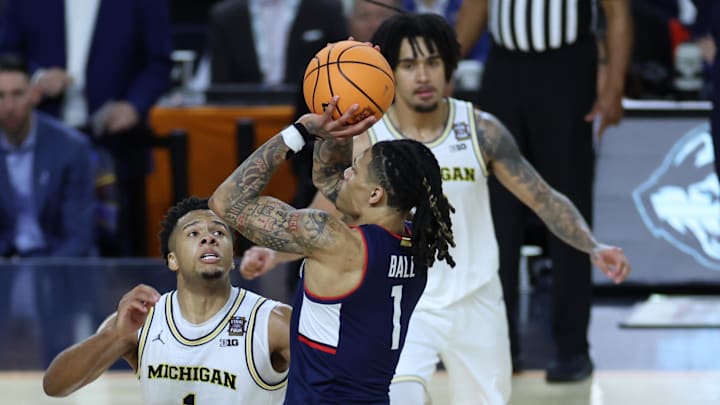
This is not just about losing a starter. It is about losing a specific type of player that UConn has relied on.
Ball has started 74 games over the last two seasons. He has been a steady presence in the backcourt and a key part of how the Huskies space the floor. Even in a season impacted by injury, he averaged 12.8 points and still showed up in big moments, including multiple three-pointers in both Final Four games.
UConn’s offense has thrived on guards who can make shots under pressure. Ball fit that mold. Without him, the structure of the offense changes.
The numbers show why he mattered so much
Ball’s development tells you everything about his importance.
He made a major jump from his freshman to sophomore season, going from 3.3 points per game to 14.4 while shooting over 41 percent from three. That kind of leap is usually a sign of a player figuring everything out.
This past season was more uneven. The wrist injury clearly affected his shooting, dropping him to 30 percent from deep. Still, the ability never disappeared. He remained a threat defenses had to respect.
That gravity is not easy to replace.
Who steps up in his place?
UConn is not starting from scratch, but the pressure increases across the roster.
Braylon Mullins becomes even more important as a returning scorer. Other guards will need to handle more responsibility, not just as shooters but as creators. The offense will likely lean more on balance rather than one consistent perimeter presence.
There are options on the roster, but none replicate Ball’s exact role. That means adjustments rather than replacements.
In a competitive Big East Conference, those adjustments matter every night.
The long-term outlook still matters
The decision for Ball to take a medical redshirt is about more than this season.
It gives him time to fully recover instead of playing through an issue that already impacted his performance. For a guard whose game depends heavily on shooting rhythm, that is critical.
If he returns fully healthy in 2027-28, UConn could get back a more complete version of the player who broke out as a sophomore. That version of Ball has All-Big East potential and could push toward national recognition.
What this means for UConn’s ceiling in 2026-27
The expectations do not disappear, but they do shift.
Without Ball, UConn loses a proven perimeter option and late-game shot maker. That lowers the margin for error, especially in close games where shot creation and spacing become critical.
At the same time, programs like UConn are built to adapt. Player development and depth will determine how much this loss truly impacts the season.
Ball’s absence will be felt throughout the year. But if anyone is going to find a way, it's Dan Hurley and his UConn Huskies.
 Add us as a preferred source on Google