

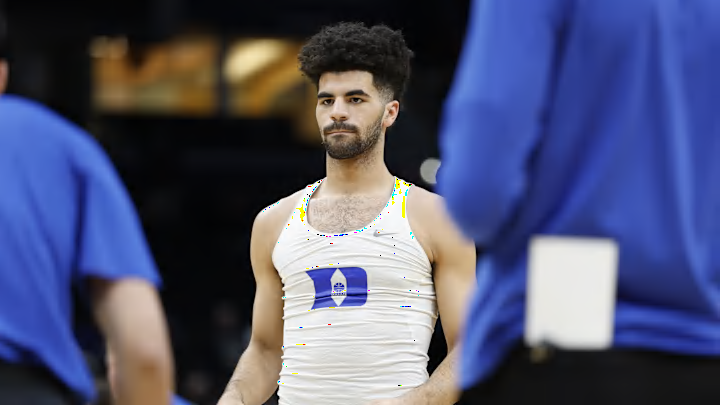
For a program like Duke Blue Devils, roster continuity is often the difference between being talented and being dangerous.
That’s what makes Boozer’s return so significant.
Duke has relied heavily on elite freshmen in recent seasons, from Cooper Flagg to Cameron Boozer, but that model comes with volatility. Boozer coming back gives Jon Scheyer something he has lacked at times: a guard who understands the system, has played in high-leverage NCAA Tournament moments, and is ready to lead rather than learn.
His late-season surge showed exactly what he can be. Once injuries forced him into a bigger role, Boozer looked far more comfortable controlling pace, making reads, and scoring efficiently. That version of him is what Duke now gets for a full season.
Year 2⃣ loading 👿 pic.twitter.com/kROQucGvEt
— Duke Men’s Basketball (@DukeMBB) April 16, 2026
A true point guard in a crowded backcourt
Duke’s 2026-27 roster will have talent, but it also has questions. Between returning players, incoming five-star guard Deron Rippey Jr., and pending NBA Draft decisions, there is no shortage of options.
What Boozer provides is clarity.
He is not just another guard. He is a true facilitator who can organize an offense, limit turnovers, and create structure in big moments. That matters even more after the way last season ended, when one chaotic possession helped swing an Elite Eight game against UConn.
Boozer’s growth as a decision-maker is arguably the most important internal development for Duke. If he takes another step, he becomes the connective piece that allows scorers like Isaiah Evans or incoming talent to thrive without forcing the offense.
Life after Cameron Boozer starts here
For the first time in his career, Cayden will play without his twin brother Cameron, a projected top pick in the 2026 NBA Draft.
That changes everything.
Last season, Cayden often operated in the background. Now, he steps into a leadership role by necessity. Duke no longer has a generational centerpiece to lean on. Instead, it will need balance, chemistry, and guard play.
This is where Boozer’s return becomes more than just a roster move. It’s a shift in identity.
Duke’s ceiling in 2026-27 will depend less on one superstar and more on how well its pieces fit together. Boozer is central to that equation because he dictates tempo, spacing, and late-game execution.
Experience that actually matters in March
Not all experience is equal. Boozer’s is valuable because of where it came.
He didn’t just play minutes as a freshman. He started ACC Tournament games. He ran the offense in the NCAA Tournament. He produced under pressure and also experienced failure on the biggest stage.
That combination tends to produce major sophomore jumps.
Guards who have been tested in March typically make the leap from promising to reliable. For Duke, that could mean fewer late-game mistakes, better shot selection, and a calmer offensive approach when games tighten in the tournament.
Raising Duke’s ceiling in 2026-27
Duke was already going to be talented. Boozer’s return makes it more functional.
Instead of scrambling to find a lead guard in the transfer portal, the Blue Devils now have an internal option with upside. Instead of relying solely on freshmen, they have a player who understands expectations in Durham.
That raises both the floor and ceiling.
If Boozer develops into a high-level lead guard, Duke becomes a legitimate national title contender again. If he stagnates, the roster still has talent but lacks direction.
That’s the reality of modern college basketball. Guard play decides everything.
And for Duke, the biggest offseason win might not come from the portal at all. It might already be in place.
 Add us as a preferred source on Google