

Preseason rankings are useful because they give college basketball fans a starting point.
They're also guaranteed to be wrong.
Some team currently sitting outside the national top 10 will become one of the biggest stories of the season. A transfer will be better than expected, a freshman will mature faster than anticipated or an experienced roster will develop chemistry that no projection system could accurately measure in September.
The current CBS Sports Top 25 And 1 begins with Florida, Duke, Illinois, UConn, Texas, Arizona, Michigan State, Louisville, Virginia and Arkansas. That's an impressive group, but it hardly represents the complete list of teams capable of becoming dangerous by March.
Here are 10 programs outside that current top 10 that have a realistic path toward becoming major NCAA Tournament threats.
Kansas
Kansas is exactly the type of team capable of making a preseason ranking look silly by January.
Bill Self already had one of the country's premier freshmen in Tyran Stokes and a collection of intriguing newcomers. Then the Jayhawks' outlook received another boost through the eligibility developments surrounding Tre White, adding an experienced player to a roster that needed exactly that.
The appeal is the combination of ceiling and coaching. Stokes could become one of college basketball's best freshmen, while Self has repeatedly shown an ability to shape evolving rosters into teams capable of winning difficult Big 12 games. Kansas may enter the season outside the top group, but nobody should be surprised if the Jayhawks are comfortably inside the top 10 by conference play.
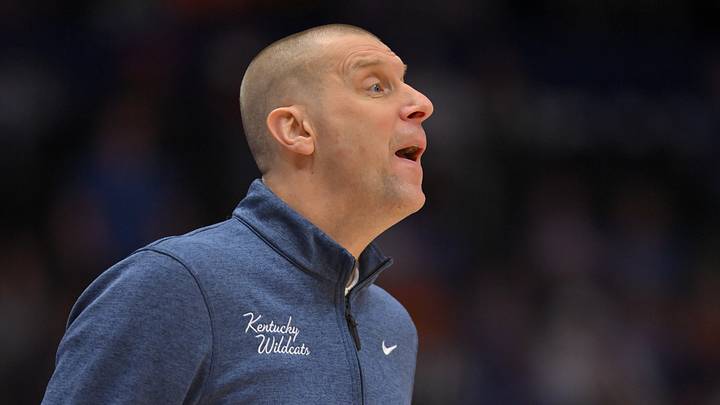
Kentucky
Kentucky's offseason became much more interesting when Mark Pope landed Milan Momcilovic.
Momcilovic made 136 3-pointers last season at Iowa State, giving Kentucky an elite shooter with the size to create spacing problems from the frontcourt. His presence should change the geometry of the Wildcats' offense because defenders can't simply help into the lane without risking an open shot from one of the country's most dangerous perimeter weapons.
Kentucky still has chemistry questions to answer, as nearly every reconstructed roster does. But Pope has a collection of pieces that fit the way he wants to play. If the Wildcats defend well enough to complement their offensive potential, they could rise quickly.
Iowa State
Iowa State's September outlook changed substantially when Tamin Lipsey gained the ability to return for a fifth season through the recent court ruling.
Lipsey is not simply another veteran guard. He owns Iowa State's career records for steals and starts and has earned All-Big 12 defensive recognition three times. Bringing that kind of experience back into T.J. Otzelberger's system changes the Cyclones' floor immediately.
There are still concerns. Killyan Toure's shoulder injury is expected to keep him out for a period of time, leaving Iowa State thinner on the perimeter than it would prefer. But Lipsey gives the Cyclones stability while the rest of the rotation develops. Iowa State already knows how it wants to win. Now it has its veteran leader back to execute that plan.
Michigan
It's unusual to describe the defending national champion as a team capable of surprising people, but Michigan's offseason has created enough uncertainty to make that possible.
The Wolverines suffered a brutal blow when five-star freshman Brandon McCoy Jr. tore his ACL and was lost for the season. That changed the roster's ceiling and put more responsibility on players such as Elliot Cadeau and Trey McKenney.
Then came positive news. Roddy Gayle was awarded a fifth year through a federal court ruling last week, providing Michigan with another experienced player at a time when it badly needed one. The Wolverines won't look exactly like the team that won the championship, but they still have enough talent and experience to remain relevant nationally. Writing off a defending champion before October would be premature.
Tennessee
Tennessee may have one of the widest ranges of possible outcomes among high-level SEC teams because Rick Barnes rebuilt so much of his backcourt.
Dai Dai Ames, Juke Harris, Jalen Haralson and Terrence Hill Jr. give the Volunteers an intriguing collection of perimeter talent, but most of it hasn't played together. That makes November particularly important as Barnes establishes roles and determines which combinations can survive defensively at the level he demands.
The reason for optimism is the program's identity. Tennessee knows what it wants to be defensively, and that gives a reconstructed roster something concrete around which to build. If the offense comes together quickly, the Volunteers could become far better than their initial national placement suggests.
Houston
Putting Houston on a sleeper-type list almost feels disrespectful considering what Kelvin Sampson has built.
That's also why the Cougars belong here.
Houston doesn't require a roster filled with preseason All-Americans to become a nightmare in March. Sampson's teams defend, rebound, create extra possessions and force opponents to play uncomfortable basketball for 40 minutes.
Dedan Thomas Jr. gives Houston another important perimeter piece as the Cougars reshape their rotation. There may be teams with more obvious offensive firepower, but Houston's style is unusually portable. When NCAA Tournament games become slower and more physical, the Cougars generally look very comfortable.
Gonzaga
Every few years, the preseason conversation seems to move away from Gonzaga.
Mark Few usually provides a reminder.
Braden Huff gives the Bulldogs a potentially elite interior scorer if he remains healthy, while Gonzaga continues to operate one of the most consistent offensive systems in college basketball. There have been offseason changes and backcourt questions, but those are hardly new challenges for Few.
Gonzaga doesn't need to dominate November headlines. The Bulldogs need to improve steadily, establish their best rotation and arrive in March playing efficient offensive basketball. Few's track record suggests that's a reasonable expectation.
BYU
BYU's ambitions have changed.
The Cougars are no longer simply trying to prove they belong in the Big 12. They're constructing rosters designed to compete near the top of it, and retaining Rob Wright III was a major part of that effort.
Wright averaged 18.1 points and 4.6 assists last season while shooting 41% from 3-point range. He's a proven lead guard in a league where experienced guard play is invaluable. BYU has surrounded him with additional talent and should have enough offensive firepower to make life difficult for anyone.
The Big 12 schedule will expose weaknesses quickly, but it will also give BYU repeated opportunities to build a strong NCAA Tournament résumé. The Cougars have the personnel to capitalize.
St. John's
Rick Pitino has already accomplished the first part of the job by restoring national relevance to St. John's.
The next step is turning that relevance into a sustained NCAA Tournament run.
Pitino's teams are difficult to play because they defend aggressively, force opponents to make uncomfortable decisions and generally improve as the season progresses. St. John's also continues to attract the kind of talent necessary to compete at the top of the Big East.
The question is offensive consistency. If the Red Storm find enough reliable scoring to complement their defensive identity, they could become the type of lower-seeded or underappreciated team nobody wants to see in March.
Alabama
Nate Oats gives Alabama one enormous advantage before the season even starts: everyone understands exactly how the Crimson Tide want to play.
Alabama wants pace, spacing, 3-point volume and pressure on the rim. When the personnel executes that style efficiently, opponents can fall behind quickly because trading twos for Alabama threes is rarely sustainable.
The defensive end remains the swing factor. Alabama doesn't need to become the best defensive team in the country, but it needs enough stops to allow its offensive advantages to matter. If Oats finds that balance, the Crimson Tide could move from outside the preseason top tier into the middle of the national championship conversation.
Someone outside the top 10 will become a contender
It happens every season because preseason rankings are snapshots rather than verdicts.
Kansas has an elite freshman and one of the best coaches in college basketball. Kentucky added perhaps the country's premier high-volume shooter. Iowa State unexpectedly gets another season from Lipsey. Michigan received important late eligibility news after suffering one of the offseason's most damaging injuries.
Then there are programs such as Houston and Gonzaga that have earned enough institutional trust to make preseason placement almost irrelevant.
Florida, Duke and Illinois deserve the attention they're receiving right now.
But the national championship race won't look exactly the same in January.
One or more of these teams may be the reason why.
 Add us as a preferred source on Google