


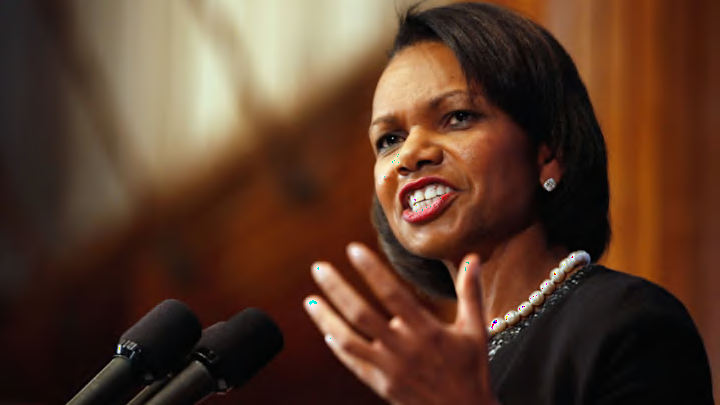
The highly anticipated report sanctioned by NCAA Basketball came out with their findings. However, the NCAA Commission blew the perfect opportunity to champion effective reform.
When the NCAA announced that Condaleeza Rice would chair of the committee that would look into wide-scale corruption in college basketball, there was some hope that the NCAA would look into much-needed reform. It was the perfect opportunity to admit mistakes and address the antiquated rules that have caused the stain of an FBI investigation. Imagine how refreshing it would’ve been to hear the NCAA talk about their antiquated rules and their failure to keep up with an ever-changing society. They would do what parents all over the world teach their kids… take responsibility for your mistakes.
Instead what the NCAA released was nothing more than a report that purported themselves as victims of the NBA and shoe companies with a side of “college athletes don’t know how lucky they are”.
On many levels, that should’ve been expected. Traditionally the NCAA’s response to its shortcomings is to make their already outdated rules and guidelines even more outdated.
One and Done Rule
Nothing brings out fake concern about student-athletes more than the “one and done” college basketball player. The NCAA is right when they say that this is an NBA-NBPA issue since they control who is and isn’t eligible to sign up for the draft.
But, in nothing comes off more disingenuous that the NCAA suggesting that the NBA rule hurts players “freedom of choice”.
"One-and-done has played a significant role in corrupting and destabilizingcollege basketball, restricting the freedom of choice of players, and undermining therelationship of college basketball to the mission of higher education. – Commission Report"
The NCAA and it’s members allow coaches impose stipulations when wanting a release from a letter of intent. Schools routinely restrict what schools student-athletes can transfer to. No one abused this power more than former Pitt coach Kevin Stallings. Despite Cameron Johnson graduating in three years, Stallings and the university still tried to prevent Johnson from transferring to the University of North Carolina.
This practice has long let coaches and schools have complete control over an athlete collegiate career, intentionally throttling player choice. At least in the NBA’s case, the player can weigh his options and have a financial reward for doing so. Whether the player ends up overseas or in the G League, if the goal is to get paid for playing basketball, that goal is achieved whether it’s in the NBA or not in the NBA.
So contrary to the Commission’s statement, player choice isn’t being restricted.
Furthermore, it wouldn’t cure the “one and done” culture. The NBPA would have to agree that players who drop out of school for a year wouldn’t immediately be eligible for the G-League. Even if that is the case, players would still have the choice of playing overseas or another ‘minor league’ basketball option.
Apparel Companies
The NCAA and it’s members have benefited from their deals with the Apparel companies. Leagues such as Nike EYBL, adidas Gauntlet, and Under Armour Association gives college coaches access to games that involve D1 talent prospects facing off against equitable talent.
Not only do the coaches get a better handle of seeing the player against top-flight competition, it also gives them a chance to use the apparel association as a bargaining chip to attract talent in the corresponding apparel’s league. Is it a guarantee of some sorts, of course not. But, having been to the Skills Academy of one of the major apparel companies, I received a first-hand look at the influence it potentially has.
For the universities, the deals with the apparel companies provide a massive upside. Business Journal took a look at the top 20 apparel deals in college athletics. The three major apparel companies were all represented in the top 3 with UCLA’s deal with Under Armour being the most lucrative followed by Louisville/Adidas and Nike/Texas.
With that being the backdrop, the NCAA found a way to throw their financial partners, and yes, that’s what they are, under the bus.
"The apparel companies that actively sponsor non-scholastic basketball are publiccompanies. It appears, however, that they do not have effective controls in place in theirspending in non-scholastic basketball. The Commission calls on the boards of thesecompanies to publicly support and implement financial transparency and accountabilitywith respect to their own investments in non-scholastic basketball."
Left out of this ‘preaching from the pulpit’ statement, is the fact how much the NCAA and their members benefit from this activity. This is what helps Louisville have enough money to get Rick Pitino, it’s what helps Kansas State land Micheal Beasley. The NCAA wants you to believe that the apparel companies are forcing them and their to take the money without benefit.
College Athletes Don’t Know How Lucky They Are
Out of all of the things in this report, this one was the most disturbing. The smugness and disillusionment of the NCAA was summed up in one sentence.
"We know too that many young men who would otherwise have little chance ofattending college are able to take advantage of their talents to achieve something of greatvalue in our society and economy – a college degree."
This is the stereotypical statement made about athletes who come from challenging economic situations. It gives the appearance of “dumb athletes” getting handouts other students don’t get. It also borders on racial lines. Something our society doesn’t need.
This “Plantation Mentality” is why the NCAA is where it is. It makes billions off the backs of an unpaid labor force. Unfortunately, too many people equate “free education” with “paid education”. The NCAA needs to keep hammering this charade to keep help shade it’s seedy “for profit” model. Gigantic television contracts, apparel deals, and sponsors are the ones who help fund the model we know as college basketball. The athletes aren’t getting a “free education”.
There’s a reason why former players like Ed O’Bannon took the NCAA to court. It’s a sham they sell fans who are largely jealous that they didn’t have the same opportunity.
The NCAA loves to compare athletes to the general population of the school but the one thing they leave out is the restriction on earned income. Let athletes earn income based on an opportunity like any other student.
There are students at every school who have parents, relatives, close friends who provide opportunities to earn income while in school that other students don’t have. Does that make the playing field unfair? There are paid and unpaid internships. Is that legislated by the school in the name of ‘fairness’?
So if an athlete wants to sign an autograph for money, why is it a violation? If an athlete wants to sign a deal to advertise with a company, it’s a violation. Why not allow athletes to earn their own money like any other student?
The fear that it would cut into the NCAA’s money is the reason why. It has nothing to do with an “even playing field”.
So with the FBI investigation still looming, the NCAA had double-downed on blaming everyone but themselves for this mess. NCAA President, Mark Emmert, still refuses to acknowledge the NCAA’s shortcomings and how it’s contributed to this mess. Instead, he sent the well-respected Condaleeza Rice to microphone to deliver a message that signified nothing.