

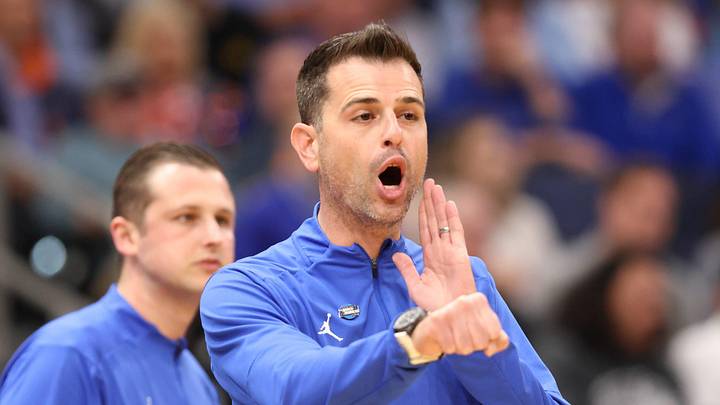
College basketball has changed dramatically over the past few years. Coaches aren't just coaching anymore. They're recruiting high school prospects, managing transfer portal additions, re-recruiting their own players every offseason, navigating NIL budgets and trying to build championship-caliber rosters on the fly.
The NBA offers something many college coaches rarely get these days: the opportunity to focus almost entirely on basketball.
That's part of what made Dusty May's move so fascinating. He had just led Michigan to a national championship and appeared to have one of the best jobs in the sport. Yet the chance to coach Cooper Flagg and lead one of the NBA's marquee franchises proved too good to pass up.
If May's departure is the start of a larger trend, who could be next? Here are the 10 college basketball coaches who seem most likely to follow a similar path.
10. Rick Pitino, St. John's
Let's start with the obvious caveat: age.
Pitino is 73 years old, which makes him an unlikely long-term NBA solution. But if an owner wanted a respected basketball mind to stabilize a franchise for a few seasons, few coaches could match his resume.
He's won everywhere he's been, understands how to build culture and still coaches with remarkable energy. The odds may be long, but completely ruling him out feels unwise.
9. Kelvin Sampson, Houston
Much like Pitino, Sampson's age is the biggest obstacle.
What isn't a concern is his ability to coach. Houston has become one of the most consistent programs in America under his leadership, built on toughness, discipline and relentless effort.
NBA executives respect Sampson tremendously. While a franchise probably isn't hiring him as a decade-long answer, it's not hard to envision a team looking for an experienced culture builder making a call.
8. Greg McDermott, Creighton
McDermott has quietly become one of the most respected offensive coaches in college basketball. Albeit, he did just retire from Creighton. Money talks and the NBA could be intriguing
Year after year, Creighton lost key pieces and somehow kept winning. His teams moved the ball, space the floor and consistently played efficient offense without relying on elite recruiting classes.
That ability to maximize talent is something NBA organizations notice.
7. Tommy Lloyd, Arizona
Lloyd's coaching style feels tailor-made for today's game.
His teams play with freedom, pace and skill, and his extensive international recruiting background gives him connections throughout the basketball world. Before becoming Arizona's head coach, Lloyd spent more than two decades helping build Gonzaga into a national power.
If an NBA franchise wants a fresh voice with a modern offensive approach, Lloyd would make plenty of sense.
6. Todd Golden, Florida
Golden has become one of the fastest-rising coaches in the country, and it's easy to see why.
He's comfortable with analytics, embraces modern roster-building strategies and doesn't appear married to doing things a certain way simply because that's how they've always been done.
Those qualities are increasingly valued in NBA front offices.
5. T.J. Otzelberger, Iowa State
Otzelberger may not generate as many headlines as some of the names above him, but his reputation continues to grow within the sport.
He's transformed Iowa State into one of the toughest programs in the country and consistently gets more out of his roster than many expect. His teams defend, compete and play with an edge every night.
Those traits translate regardless of level.
4. Mark Pope, Kentucky
Kentucky may be a college basketball job, but it often feels more like running a professional franchise.
The roster turnover is constant. Expectations are enormous. Every move is analyzed.
Pope's NBA playing background and experience navigating that pressure make him an intriguing candidate. If he continues building Kentucky into a national contender, professional opportunities could eventually follow.
3. Nate Oats, Alabama
Among active college coaches, Oats may already run the most NBA-style system in the sport.
Everything Alabama does offensively is rooted in pace, spacing and shot selection. His teams embrace analytics, hunt threes and layups, and play a style that would feel familiar to anyone watching an NBA game on a Tuesday night.
The biggest question isn't whether Oats could coach in the NBA. It's whether he'd want to leave one of the best jobs in college basketball. Still, if a franchise comes calling with the right opportunity, it's hard to imagine he wouldn't listen.
2. Jon Scheyer, Duke
Scheyer feels like the next generation of NBA coaching candidate.
He's still young by coaching standards, communicates well with players and spends every season managing rosters filled with future professionals. Few coaches in America have more experience balancing superstar expectations while still maintaining a team-first culture.
NBA front offices are constantly searching for coaches who can connect with modern players. Scheyer checks a lot of those boxes.
1. Dan Hurley, UConn
The easiest choice on this list is the coach who already came closest to leaving.
When the Lakers pursued Hurley, it wasn't some exploratory phone call. It was a legitimate attempt to lure him away from college basketball. He ultimately stayed at UConn, but the interest confirmed what many around the sport already believed: NBA teams view him as a serious candidate.
Hurley's intensity won't be for everyone. Some franchises may prefer a calmer presence. But few coaches in basketball have built a stronger reputation for player development, culture-building and winning at the highest level.
Dusty May's move to Dallas may have opened another door between college basketball and the NBA. If another coach walks through it soon, Hurley still feels like the safest bet.
Dusty May may have started a conversation
The reality is that coaching in college basketball has never been more demanding. Between NIL, the transfer portal and constant roster management, the job barely resembles what it looked like a decade ago.
That's why May's decision could end up being more significant than a single coaching change.
For years, the NBA primarily looked to its own assistant coaching ranks when filling vacancies. If May succeeds with the Mavericks, more franchises may begin looking toward college basketball's most innovative minds.
And if that happens, don't be surprised if several names on this list start hearing their phones ring.
 Add us as a preferred source on Google