

Florida begins October as the SEC's most complete team.
That doesn't mean the conference race is already decided.
Preseason projections reward known quantities, and Florida has more of them than almost anyone. Thomas Haugh, Alex Condon and Rueben Chinyelu give the Gators a frontcourt with experience, size and national awards potential. Several other important pieces also return from a 27-win team.
The challengers have more questions, but they also have considerable upside.
Tennessee needs a new backcourt to fit together. Arkansas needs its young stars to make another leap. Kentucky is building around an intriguing combination of shooting and interior size. Vanderbilt has one of the country's best guards, while Alabama's offensive system guarantees the Crimson Tide will remain dangerous.
The SEC championship may ultimately come down to which team provides the best answers to these five questions.
1. Can anybody match Florida's combination of talent and continuity?
This is the question every SEC contender has to answer before discussing Florida's weaknesses.
The Gators don't have many obvious ones.
Haugh averaged 17.1 points and 6.1 rebounds last season and enters the year as one of college basketball's leading national player of the year candidates. Condon gives Florida another versatile big capable of impacting games as a scorer, passer and rebounder. Chinyelu provides the physical interior presence that allows the other two to play more freely.
Continuity makes that talent more intimidating.
Florida isn't asking its best players to learn one another's tendencies in November. The Gators already know where Haugh prefers the ball, how Condon sees passing lanes and what Chinyelu provides defensively.
The challengers may eventually reach Florida's level.
They just have more work to do before getting there.
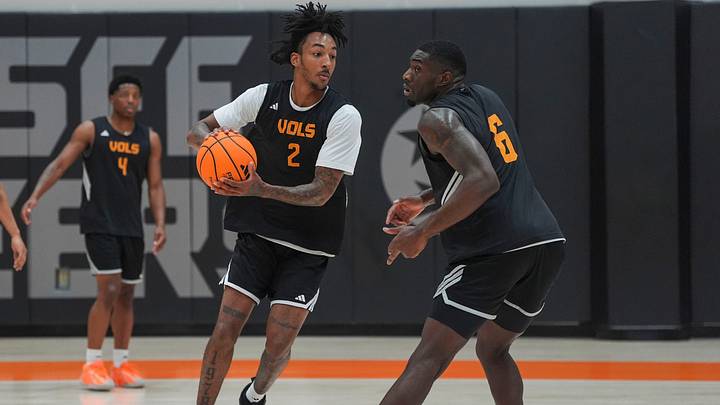
2. How quickly can Tennessee's new backcourt become dependable?
Tennessee's ranking near the top of the SEC is based partly on trust.
Barnes has built a program with a recognizable defensive identity, and the Volunteers rarely become an easy opponent simply because personnel changes.
This year's challenge is substantial.
Dai Dai Ames, Juke Harris, Jalen Haralson and Terrence Hill Jr. give Tennessee plenty of perimeter talent, but the group must establish roles. Who initiates offense? Who becomes the late-clock creator? Which combinations defend at the level Barnes demands? Who gets the ball when Tennessee needs a basket with two minutes remaining?
Those questions don't have to be answered in the first week of November.
They need to be answered before the SEC schedule becomes unforgiving.
If Tennessee finds reliable solutions, the Volunteers have enough talent to challenge Florida for the league title. If the backcourt remains inconsistent, Tennessee may spend the season chasing rather than leading.
3. Is Arkansas ready to turn young talent into a championship-level team?
Calipari has assembled another talented collection of players, but talent accumulation and championship basketball aren't automatically the same thing. Arkansas needs defined roles, reliable defense and players willing to impact games when they aren't getting shots.
The Razorbacks' ceiling is enormous if those pieces fit.
Thomas could become an All-American. Arkansas' newcomers could provide enough depth to survive the SEC schedule. Calipari certainly understands how to manage elite talent.
Now Arkansas has to turn possibility into consistency.
4. Can Kentucky's shooting create one of the SEC's best offenses?
Momcilovic changes the equation.
He didn't merely shoot well at Iowa State. He made a school-record 136 3-pointers while connecting on 48.7% of his attempts from behind the arc.
That level of shooting creates space before the possession even develops.
Defenders can't casually help away from Momcilovic. Closeouts have to be aggressive, which creates driving opportunities for guards and additional room for Moreno around the basket.
Moreno provides the interior half of the equation. He led Kentucky in rebounding and blocked shots as a freshman while shooting 58.2% from the field.
Pope now has the ingredients for an extremely efficient inside-out offense.
The unknown is whether Kentucky's guards can consistently organize it. Shooting only creates an advantage if the offense moves the ball well enough to exploit defensive reactions.
If that happens, Kentucky may be considerably better than its preseason SEC placement.
5. Which challenger outside the obvious favorites makes the biggest jump?
This is where the SEC race becomes especially interesting.
Vanderbilt has Tanner, who averaged 19.5 points, 5.1 assists and 2.4 steals last season. Alabama has Oats and an offensive system capable of producing points in bunches. Missouri has enough talent to become a significant factor, while Texas' enormous collection of transfers and freshmen gives Miller one of the league's most unpredictable rosters.
At least one of those teams will probably be better than expected.
Vanderbilt is particularly fascinating because Tanner gives the Commodores a proven late-game creator. Teams without dependable guard play often struggle once conference games become tight and heavily scouted. Vanderbilt doesn't have that problem.
Texas represents the opposite kind of possibility.
The Longhorns have significantly more uncertainty, but Johnson, Punch, Freeman, Lewis and an excellent freshman class give Miller plenty of combinations to explore. Texas could look average in November and dangerous by February.
The SEC champion may ultimately come from the obvious group.
The shape of the race, however, will be determined by the teams that force their way into it.
Florida owns the advantage entering October
Every conference race begins with assumptions.
Right now, the safest assumption in the SEC is that Florida will be extremely good.
The Gators possess proven stars, complementary frontcourt pieces and continuity. Tennessee, Arkansas and Kentucky all have enough talent to challenge, but each has more significant questions to answer.
That's what makes October important.
Preseason practice won't decide the SEC championship, but it will begin establishing roles, rotations and chemistry that matter once January arrives.
Florida has the fewest questions.
Everyone else has the next three months to find better answers.
 Add us as a preferred source on Google