

The ethos of modern college basketball has been driven by coaches like Todd Golden, Dusty May, Jon Scheyer, and Tommy Lloyd, conveniently, the four coaches who earned No. 1 seeds in this year’s NCAA Tournament. Rather than playing the five-out, small-ball, three-and-layups style that trickled down from the Steph Curry Warriors and James Harden Rockets, they’ve supersized, emphasizing rim dominance on both ends of the floor with massive front courts.
While the small-ball, five-out, three-point-heavy style bears out great results over a seven-game series, in college, where the championships are decided by single-elimination tournaments, it leaves the best teams vulnerable to massive variance. Emphasizing rim dominance raises the floor, and is another reason, aside from NIL and the Transfer Portal, that we’ve seen the death of the Cinderella story in March Madness.
Yet, with all this focus on dominating the paint, as they always have, the guards run march. Somebody has to get the bigs the ball, that’s why guards still tend to decide the biggest games of the season. That’s also why four of our five members of the 2026 March Madness Round of 32 All-Tournament team happen to be guards.

Tamin Lipsey, Iowa State
Joshua Jefferson is Iowa State’s best player, and the senior forward has played just three minutes in the NCAA Tournament after suffering an ankle injury in the first round. Yet, the Cyclones have a dominant 108-74 win over Tennessee State and on Sunday, notched an 82-63 win over seventh-seeded Kentucky, outscoring the Wildcats 51-33 in the second half.
While Jefferson is the team’s best player, over the last four years, as TJ Otzelberger’s teams have secured three top-three seeds in March Madness, you could easily argue that Tamin Lipsey has been the most important. The 6-foot-1 senior point guard lived up to that billing on Sunday with 26 points, 10 assists, and 5 steals.
Kentucky stormed out to an early lead while the Cyclones couldn’t hit any shots, but as it always does, the Cyclones' defense settled in, and with Lipsey as the tip of the spear, forced 20 turnovers and scored
Jeremy Fears Jr., Michigan State
Anytime you join and pass Magic Johnson in the record books in the same game, it’s a pretty good day. That’s what Jeremy Fears Jr. did against Louisville on Saturday, despite shooting a wretched 3-13 from the field.
Even though nothing was falling, Fears was an offensive maestro, orchestrating everything for the Michigan State offense. He’s a master at probing the defense off the pick-and-roll and forcing defenders to commit to him just enough for him to find a shooter or, ideally, for our viewing pleasure, a cutting Coen Carr ready to tear the rim off.
With 16 assists, Fears passed Magic Johnson’s unofficial Michigan State NCAA Tournament record (assists weren’t an official stat for his 14-assist performance), and joined Johnson, who was the last player to post back-to-back 10+ assist games in March Madness. Fears dished out 11 in Michigan State’s first-round win over North Dakota State.
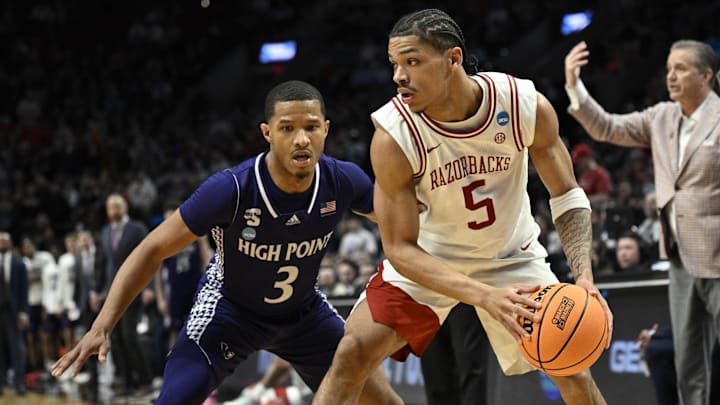
Darius Acuff Jr., Arkansas
If you needed a bucket with the game on the line, out of all 32 teams that made advanced in the NCAA Tournament, there isn’t a player you’d rather give the ball to than Darius Acuff Jr. John Calipari has had a ridiculous amount of excellent guards throughout his coaching career, from Derrick Rose to John Wall, Devin Booker, Jamal Murray, De’Aaron Fox, Shai Gilgeous-Alexander, Tyrese Maxey, and more. In college, Cal has never had a scorer like Acuff.
The 6-foot-3 freshman wears the Allen Iverson sweatband on his arm, and he plays like AI. He’s a bulldog getting downhill, but still has the handle and wiggle to stop on a dime and change direction at ease, and the balance and body control to pull up or finish at the rim with ease. Unfortunately, those abilities don’t translate to the other end of the floor, but that’s another story for another day.
Acuff took over in crunch time, scoring or assisting on 17 of Arkansas’s final 21 points. He got wherever he wanted on the floor, knocking down big shot after big shot. With his 35-point outing, he is averaging 30 points and 7.2 assists in the postseason with 46/49/87 shooting splits, and the Razorbacks are 5-0. Over that stretch, he has a 36.4 percent usage rate. Against High Point, his usage rate was 41.4 percent.
Alex Karaban, UConn
No player in college basketball has more experience than Karaban, UConn’s fifth-year senior and the sport’s only active two-time national champion. That championship guile was on display Sunday night in Philadelphia when no other Husky could get their offense going in the second half.
Karaban was the only Husky on the board for the first seven minutes after intermission, trading punches with UCLA as the Bruins started the half on an 11-8 run to erase a halftime deficit. The veteran forward had 16 of his 27 points in the second half and kept UConn’s head above water until the rest of the team could get going. That’s what veteran leaders are for, and Karaban was getting it every which way, knocking down threes, doing damage in the paint, and getting to the free-throw line.
At 6-foot-8, the senior is a bit undersized at the four with modern college basketball’s push for massive front courts, but his shooting and passing more than make up for it.
Fletcher Loyer, Purdue
Through his historic four-year career, Braden Smith has had one consistent weakness, and there’s not much he can do about it. At 6-foot, 170-pounds, Smith is just always going to struggle with big, physical, athletic guards. He did against Miami because that’s exactly what Jai Lucas wants in the backcourt. Smith, as he has at times in his tournament career, including Purdue’s loss to Farleigh Dickinson his freshman year, struggled, going to 3-12 from the floor with eight turnovers to his eight assists.
Four years ago, against FDU, Smith’s running-mate couldn’t bail him out. On Sunday in the Round of 32, Fletcher Loyer was more than up to the task. When Loyer is hot, the Boilermakers are just about impossible to beat. When he scores 20 points over the last four years, Purdue is 13-2 when Loyer scores 20+ points, and Sunday was the first time he’s ever done it in the NCAA Tournament. It’s even more helpful when, like on Sunday, he does it on just seven field goal attempts.
Loyer went 6-7 from the field, 4-4 from three, and 8-8 from the free throw line. His only miss came when he got thrown a grenade late in the shot clock and just had to get it out of his hand. The Purdue offense is constructed around the Smith-Trey Kaufmann-Renn pick-and-roll, and all the attention that combination draws creates open shots for Loyer on the backside. If they continue to fall at this rate, Matt Painter’s senior trio may finally reach the mountaintop in March.
Busting Brackets March Madness All-Tournament Team
- Round of 64
- Round of 32
- Sweet 16
- Elite Eight
- Final Four
 Add us as a preferred source on Google