

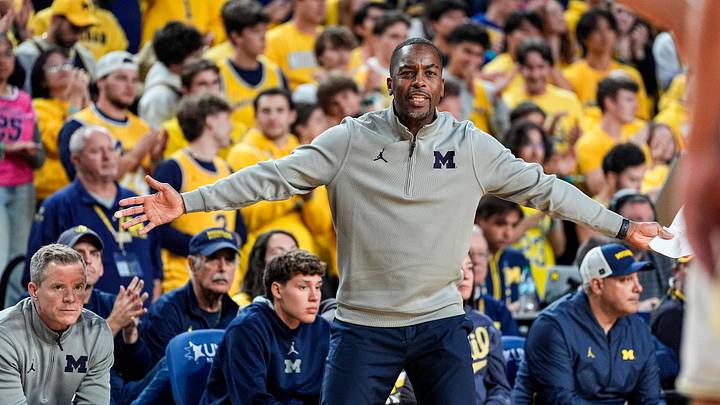
Michigan basketball experienced an extraordinary offseason that few programs could have anticipated.
The Wolverines celebrated a national championship in April, watched head coach Dusty May leave for the NBA in June and eventually promoted assistant Mike Boynton Jr. to lead the defending champions.
For most programs, losing a national championship coach would create an enormous amount of uncertainty. Michigan managed to maintain considerable stability, retaining important players and keeping much of its championship infrastructure intact.
However, the Wolverines' latest exhibition offered a reminder that maintaining a championship standard is never automatic.
Michigan defeated Oregon State 98-93 on October 16, surviving a game that featured 18 lead changes and 11 ties. Although the Wolverines ultimately secured the victory, allowing 93 points against a rebuilding opponent raised interesting questions about the team's defensive development.
The performance was especially notable considering Michigan's identity during last season's national championship run.
The defense that helped Michigan win everything is still developing
Michigan finished the 2025-26 season with a remarkable 37-3 record, including a 19-1 mark in Big Ten play.
The Wolverines defeated UConn 69-63 in the national championship game, capturing their first NCAA title since 1989. Their success was built around outstanding talent, impressive depth and a defensive system that ranked first nationally in KenPom adjusted defensive efficiency.
Boynton played an important role in establishing that identity.
Serving as Michigan's defensive coordinator under May, he helped develop a system that consistently challenged opponents and created opportunities for the Wolverines to control games.
That background made Boynton a logical choice when Michigan needed a replacement for May.
However, the Oregon State exhibition demonstrated that last season's defensive success won't automatically carry over.
The Beavers shot 52.5 percent from the field and remained competitive throughout the contest. Michigan also lost the rebounding battle 37-29, an unusual result for a program that relied heavily on its interior presence during the championship season.
The Wolverines still produced enough offense to win, but the defensive performance provided Boynton with several areas to address before the regular season begins.
Dusty May's departure created an unusual challenge
May's decision to become head coach of the Dallas Mavericks was one of the most surprising developments of the college basketball offseason.
He had guided Michigan to a 64-13 record across two seasons, transforming the program into a national championship contender after previously leading Florida Atlantic to the 2023 Final Four.
His departure came shortly after the Wolverines captured their second national championship.
Michigan responded by naming Boynton interim head coach before officially removing that designation on July 10. The university awarded him a two-year contract, placing an experienced former Big 12 head coach in charge of one of college basketball's most recognizable programs.
Boynton previously spent seven seasons leading Oklahoma State, compiling a 119-109 record and helping develop future NBA No. 1 overall selection Cade Cunningham.
His experience was valuable, but Michigan's circumstances created an unusual situation.
Rather than rebuilding a struggling program, Boynton inherited a defending national champion with enormous expectations.
Every performance will inevitably be compared with the standard May established.
Michigan's returning guards offer an important advantage
Although the Wolverines lost considerable frontcourt talent to the NBA, they retained several important pieces.
Elliot Cadeau and Trey McKenney remain central figures in Michigan's backcourt, providing experience and continuity during the coaching transition.
Cadeau delivered an outstanding performance against Oregon State, scoring 27 points and distributing eight assists. After managing only one point in the first half, he scored 26 after halftime and helped Michigan survive several tense moments.
McKenney contributed 18 points, providing another reliable scoring option.
The Wolverines also received an encouraging performance from Moustapha Thiam, who finished with 19 points and 10 rebounds. Thiam's presence will be especially important after Michigan lost several members of last season's imposing frontcourt.
Freshman Quinn Costello added 10 points off the bench, demonstrating the potential value of Michigan's younger players.
Those performances illustrated why the Wolverines remain capable of competing at a high level despite the coaching change.
However, replacing the production and defensive impact of departed stars won't happen immediately.
Three NBA lottery picks leave enormous expectations behind
Michigan's championship roster featured several players who subsequently became NBA lottery selections.
Morez Johnson Jr. was selected ninth in the 2026 NBA Draft, followed by Yaxel Lendeborg at No. 11 and Aday Mara at No. 12.
Losing three lottery picks would challenge any program, regardless of its coaching situation.
Those departures removed a considerable amount of size, athleticism and experience from Michigan's rotation. The Wolverines responded by adding talented newcomers, but developing the same defensive chemistry will require time.
The Oregon State exhibition demonstrated that challenge.
Michigan forced 17 turnovers and converted those mistakes into 31 points, an encouraging indication that the team can still create offense through defensive pressure.
However, the Wolverines also allowed Oregon State to shoot efficiently and surrendered a rebounding advantage.
The contrast illustrates the difference between producing disruptive defensive possessions and maintaining consistent defensive control throughout an entire game.
Boynton understands that distinction better than most coaches, given his role in Michigan's championship defense.
Now he must develop a new group capable of meeting those expectations.
The defending champions face another significant test
Michigan will conclude its exhibition schedule against Houston on October 25 at Van Andel Arena in Grand Rapids.
The matchup provides another opportunity to evaluate the Wolverines against demanding competition before the November 2 regular-season opener against Oakland.
Boynton has already guided Michigan to exhibition victories over Eastern Michigan and Oregon State. Those results are encouraging, but the quality of the performances matters more than the preseason record.
The Wolverines have enough offensive talent to compete with outstanding opponents. Their returning guards provide experience, while the rebuilt frontcourt offers considerable potential.
The bigger question involves whether Michigan can recreate the defensive consistency that made last season's team so difficult to beat.
Winning a national championship requires exceptional execution, chemistry and resilience.
Defending one demands all those qualities while managing the expectations that accompany success.
Michigan survived the departure of its championship coach. The next challenge is proving that the standard he helped establish can survive without him.
 Add us as a preferred source on Google