

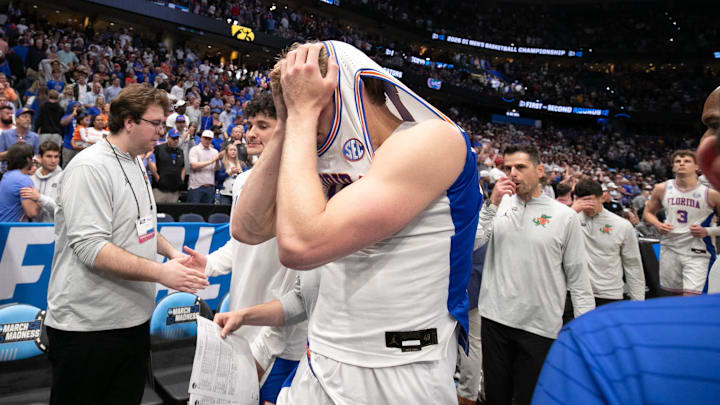
The money is real now.
You can see it in the rosters, the recruiting battles, the expectations. The NIL era has turned college basketball into something closer to a marketplace, where teams are built with millions of dollars behind them.
But March Madness has a way of cutting through all of that.
And this year, it’s delivering a message that feels impossible to ignore.
Money doesn’t guarantee anything.
The most expensive teams didn’t last long
Start with the obvious.
The Kentucky Wildcats had the most expensive roster in the sport at around $20 million. They didn’t make the Sweet 16.
Louisville spent over $10 million. Same result.
BYU invested heavily too and didn’t even survive the first round.
That’s the part that hits hardest.
These weren’t underdogs taking a swing. These were teams built to win right now. And they’re already home.
The 5 most expensive rosters in college basketball:
— FanDuel Sportsbook (@FDSportsbook) March 23, 2026
🏀 Kentucky: $20 million (Round of 32 exit)
🏀 BYU: $13 million (Round of 64 exit)
🏀 Duke: $12 million (Sweet 16+)
🏀 Arkansas: $11.5 million (Sweet 16+)
🏀 Louisville: $10.5 million (Round of 32 exit)
The NIL era. pic.twitter.com/UpLJL8RoqH
Kansas had the 9th-most expensive roster in college basketball this season with $9.5 million in NIL 😳
— FanDuel Sportsbook (@FDSportsbook) March 23, 2026
They didn't make the Sweet 16. pic.twitter.com/D3nT8e0a8w
But money still matters, just not how you think
Here’s where it gets more interesting.
A lot of the teams still playing spent big too. This isn’t a story about underdogs taking over completely. It’s about balance.
The Sweet 16 NIL spending looks like this:
- Duke Blue Devils men's basketball — $12.0M
- Arkansas Razorbacks men's basketball — $11.5M
- Michigan Wolverines men's basketball — $10.5M
- St. John's Red Storm men's basketball — $10.5M
- Arizona Wildcats men's basketball — $9.75M
- Alabama Crimson Tide men's basketball — $9.5M
- Tennessee Volunteers men's basketball — $9.5M
- UConn Huskies men's basketball — $9.5M
- Illinois Fighting Illini men's basketball — $9.0M
- Purdue Boilermakers men's basketball — $8.75M
- Michigan State Spartans men's basketball — $8.5M
- Houston Cougars men's basketball — $8.5M
- Iowa State Cyclones men's basketball — $8.25M
- Texas Longhorns men's basketball — $7.5M
- Nebraska Cornhuskers men's basketball — $6.75M
- Iowa Hawkeyes men's basketball — $6.25M
Sweet 16 NIL payments:
— Mr_Cantone (@MrToeKneeSee) March 23, 2026
Duke $12.0mm
Arkansas $11.5mm
Michigan $10.5mm
St. John's $10.5mm
Arizona $9.75mm
Alabama $9.5mm
Tennessee $9.5mm
UConn $9.5mm
Illinois $9.0mm
Purdue $8.75mm
Michigan State $8.5mm
Houston $8.5mm
Iowa State $8.25mm
Texas $7.5mm
Nebraska…
There’s money here. A lot of it.
But it’s not just about how much you spend. It’s about how the pieces fit.
March doesn’t care about your payroll
That’s the part people forget every year.
This tournament isn’t built for the most talented team. It’s built for the most connected one.
One bad stretch. One cold shooting night. One team that’s just a little tougher, a little more locked in.
That’s all it takes.
That’s how Iowa State Cyclones men's basketball can knock out a team like Kentucky.
That’s how seasons end before they’re supposed to.
The gap between spending and winning
There’s still a clear pattern.
Most teams still alive invested heavily. You’re not stumbling into the Sweet 16 by accident anymore.
But the difference is this.
Spending gets you in the room. It doesn’t guarantee you stay there.
That’s where coaching, chemistry, and experience take over.
The reality of the NIL era
This is what the NIL era really looks like.
Not dominance. Not certainty.
Just higher stakes.
Programs are spending more than ever, and the pressure is rising right along with it. When a $20 million roster goes home early, it’s not just a loss. It’s a statement.
And when teams with slightly less money keep winning, it reminds everyone of something simple.
You can buy talent.
You still have to earn everything else.
That’s what March Madness has always been.
And even now, with all the money in the world flowing through the sport, that hasn’t changed.
 Add us as a preferred source on Google