

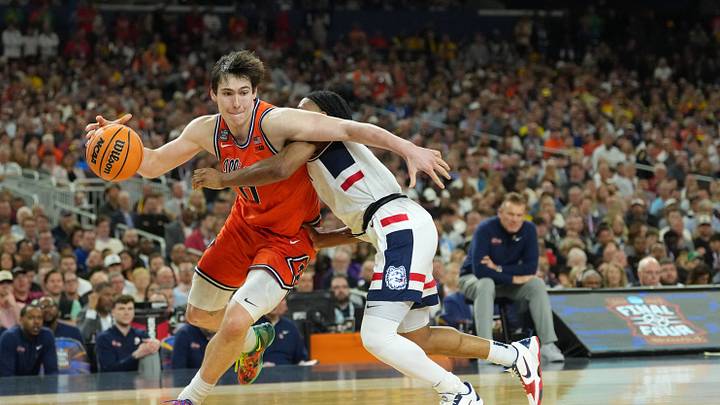
The first games will not arrive until November, but the Big Ten hierarchy is already taking shape. From Final Four contenders to programs facing another long winter, here is where all 18 teams stand as students return to campus.
Football will dominate the conversation for the next two months. That does not mean college basketball has stopped moving.
Most rosters are settled, newcomers are arriving on campus and fall practices are approaching. There are still unresolved eligibility cases, but the broad outline of the 2026-27 Big Ten race has come into focus.
The conference appears ridiculously strong at the top. Illinois, Michigan State and defending national champion Michigan are legitimate national-title contenders. USC, UCLA and Nebraska could begin the season in the national rankings, while several more teams have realistic NCAA Tournament aspirations.
These are not predictions of the final standings. They are a close up of each program entering the school year, nearly two months before the first meaningful basketball is played.
18. Penn State Nittany Lions
Penn State finished at the bottom of the Big Ten last season, and there is little evidence Mike Rhoades has constructed a roster capable of making a dramatic climb.
The Nittany Lions lost leading scorer Freddie Dilione V to Georgia and promising freshman Kayden Mingo to Baylor. Rhoades responded by assembling a group largely built around mid-major transfers, including Jay Rodgers, Brant Byers, Roberts Blums and Dasonte Bowen.
Some of those players could outperform expectations, but Penn State does not have a proven Big Ten star or an obvious source of consistent offense. Another bottom-three finish would create serious questions about the program’s direction under Rhoades.
17. Rutgers Scarlet Knights
Steve Pikiell once made Rutgers one of the most uncomfortable opponents in the conference. That identity has faded.
The Scarlet Knights have ranked outside the top 100 nationally in adjusted defensive efficiency in consecutive seasons. That is an alarming trend for a program that rarely possesses enough elite offensive talent to survive without its defense.
Tariq Francis, Darren Buchanan Jr. and Jamichael Davis give Rutgers some continuity. Virginia Tech transfer Christian Gurdak should help inside, but the roster still lacks enough established difference-makers to inspire confidence.
If Rutgers cannot rediscover its defensive edge, it will spend another season near the bottom.
16. Northwestern Wildcats
Chris Collins faces the nearly impossible task of replacing Nick Martinelli, who averaged 23 points per game and carried Northwestern through long offensive stretches last season.
Jake West is the best returning piece after a promising freshman campaign. Bellarmine transfer Jack Karasinski averaged nearly 22 points last season and could become an important scorer, but producing against Big Ten defenses will present an entirely different challenge.
The Wildcats also lost Tre Singleton to Iowa State and must rely heavily on transfers from smaller programs. Collins will keep Northwestern competitive on many nights. The roster, however, does not appear talented enough to survive the conference schedule consistently.
15. Washington Huskies
Washington has enough talent to climb significantly higher, but the Huskies must prove they can finally turn intriguing pieces into wins.
Wesley Yates III could become one of the conference’s most productive guards if he stays healthy. Ryan Beasley gives the Huskies another creator, while Texas Tech transfer LeJuan Watts averaged 11.6 points and six rebounds last season.
That is a respectable core. The uncertainty comes inside after Hannes Steinbach departed for the NBA. Lathan Sommerville must take a substantial step forward for Danny Sprinkle’s team to become a legitimate postseason contender.
Year three is an important one for Sprinkle after two disappointing seasons in Seattle.
14. Minnesota Golden Gophers
Minnesota is the first team in these rankings with a realistic chance to become a major surprise.
Niko Medved guided the Golden Gophers to eight Big Ten victories during his first season despite modest expectations. He now returns Isaac Asuma, Bobby Durkin and Jaylen Crocker-Johnson while adding former Colorado State guard Kyan Evans.
Evans struggled at North Carolina, but he previously thrived under Medved. That reunion could stabilize Minnesota’s backcourt.
The Golden Gophers do not possess overwhelming talent, but Medved has a long history of getting more from his rosters than expected. Minnesota should be competitive enough to make several teams above it uncomfortable.
13. Oregon Ducks
Dana Altman essentially started over after Oregon’s miserable 12-20 season.
Nate Bittle graduated, Jackson Shelstad transferred to Louisville and Kwame Evans Jr. also departed. Sean Stewart is the only returning player from last year’s roster.
The rebuild, however, includes considerable upside. Tyrone Riley IV, Jasper Johnson, Andrew Meadow, Dwayne Aristode, Taylor Bol Bowen and highly regarded freshman Tajh Ariza give Altman a deeper and more athletic group.
Oregon’s biggest question is simple: Who closes games?
The Ducks have numerous interesting options but no proven Big Ten star. Altman has rebuilt successful rosters before, making Oregon one of the conference’s most difficult teams to rank in August.
12. Maryland Terrapins
Maryland’s ceiling is much higher than No. 12. Its floor is also dangerously low.
Five-star freshman Baba Oladotun could immediately become one of the most talented players in the Big Ten. DJ Wagner and Bishop Boswell add experience to the backcourt, while Andre Mills returns after averaging 12.2 points last season.
The biggest variable is Pharrel Payne. Maryland expects the powerful center to return, but his eligibility situation has lacked complete certainty. A healthy, eligible Payne would give Buzz Williams one of the conference’s best interior players.
Maryland has enough talent to push toward the top half of the standings. After a disastrous first season under Williams, however, potential alone is not enough to move the Terrapins higher.
11. Wisconsin Badgers
Every offseason seems to produce a reason to doubt Wisconsin. Greg Gard usually finds a way to make those doubts look foolish.
This season could provide his most difficult test yet.
John Blackwell transferred to Duke and Nick Boyd graduated, leaving the Badgers with an almost entirely new backcourt. Trey Autry, Eian Elmer and Australian guard Owen Foxwell must establish themselves quickly.
The frontcourt is far more dependable. Nolan Winter and Austin Rapp return to give Wisconsin size, skill and continuity.
The Badgers will protect the basketball, execute in the half court and win games many expect them to lose. Whether they possess enough backcourt creation to reach the NCAA Tournament is the larger concern.
10. Iowa Hawkeyes
Ben McCollum’s first Iowa team reached the Elite Eight and delivered one of the most surprising seasons in the country.
Repeating that run without Bennett Stirtz will be extremely difficult.
Stirtz was the engine of everything Iowa did before becoming a first-round NBA draft pick. The Hawkeyes still return three starters in Kael Combs, Cooper Koch and Cam Manyawu, preserving far more continuity than most transfer-era rosters.
Illinois State transfer Ty’Reek Coleman should help the backcourt. Andrew McKeever, a 7-foot-2 transfer from Saint Mary’s, averaged 9.2 rebounds last season and gives McCollum a massive interior presence.
Iowa should remain in the NCAA Tournament conversation. Another Elite Eight appearance would require McCollum to produce an even greater coaching achievement.
9. Purdue Boilermakers
For the first time in years, Purdue enters a season without Braden Smith, Fletcher Loyer or Trey Kaufman-Renn.
That trio defined an era of Boilermakers basketball. Matt Painter now must identify the players capable of replacing its production and leadership.
C.J. Cox and Gicarri Harris return in the backcourt, while Omer Mayer and 7-foot-4 Daniel Jacobsen offer upside. Princeton transfer Caden Pierce could become one of Purdue’s most important players because of his rebounding, intelligence and versatility.
Freshman guard Luke Ertel is another name to watch.
The Boilermakers might lack the star power of recent teams, but betting against Painter is rarely comfortable. Purdue should improve considerably between November and February.
8. Indiana Hoosiers
Indiana assembled one of the conference’s most impressive transfer classes. Unfortunately, its frontcourt depth took a late hit before school even began.
Markus Burton arrives from Notre Dame to become the primary offensive creator. Aiden Sherrell, Samet Yigitoglu, Bryce Lindsay, Darren Harris and Jaeden Mustaf give Darian DeVries a talented collection of newcomers around returning forward Trent Sisley.
Sam Alexis was expected to add experience inside after averaging 8.8 points and shooting a program-record 68.7% last season. The Tennessee Court of Appeals, however, stayed the injunction that had granted Alexis an additional season. He is currently ineligible while the legal process continues.
Indiana still has NCAA Tournament talent without Alexis. The Hoosiers simply have less margin for injury or foul trouble in the frontcourt.
7. Ohio State Buckeyes
John Mobley Jr. is ready to become the face of Ohio State basketball.
The dynamic guard already ranks among the Big Ten’s best returning perimeter players. Sophomore A’mare Bynum also possesses breakout potential, giving Jake Diebler two exciting young building blocks.
The Buckeyes supplemented that returning talent with Justin Pippen, Curtis Givens III and highly regarded freshman Anthony Thompson. Thompson has the size and skill to emerge as a potential one-and-done forward.
Ohio State must replace the leadership and production of Bruce Thornton, but this roster might be more athletic and explosive than last season’s NCAA Tournament team.
The Buckeyes are a legitimate top-five threat if their young frontcourt develops quickly.
6. Nebraska Cornhuskers
Last season proved Nebraska’s breakthrough was no longer a hypothetical.
The Cornhuskers reached the Sweet 16 and won an NCAA Tournament game for the first time in program history. Fred Hoiberg now has a roster capable of showing that run was not a one-year accident.
Pryce Sandfort returns as one of the conference’s best players. Braden Frager is back after an excellent freshman season, and Connor Essegian remains a dangerous perimeter scorer.
Hoiberg also added multiple productive transfers, including Sam Orme, Trevan Leonhardt and Boden Kapke.
Nebraska will no longer surprise anyone. The Huskers are deep, experienced and capable of finishing in the Big Ten’s top four. Handling elevated expectations will determine whether they can make another run in March.
5. UCLA Bruins
Mick Cronin lost Donovan Dent and Tyler Bilodeau, but UCLA has quietly assembled another roster with a high ceiling.
Trent Perry and Eric Dailey Jr. return as proven building blocks. Eric Freeny and Xavier Booker provide additional continuity, while Jaylen Petty, Joe Philon and Filip Jovic strengthen the rotation.
The late addition of Serbian forward Nikola Kusturica pushed the Bruins firmly into the national Top 25 conversation. ESPN moved UCLA inside its preseason Top 25 following his commitment.
UCLA’s ultimate ceiling will depend on its defense. The Bruins finished only 49th in adjusted defensive efficiency last season, well below the standard established by Cronin’s best teams.
If that end of the floor improves, UCLA can challenge for the conference title.
4. USC Trojans
USC might possess the widest gap between its potential and its predictability.
The Trojans started last season 18-6 before losing their final eight games. Eric Musselman responded by retaining Rodney Rice, Jacob Cofie and Alijah Arenas, three pieces around whom he can build a dangerous offense.
Georgetown transfer KJ Lewis and former UConn big man Eric Reibe add more talent. USC also signed a strong freshman class headlined by Christian Collins and brothers Adonis and Darius Ratliff.
Few teams in the league can match the Trojans’ raw ability.
Musselman must prove he can turn it into a cohesive team that defends and responds when adversity arrives. If he does, USC has Final Four upside. If he does not, another uneven season is possible.
3. Michigan Wolverines
Michigan won the national championship and then lost the coach responsible for constructing the program.
Dusty May’s departure for the Dallas Mavericks changed the Wolverines’ outlook, but it did not erase an outstanding roster.
Final Four Most Outstanding Player Elliot Cadeau returns alongside Trey McKenney and L.J. Cason. Michigan added Moustapha Thiam, Jalen Reed and J.P. Estrella to its frontcourt while signing elite guard Brandon McCoy.
Interim coach Mike Boynton inherited enough talent to compete for another championship. He also inherited enormous pressure.
Boynton reached the NCAA Tournament only once in seven seasons at Oklahoma State. Leading a defending champion filled with NBA prospects represents a completely different challenge.
Michigan remains a national contender. Its ranking reflects uncertainty on the bench, not a lack of ability on the court.
2. Michigan State Spartans
Tom Izzo has another team capable of giving him an opportunity to chase his second national championship.
Jeremy Fears Jr. is the early favorite for Big Ten Player of the Year and one of the leading national player of the year candidates. He averaged 15.3 points and nearly 10 assists last season, controlling games in a way few college point guards can match.
Coen Carr, Cam Ward, Kur Teng, Jordan Scott and Kaleb Glenn give the Spartans an athletic and experienced group around him.
The biggest concern is the frontcourt. Charlotte transfer Anton Bonke and Jesse McCulloch must replace the production lost with Jaxon Kohler and Carson Cooper.
Michigan State owns the conference’s best point guard and perhaps its best coach. That combination makes the Spartans an obvious threat to finish first.
1. Illinois Fighting Illini
Illinois begins the school year with the Big Ten’s best combination of proven production, size and high-end newcomers.
The Fighting Illini are coming off a Final Four appearance and return Andrej Stojakovic, David Mirkovic, Tomislav Ivisic, Zvonimir Ivisic and Jake Davis.
That would be enough to keep Illinois near the top of the league. Brad Underwood also added Providence transfer Stefan Vaaks and five-star guard Quentin Coleman.
Stojakovic is a potential Big Ten Player of the Year candidate. Mirkovic and the Ivisic brothers give Illinois a collection of skilled size that few teams nationally can match. Coleman could become the dynamic perimeter creator the roster needs after Keaton Wagler’s departure.
There are questions at point guard and considerable expectations surrounding a relatively young backcourt. Every Big Ten contender has at least one weakness, though.
Illinois has the conference’s deepest frontcourt, a returning star and a coach who just reached the Final Four.
Until somebody takes the top spot from the Illini, it belongs to them.
 Add us as a preferred source on Google